Here is something I have believed for a long time and only recently found the numbers for: most of us in Southeast Asia have been buying skincare for a climate we don’t live in.
We buy French because the name sounds bougie. We buy Korean because the actress looked good when she cries. None of that is nothing; those countries make excellent products. But Paris has a spring. Seoul has a winter. Singapore has a single season that runs from January to December and is called “wet.”
Read more: Is T-Pop the Next K-Pop? Inside the Rise of Thailand’s Music Industry
That gap, between where the formula was designed and where the face actually sweats, is the whole business case for T-Beauty. And in the last year, Thai brands have started making it out loud.
The Sunscreen That Beat Korea in China
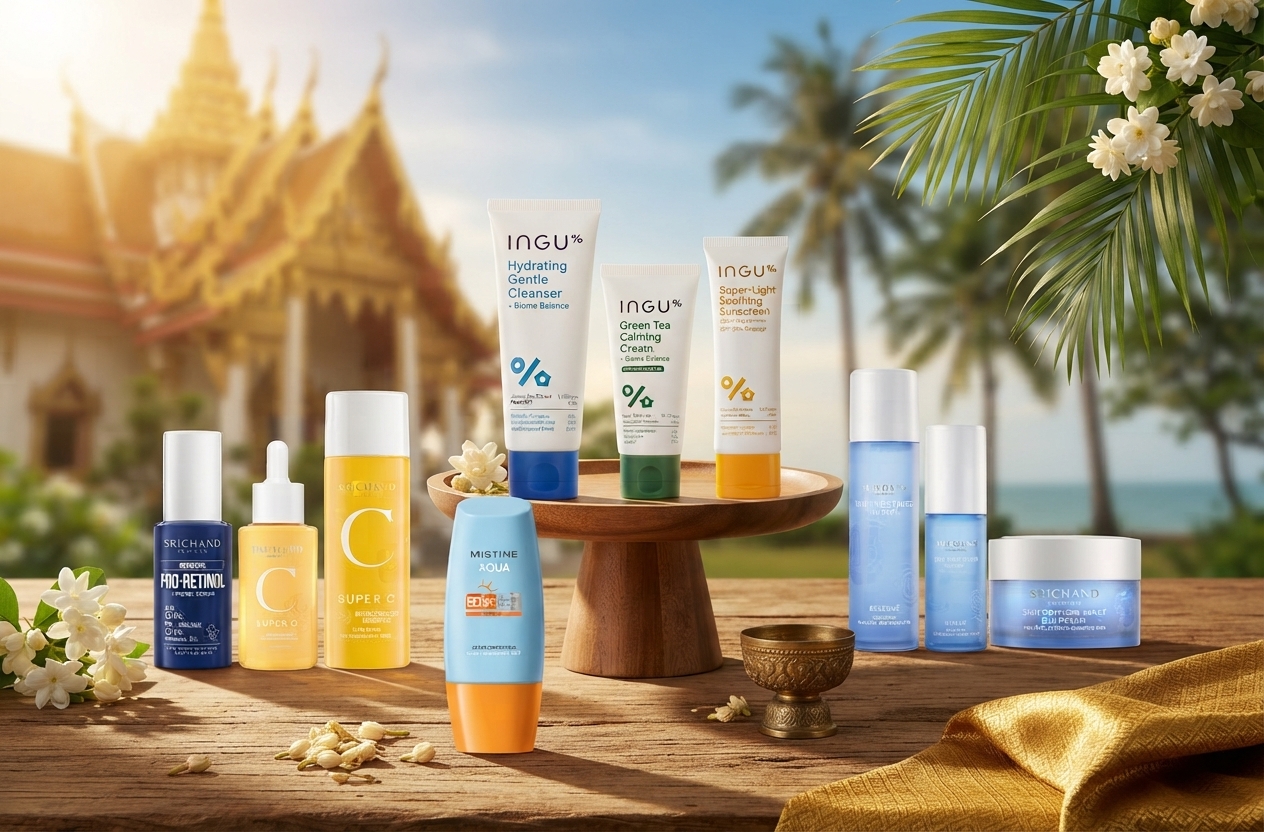
INGU Skin’s founder Chayadhorn Kitiyadisai put it to The Straits Times more plainly than any consultant would: Thailand has no seasons, only sun, heat and humidity, so it makes sense to trust skincare built around exactly that.
The ledger backs him up. INGU went from US$2 million in revenue in 2022 to US$16.5 million in 2025. When it launched in Singapore earlier this year, 8,000 people signed up for a fan event within 24 hours. The venue could take 1,000. Some flew in from Kuala Lumpur and Manila. Two containers of product sold out in two hours.
View this post on Instagram
Then there is Mistine, which started as a Thai direct-selling business in 1988, the kind of brand your aunt sold out of a catalogue. By 2021 it was the best-selling sunscreen in China by volume, and held that spot for three consecutive years, according to China Daily. A Thai brand outsold Korea, Japan and the entire French pharmacy aisle in the largest beauty market on earth, in the one category where Southeast Asian expertise should be obvious. Nobody threw it a party.
We Already Make It. We Just Don’t Own It.
The part of the story that gets left out of the glossy versions is who has been manufacturing everyone else’s products all along.
Southeast Asia, and Thailand in particular, is a contract-manufacturing base for the global beauty industry. The formulation know-how, the GMP-certified factories, the ingredient supply chains: much of it has been sitting in Bangkok and Chonburi, quietly making other people’s luxury.
Read more: Louis Vuitton Wins Lawsuit Against Molly Tea but Did It Copyright an Ancient Suzhou Flower?
So when a Thai founder decides to put their own name on the bottle, they are not starting from scratch. They are cutting out the middleman who used to fly in, add a French label and a 400 per cent markup, and fly out. Chayadhorn has three generations of family cosmetics manufacturing behind him. Srichand has been making products for 78 years. That is not a start-up story. That is a supply chain finally deciding to own more.
Why “Cheap” Was Never the Insult We Thought
Here is where the colonial hangover shows up.
For most of the last century, Southeast Asians learned that expensive and foreign meant better, and local meant something you used until you could afford not to. We still carry it. Ask anyone who has watched their mother hide the Thai sunscreen behind the Lancôme when guests come over.
But two things happened. The first is that the internet made the ingredient list public, and it turned out a great many prestige products were selling packaging. The second is that Southeast Asian brands got very good, very quickly, at doing three things at once: accessible, affordable and effective. Not two out of three. All three.
View this post on Instagram
Srichand’s marketing chief Rabil Sirimanakul told ST that people kept asking why the company did not change its name to something more international, because Srichand sounds like a grandmother. They kept it on purpose. The point was to prove that being Thai could be modern without pretending to be something else. A grandmother’s name on a product that works is a stronger flex than a made-up French word on a product that doesn’t.
Read more: Thailand Submits Cannes Contender ‘9 Temples to Heaven’ for the Oscars
No shade towards Korean or Japanese skincare. It is an argument against buying it for the wrong reasons. If a K-drama is doing the shopping for you, the actress’s glam squad is not going to be there when the sun is making you wet.
The K-Beauty Playbook, and the Trap Inside It
To their credit, the Thai brands know exactly what they are up against. Chayadhorn’s own diagnosis of K-Beauty’s success is that Korea built an ecosystem: the drama, the idol, the product, all in one picture. Thailand now has the beginnings of the same machine, with T-Pop and the BL-drama wave doing overseas work that trade fairs never could.
There is a trap here, and it is the same one every second-mover falls into. Copying Korea’s playbook means competing on Korea’s terms: glamour, aspiration, the idol’s face. Korea will always be better at being Korean. Thailand’s actual advantage is old-school and more durable. It is the only major beauty exporter whose home market has the same weather as the customer’s.
View this post on Instagram
That is a positioning no amount of soft power can buy. Aim for “the sunscreen that works in Jakarta,” not “the next Seoul,” and the drama can come later.
Reverse the Pilgrimage
For decades, the traffic has run one way. Asian tourists fly to Paris and Milan, queue outside a flagship, and bring home a bag that costs more than the flight. It is a ritual, and it works because it is girl-math asian edition.
Bangkok gets 30-odd million visitors a year who come for the food, the temples, the massages and the nightlife, and go home with elephant pants. Almost none of them think of Thailand as a place you fly to for skincare, even though the country is Asia’s second aesthetics destination after Korea and has a domestic beauty market the Commerce Ministry expects to pass US$10 billion by 2030.
Read more: Hanfu, Tang Suits, and Sneakers: Why Gen Z Is Wearing Qipao to University in 2026
That is the gap. The same magic that makes a Chanel bag feel worth queuing for in Paris can be made to work for a Bangkok pharmacy haul. The brands are ready. Kris Jenner and Georgina Rodríguez have already been photographed with Cathy Doll sunscreen, which tells you the West will happily discover Thai beauty and sell it back to us at a markup if we let them.
So this is a note to the Asian baby girls of Singapore, KL, Manila and Jakarta, and to the third-culture kid cousins in London and Sydney who still get their skincare shipped from home. The Thai-ABGs are growing up. It has the factories, the formulas, and the weather on its side. What it does not yet have is us.
Buy for your climate, not your crush. Your face will notice before your feed does.