
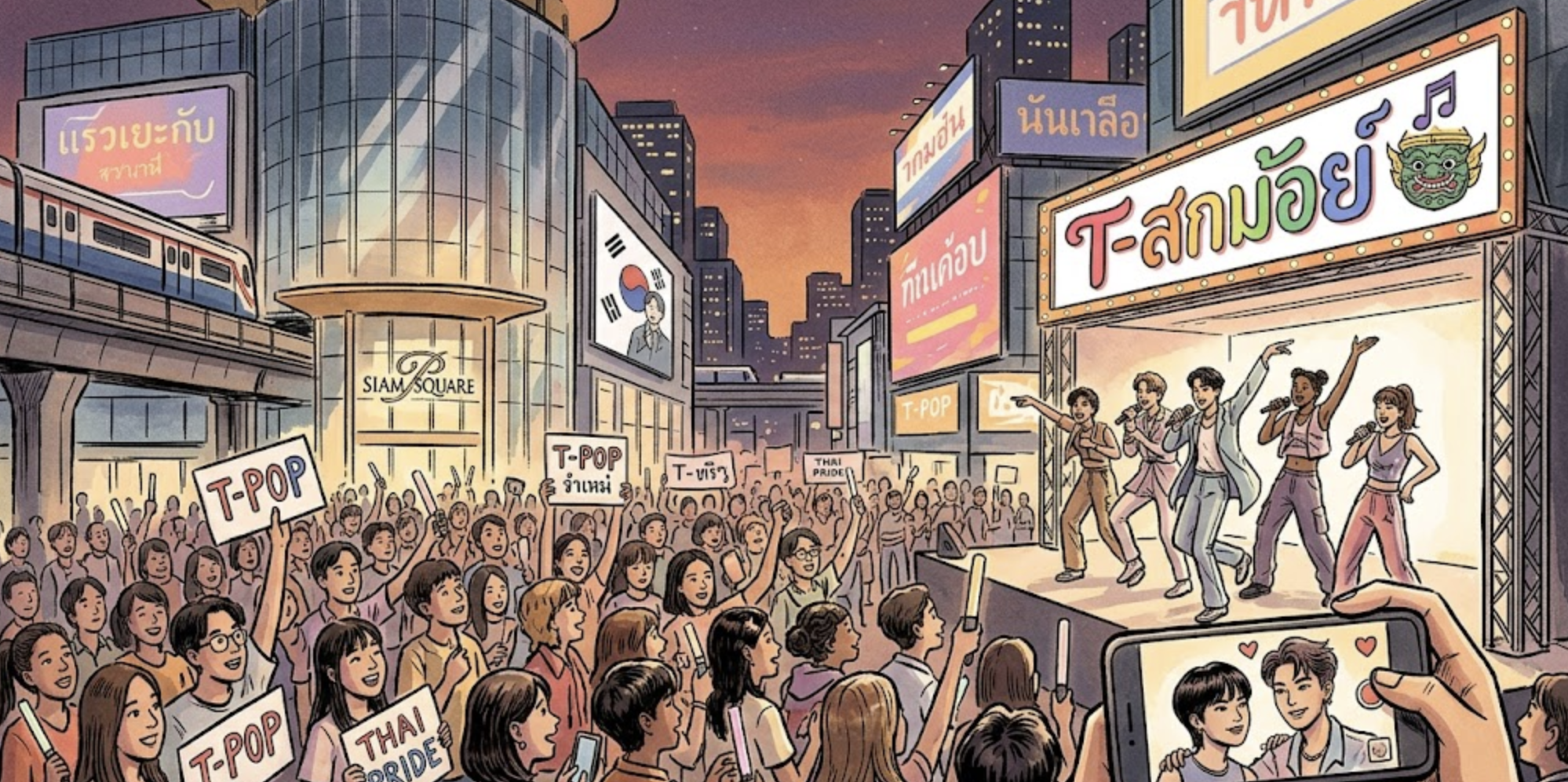
Bangkok at dusk operates on a specific kind of kinetic energy. Under the neon glow of the Siam Square billboards, thousands of young people gather, their attention fixed on a temporary stage. When the opening chords of a syncopated synth-pop track echo through the concrete plaza, the crowd moves in perfect unison. This is not Seoul, and the language echoing off the glass facades is not Korean. This is Bangkok, the beating heart of Thai pop, or T-pop, a musical movement aggressively expanding its territory across Southeast Asia and beyond.
For the past two decades, South Korea’s entertainment industry set the gold standard for global cultural exports. Hallyu, the Korean wave, transformed localised music into a multi-billion-dollar geopolitical asset. Now, Thailand intends to replicate that trajectory. The Thai government formally designated T-pop as a core pillar of its soft-power strategy, allocating substantial state resources to export its cultural products. The initiative targets a global market hungry for fresh visual and auditory experiences.
Read more: Thailand Embraces Microdramas With New Telco Deal as Vertical Short-Dramas Takeover Southeast Asia
The comparison to Seoul is inevitable, but Thailand operates under a different cultural philosophy. Where K-pop relies on rigid training regimes, flawless synchronisation, and heavily policed public personas, T-pop offers an entirely different atmosphere. The Thai industry prioritises approachability, fluid identity, and direct fan interaction.
Consider the stratospheric rise of Daou Pittaya and Offroad Kantapon. The duo emerged from the survival reality show LAZ iCON before solidifying their status in the five-member boy band LAZ1. Their transition into television dramas, particularly the romantic series Love in Love Out, exemplifies the multi-platform synergy unique to Thai entertainment. In the Thai model, musical performance and television acting interlock seamlessly. Fans do not look at stars like Daou and Offroad through a glass ceiling of hyper-curated perfection. Instead, they interact with them through weekly television broadcasts, social media livestreams, and frequent public events.

Sociopolitical factors heavily influence this cultural shift. Thailand possesses some of the most progressive attitudes toward gender fluidity and LGBTQ+ rights in Asia, culminating in the historic passage of the marriage equality bill. This societal openness shapes T-pop. While K-pop frequently maintains conservative boundaries regarding gender presentation and sexuality, Thai entertainment actively celebrates diversity. Musicians openly discuss their identities, and the immense popularity of Boys’ Love dramas provides an immediate, highly lucrative pipeline for T-pop soundtracks and artist visibility. The music industry reflects a society comfortable with complexity, presenting a modern, inclusive vision of Asia that appeals deeply to Gen Z consumers worldwide.
The commercial statistics confirm this international expansion. International streaming data reveals that overseas consumption of Thai music grew by over 120 percent between 2023 and 2026. Major global music labels are shifting their focus to Bangkok. Universal Music Group and Warner Music expanded their domestic operations, actively scouting local talent for international crossover potential. The digital infrastructure supports this growth. T-pop music videos regularly cross the 20-million-view threshold on YouTube, driven by hyper-active fandoms across China, Japan, Indonesia, and Latin America.
Challenges remain on the path to global dominance. The Korean music industry benefits from a highly centralised agency system that controls everything from talent scouting to global distribution. Thai entertainment companies are historically fragmented, often operating as boutique agencies or television networks rather than monolithic music empires. Language also presents a structural hurdle. Thai is a tonal language, which can introduce a steep learning curve for international listeners accustomed to the relatively straightforward phonetics of Korean or English.
To bypass these linguistic barriers, Thai producers deploy clever sonic strategies. They blend traditional Thai melodic structures with Western R&B, hip-hop, and hyper-pop beats, frequently peppering choruses with English phrases designed for global repetition. The visual presentation matches this sophistication. High-budget music videos leverage Thailand’s world-renowned advertising and film production infrastructure, delivering sleek, cinematic visuals that rival any Western or Korean production.
T-pop does not need to replace K-pop to achieve success. The global entertainment ecosystem is large enough for multiple regional hubs. Thailand offers a distinct alternative: a musical landscape defined by warmth, inclusivity, and vibrant cultural hybridity. As individual artists find their footing on international stages, Bangkok proves that it possesses the talent, the infrastructure, and the political will to command global attention. The movement is no longer a localised phenomenon. It is an active restructuring of global pop culture.