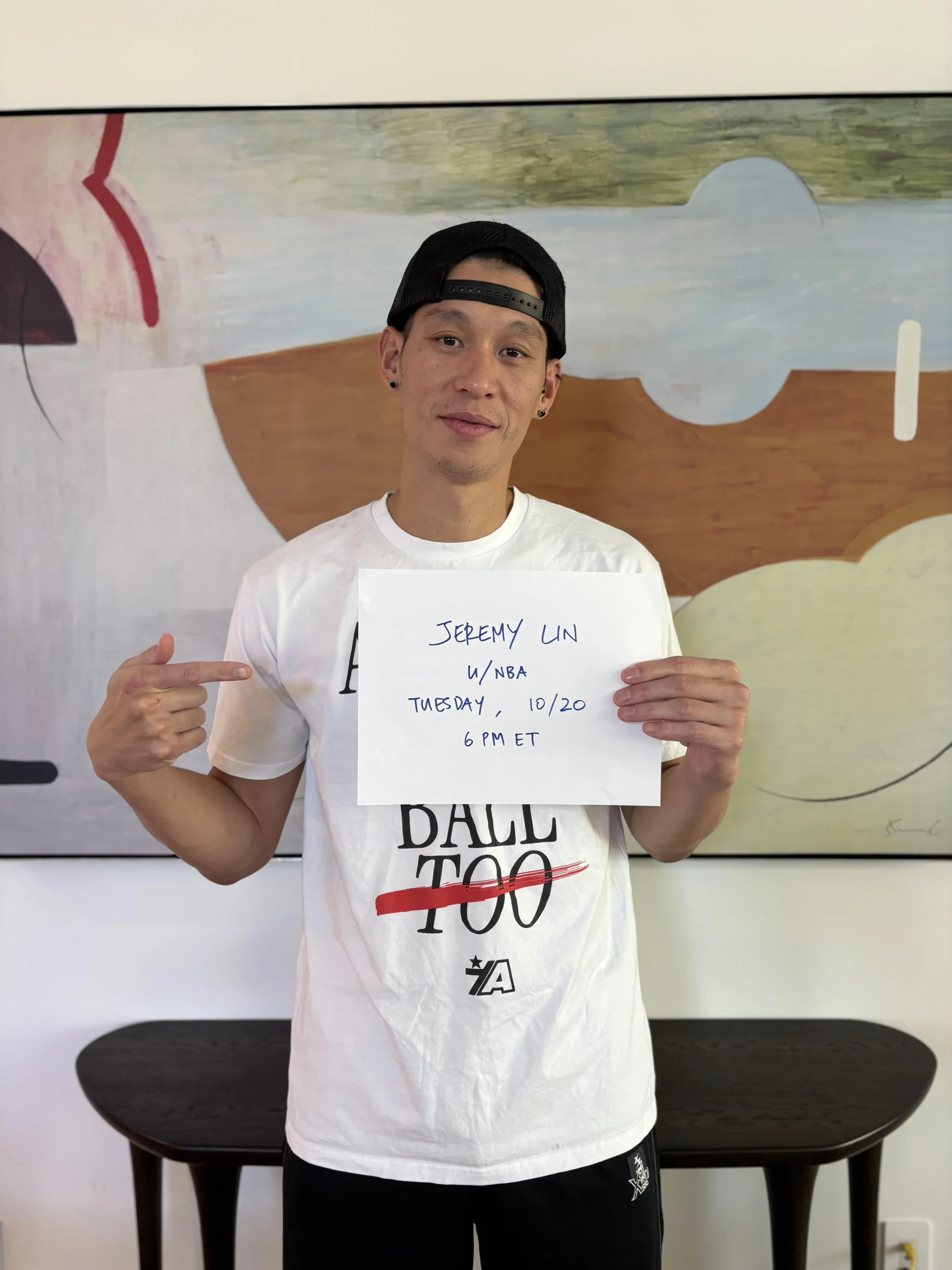
Jeremy Lin has spent much of his adult life operating under observation. In February 2012, while sleeping on his brother’s sofa on the Lower East Side, he became the focal point of global sporting discourse across several manic weeks with the New York Knicks. Fourteen years later, having finished his playing days across North America and Asia, Lin is stepping directly into the studio. He is joining ESPN as an NBA game analyst, bringing his technical perspective to live television broadcasts.
Ahead of his studio debut, Lin sat down for an open question-and-answer session on the r/nba forum on Reddit. Over several hours, he fielded queries regarding the emotional strain of high-pressure basketball, the mechanics of deceleration, and his personal memories from a decade in professional sports. The conversation offered an unvarnished account of an athlete who has thought deeply about how the game works on the hardwood and behind the microphone.
Below is the complete transcript of the exchanges Lin answered during the session.
The Reddit Q&A
Question: What advice do you have for older hoopers looking to get back into basketball? I play once a week but miss the days I would practice on an empty court for hours…
Jeremy Lin: I think my advice would be if you’re just gonna play once a week. What are some small things I can do to create distance to get my shot off? Whether it’s a jab step, or whether it’s using my eyes to deceive the defender, whether it’s just one step into their chest to be able to step back and create space. The whole point is how do you use a little to create enough space to get a shot off? Because when you get older, you lose speed. The most important thing when you get older and play recreational basketball is not getting hurt. So that would be my biggest advice. We all have our different life responsibilities, a lot of us have potentially significant others or children, so we shouldn’t want to go home hurt.
Question: Hey Jeremy, thanks for doing this AMA! You’ve talked a lot about how huge it is to separate your self-worth from how you play on the court. When you are under intense pressure, what is the best piece of advice you could give for mastering the “inner game”? How do you practically reframe that high-pressure anxiety into something useful when execution matters most? Appreciate you stopping by!
Jeremy Lin: Process over result, but also, in order to get there, there is almost this redefinition of what your standard is. And so, for example, you are about to hit or you’re about to go step out for an extremely important possession at the end of the game. Typically, your mind will be like, I must make this shot, and if you add in too much pressure, your chance of making that shot goes down and down and down. I’ve worked a lot at my shots, and if I get a good one that I’ve worked on, that I know I can make, I’m gonna shoot it. And success is taking that shot, and failure is not taking that shot, versus making the shot and not missing and missing the shot. And so, if I can focus on the process and redefine that as success for me is being able to go do what I’ve prepared myself to go do, there’s a freedom and acceptance of the results that will allow you to have the highest chance of succeeding. Pressure is great in many ways, but pressure is also something that if you have too much of it can also inhibit you. And so, yeah, how do you stay in that great mindset where you’re confident, but you’re confident about what you’re about to do, but you’re not stressed about what you’re gonna do
Read more: Why the NBA Is Talking About Spurs Guard Dylan Harper’s Philippine Flag Tattoo
Question: Hey Jeremy, Who is your favorite Pokemon starter?
Jeremy Lin: Squirtle, and it’s not even close. I don’t respect anyone else who would choose differently, especially Bulbasaur.
Question: do you watch any anime?
Jeremy Lin: I would say Naruto because he believes in the good of humanity. I think we’re all born with an inner beast inside ourselves. It’s just about learning how to harness that power and turn that gift into a superpower.
Question: what’s your favorite team to watch right now?
Jeremy Lin: Spurs. I’m extra excited to see their new three-guard lineup with Dylan Harper, Stephon Castle, and De’Aaron Fox.
Question: What’s your favorite moment about Linsanity? What was it like for you at the time?
Jeremy Lin: Favorite moment from Linsanity, I gotta say, beating the Lakers, because I grew up in Northern California, and we never liked Southern California teams, so that one was extra personal for me.

Question: I really liked your analysis of the Luka hesitation between the legs dribble as his opening move. What’s an underrated or overlooked basketball move that you love seeing players do?
Jeremy Lin: An underrated move is being able to initiate contact with a defender. And the reason why it’s underrated is because everybody thinks, naturally and logically, that if I want to get a shot off, I need distance. I need to pull away from my defender. But actually, the great offensive players are the ones that know how to get closer to a defender to then be able to stunt their movement. So when I do want to separate, I can do that even more easily.
Question: Hey Jeremy – if there is one drill a guard should do by themselves in an empty gym, what should it be?
Jeremy Lin: I would say free-flowing ball handling… doing ball handling with different types of moves and pacing, combined with being able to stop on a dime to hit a jump shot. That drill and style of workout requires just a ball, a person, and a hoop.
Read more: Zheng Qinwen Makes History as First Chinese Woman to Win China Open
Question: Hi Jeremy, who is the teammate who has helped you most throughout your NBA career, and are you still in touch with him today? What did he do?
Jeremy Lin: An underrated one is Dorell Wright when I was a rookie with the Warriors. Because I was such a downhill, aggressive player, he always said, “You gotta invest in the floater.” And eventually, I invested in the floater, and it allowed me to continue to play many more years, even after some really bad injuries.
Question: Who wins in a game of one on one where you can only shoot hook shots? You, or your Dad?
Jeremy Lin: Me, because I would sit on his right hand, and he would be over because he doesn’t know how to shoot a left-handed hook shot.
Question: I really enjoyed your Ig/tiktok breakdowns, what made you start them and what do you want viewers to take away from them?
Jeremy Lin: My goal post-retirement is to give back to basketball for the next generation, whether it is commentating on TV or doing breakdowns on social media. This is all done from a desire to pass on the knowledge from prior coaches and players to basketball fans. My goal is to eventually make breakdowns on social based on what the fans want to see.

Question: Hey JLin, random question but who is a NBA player that fans might not know that you’re close with?
Jeremy Lin: OG Anunoby, I think there’s so much respect, but the public hasn’t necessarily seen as much during that time because he was such an unknown player, and I was also not getting playing time when we went on the Raptors’ championship run. But, you know, us being able to kind of reconnect through their championship run and to be able to kind of talk after that has been really, really amazing, and he’s still just as sweet and pure and kind as he was in his second year in the league.
Question: Can you describe the 24 hours after you dunked for the first time in your life?
Jeremy Lin: So it happened in between my sophomore and junior year in high school. I was so excited about my dunk, but my older brother kept questioning the legitimacy of whether the rim was 10 feet or not. So he rained on my parade.
Question: What do you think are the most interesting narratives / stories going into this season, and do you have any thoughts to share about them?
Jeremy Lin: I’m very curious about Chet Holmgren. You know, to me, this is kind of like a turning point for him. It’s a make-or-break to some degree of, like, can he level up, or will he, you know, stay the same or even go downhill? I think he was exposed in a different way, and so seeing how he responds to that will be very interesting. And then I’m really curious about Boston. I think, like, Boston and the Raptors are both kind of like, how does Kawhi fit in? How does Tatum take that next step, or can he take that next step? Like, both of those with, you know, you bring in Kawhi, and then you have Tatum with the departure of Brown. Those are two really nice storylines as well. I mean, there’s so many, honestly, there’s so many. I think the Rockets, I think they’re going to figure out a lot of stuff. I think Van Fleet and Marcus Smart, having both of those healthy and back, I actually think if they figure it out, they’ll easily be a championship-contending team. I think they’ll be really, really good if they can stay healthy and figure out some of the chemistry and culture issues that they had last year.But they have two leaders who can do that for them and take them there.
Read more: Jeremy Lin’s Unexpected Life as a Social Justice Advocate
Question: Hey Jeremy! Now that you’re transitioning into sports commentary and content creation, who are the people in that space that you admire and would like to model your new game after? Also, any general advice for those looking to transition their career as gracefully as you have done so far?
Jeremy Lin: Yeah, I would say. You have, to me, you have the OGs, so, you know, Mike Breen, Tim Legler, Jeff Van Gundy, and they’re not all necessarily the same, you know… there’s play-by-play, some of them are analysts, like different roles, but there’s quite a few classic names and really amazing people I can learn from, which I’m studying. But then there’s also this other element of kind of like this younger, fresher blood, and so you have the Richard Jefferson, Austin Rivers, Iman Shumpert, Cam as well. And so, I wanna be able to be a blend of maybe really Legler being an elite analyst and educator, Jeff Van Gundy, of kind of how the basketball game is played, but I also want to have that closeness of, this is how things go, and this is maybe what the players are thinking and all the emotions and the mindset and the internal battles that they may be facing. Like, I want to be able to bring both of those out at the same time… Also Malika has been the most influential broadcaster in my short journey thus far. She’s really stepped up to mentor me.
Question: Hey Jeremy, I’m a Blazer fan and one series I’ll never forget watching was our playoff series against your Rockets in 2014. I remember feeling like you were really killing us that series and I was always nervous when you came in. Do you have any insights or memories about playing against the Blazers that year? Thanks for doing this, and cheers!
Jeremy Lin: Two things stick out. One is I had a turnover in Game 4, I believe, of the playoffs, at the end of regulation. And I would say that that is probably the toughest night that I’ve ever experienced as a professional basketball player. And that sticks out a lot because I grew a lot through that. In Game 5, I was then booed on my home court during the playoffs, but also went out to set a career playoff high and being able to turn those boos into cheers. The second moment that really stands out is Game 6, when Damian Lillard hits the game-winner. I remember I was guarding him in that fourth quarter, and he had not scored a single point. That’s what I remember being true, was that I was guarding him and he hadn’t scored in the fourth quarter yet. And then I got subbed out, and Coach McHale told us what our coverage was, and as we went out onto the court, Harden and Chandler Parsons, they were a little bit confused, and you can see them, like, literally on the footage. You can see, if you go back and watch, you can see them, they’re talking before the ball is being inbounded. Damian Lillard goes on to say later that he saw them confused about what the coverage was, and he immediately just sprints towards the ball, catches it, and shoots the shot, and that was not at all the play that they were designed to run. But because he felt like we didn’t know what we were gonna do defensively, he just beelines, catches the ball, hits an incredible, ridiculously hard shot, and sends us home. And that, if you want to talk about the mindset of a killer, Damian Lillard is a killer. I know firsthand.

Question: Hi Jeremy, you were one of the best downhill guards in league for a number of years. What were your go-to setups, moves and counters, and what tips do you have for the average pickup hooper to become better at getting to the rim?
Jeremy Lin: My go-to move was to have the ball in my right hand, and I would basically do a hesitation where I would hop on my left foot, and then I would plant my left foot again. So it’d be like a left-left-right footwork, but basically, I’ll do a hesitation and then go. And it was as simple of a move as you could possibly have, but it was my most effective and most-used move of my entire career. That was just something that, when I teach other people, you don’t need the flashiest moves, but you do need deception, you do need perfect angles, and you need to build your explosiveness for your first step. So those are maybe three things I would teach.
Question: What’s your jersey collection like? Did you swap/collect a lot of game worn jerseys during your playing days? Any favorites you’d care to share? Also interested in trading one of your jerseys for a game used Heat jersey from my collection?
Jeremy Lin: The answer is I don’t collect jerseys. The answer is my mom is actually the one who collects a bunch of my game-worn jerseys. To be honest, I don’t even know where they are or which ones she has, but she has been collecting them throughout my career.
Question: I got into the NBA around the pandemic. As an analyst with his own off-the-court story, what past eras / storylines / games are worth visiting either for absolute value and/or for context about today’s NBA?
Jeremy Lin: I love looking back at revolutionary players. James Harden revolutionized the stepback. Steph Curry revolutionized shooting. Dirk Nowitzki revolutionized what a power forward could look like, and he also revolutionized culturally what European players could be like, even like Steve Nash, 7 Seconds or Less, or positionless basketball, or the Memphis Grizzlies when they had Zach Randolph and Marc Gasol. So, the things I’m interested in aren’t always like who won the championship. It’s sometimes more like who changed the game, like the Grit and Grind Grizzlies, Allen Iverson. They became more than just what they did. It was like almost cultural movements to some degree, or revolutionary movements.
Question: Hi Jeremy, favorite food growing up? I always loved the smell walking through NYC China Town growing up.
Jeremy Lin: In-N-Out Order. You must try this order: Double-Double, grilled onions, whole grilled onions, extra-toasted bun (game changer), ketchup.