
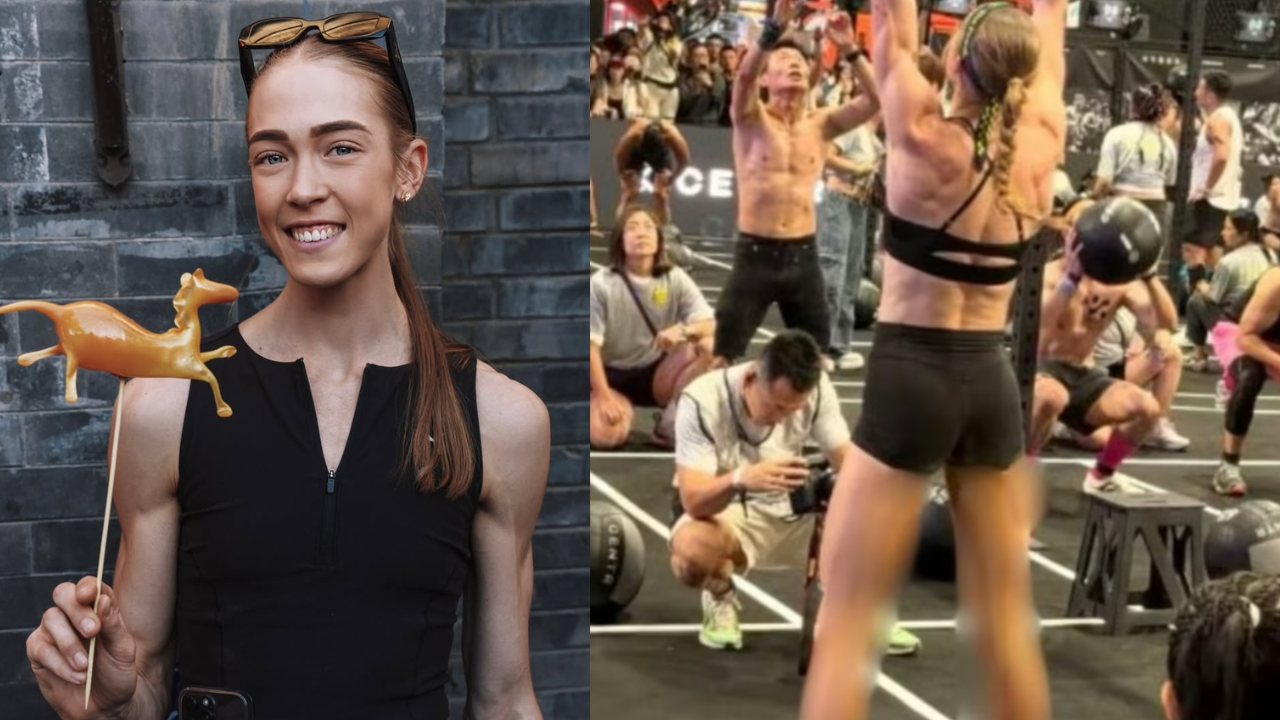
Human dignity usually tells you when to stop. When your body collapses into genuine distress in an enclosed public hall, you find a washroom, seek medical staff, and retire with whatever grace remains.
Australian athlete Joanna Wietrzyk took another route at the National Speed Skating Oval in Beijing. The 22-year-old world record holder suffered severe bowel incontinence mid-race. Rather than withdrawing, she ploughed through the remaining stations. Shared rowers, carpeted running tracks, burpee lanes, and sled handles became smeared with biological waste. She finished in one hour, one minute, and twenty-three seconds, taking the gold medal.
Then came the victory lap. Posting a hospital-bed selfie with an intravenous drip, Wietrzyk offered an unapologetic caption: “Go hard or go home… a win is a win.”
That flippant sign-off sparked international fury across the fitness community. What unfolded in Beijing was not an inspiring tale of grit. It was an appalling display of entitlement and an institutional failure by Hyrox leadership.
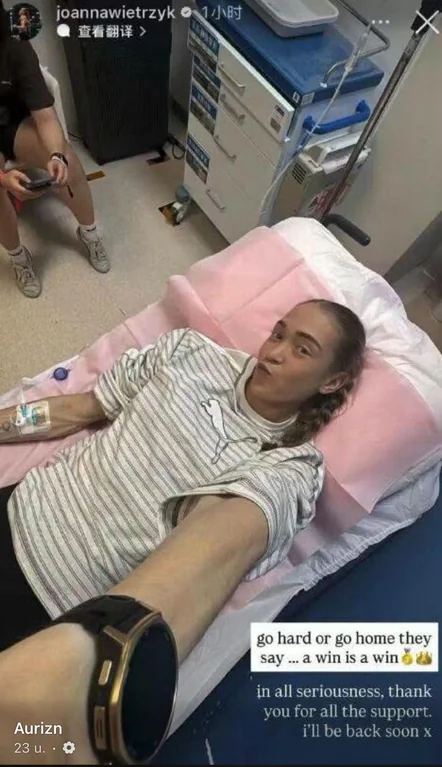
Social media platforms erupted. Competitors and spectators were sickened by the spectacle and astonished by her lack of shame. One user captured the general disgust: “Crapping yourself, inconveniencing everyone, making them uncomfortable, and still having the cheek to celebrate is diabolical.” Others labelled her “Spraygun”, a biting comparison to the infamous Australian Olympic breakdancer. The tone of her post showed an astonishing disregard for fellow athletes who trained for months, spent thousands of pounds on travel, and arrived in Beijing only to navigate puddles of excrement on shared gym gear.
Hyrox’s operational response made things worse. The company initially put out a defensive corporate statement. They spoke about how protocols for elite racing and mass participation became “blurred”. They praised her resilience and threatened to ban any critic who posted abusive remarks online.
There was no immediate apology to the athletes trailing her. No concern was voiced for the volunteer judges standing inches away from raw sewage. There were no refunds for paying customers. As Beijing competitor Joe Ho pointed out on social media: “I paid Hyrox to provide a professionally organised and safe event. If the organisation accepts that something went wrong, why not offer affected participants refunds, credits, or some meaningful form of compensation?”
View this post on Instagram
When co-founder Moritz Fuerste stepped in days later to admit the organisation made a serious mistake, the damage was already done. The leadership proved terrified of disqualifying a star athlete wearing a sponsor logo.
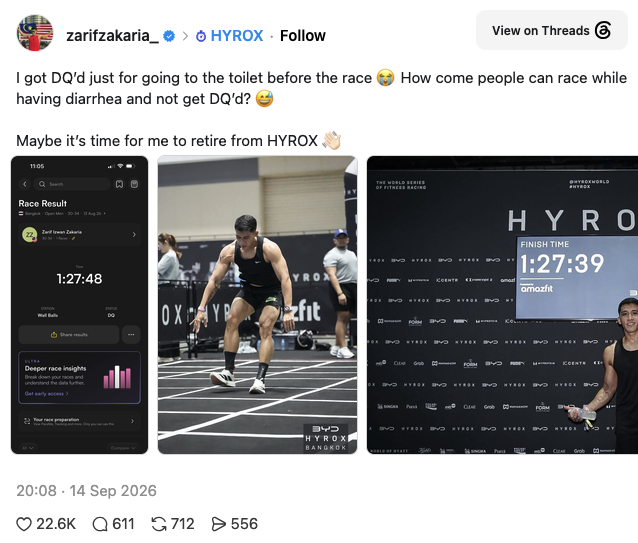
Contrast this lenient handling with how the organisation treats everyday athletes. On 13 August in Bangkok, Malaysian participant Zarif Zakaria lined up for the Men’s Open category. Feeling unwell before his wave departed, Zakaria did the decent thing and used the venue toilets. Because this brief visit delayed his start, race officials slapped him with a disqualification. He ran the entire course anyway, crossing the line in 1:27:48, only to have his result stripped.
Zakaria took to social media to highlight the double standard: “I got DQ’ed for going to the toilet before the race. How come people can race while having diarrhoea and not get DQ’ed?”
His question exposes the rot at the heart of modern fitness branding. A Southeast Asian amateur who prioritised hygiene, sanitation, and common courtesy was penalised with bureaucratic rigidity. A white, Western champion who turned an indoor arena into a biohazard was allowed to cross the line, lift the trophy, and retain her global ranking points.
Online commenters immediately seized on this glaring disparity. “This shows the double standards of white privilege,” wrote one user. “If this woman was not white, it would have been a whole other story.” Another observer noted: “If it was a person of colour, people would generalise the entire ethnic group. The Hyrox DQ would have come in straight away.”
They have a point. Western athletes are routinely afforded the benefit of the doubt. Their worst moments are framed by Western media and brand executives as heroic determination. Non-Western competitors rarely receive such generous spin. Had an Asian or African participant soiled the course during an event in London, Frankfurt, or Melbourne, officials would have dragged them off the floor inside two minutes. The offender would have been labelled uncivilised, barred from future entry, and cast as an emblem of poor hygiene. Instead, an Australian athlete in Beijing received corporate protection, institutional excuses, and a gold medal.
This bizarre episode reveals the toxic core of modern gym culture. The obsession with relentless suffering has mutated into plain narcissism. Slogans like “stay hard” and “embrace the suck” encourage people to abandon basic manners and decency. Extreme endurance running occasionally involves involuntary biological accidents on open asphalt roads. Hyrox is an enclosed warehouse containing thousands of community athletes touching the exact same surfaces. Pushing through severe stomach illness in an indoor room is selfish behaviour.
Accidents happen. What matters is how you react to them. Wietrzyk should have stepped off the course, apologised to her peers, and thanked the medical crew. Instead, she bragged about her podium spot, while Hyrox shielded their golden girl from accountability.
Hyrox built an empire on the premise that everyday fitness enthusiasts share the same floor as elite heroes. By letting an elite competitor compromise the health of hundreds of paying runners, organisers showed who really matters to them. A win is not a win when you leave your integrity, and your dignity, on the carpet.
View this post on Instagram