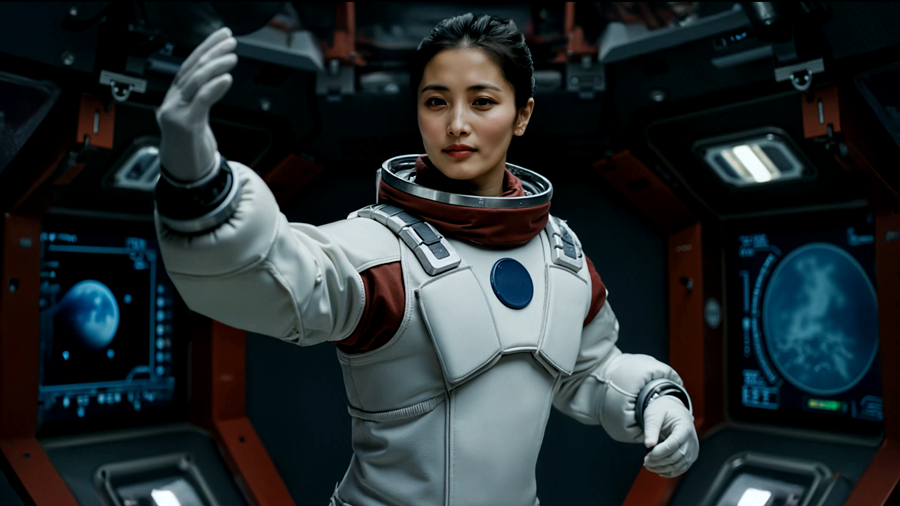
In China, a new kind of “TV for the TikTok generation” is being built not on backlots, but on servers. AI-generated microdramas — ultra-short, soapy series made for vertical viewing (known as duanju 短剧 in Chinese) — have become a multibillion‑dollar business, with tools like ByteDance’s Seedance 2.0 letting studios churn out entire series in days for a fraction of traditional budgets.
One fully AI-created saga, Master of Feng Shui, reportedly hit 100 million views within 12 hours on Douyin, underlining just how quickly audiences have embraced algorithm-made drama.
“It was raining, and then suddenly the rain stopped”
For working actors, the downside of that boom is already here. When microdrama actor Li Jiao’e moved to Hengdian’s vast studio city, he was finally landing small speaking roles and getting recognised in public — a fragile but real foothold in the industry. In the past few months, he says, the work has vanished.
“There’s nothing,” he says. “It’s like it was raining, and then suddenly the rain stopped.” He blames stricter buying standards from platforms, but also the “hype around A.I.” that’s made producers question why they should keep paying human bit‑part actors at all.
Li insists he isn’t against the technology itself — his frustration is with how it’s being used. “They’re still just imitating humans or trying to make things more humanlike,” he says. “They should be trying to unleash more imagination, taking a more unconventional route. After all, our fundamental value as humans is in our ability to imagine.”
Directors: cheaper spectacle, fewer jobs
Directors see the same double edge. Wang Yushun, who moved from TV dramas and indie films into microdramas for quicker returns, initially used AI only for mood boards.
That changed when he asked a model to generate a scene of a horse charging into a trench to rescue a general — and got back a fully choreographed sequence, complete with the horse smashing into an enemy soldier and the general galloping away. “I thought to myself, ‘Wow, this technology may really be able to replace some of the more difficult or expensive scenes,’” he recalls.
Read more: Why Microdamas Are Taking Over Asia And Why The West Could Be Next
Since then, Wang has leaned into AI for visual effects and even started a company making both AI and live‑action microdramas — but he’s had to lay off crew as demand for traditional shoots collapses. For him, switching to AI was “more a necessity than a choice”. His hope is a hybrid future: “If we could feel the warmth of a real performance, and also see the power of A.I. technology, I think that would be great.”
Founders: “You can only embrace this new era”
For AI-native founders, the calculation is colder. When ex‑tech worker Hou Xiaohu first experimented with AI video, it was only good enough for corporate promos; now he runs a 10‑plus‑person team split between prompt‑driven “screenwriting” and technical generation, turning out folklore‑inspired microdramas about sea goddesses and superhero monks. “This work isn’t exactly traditional screenwriting,” he says. “Part of it requires translating into a language that A.I. can understand. People who don’t have a traditional directing or screenwriting background might actually be better at it.”
Hou is blunt about the labour fallout. “The impact on employment — there definitely will be an impact,” he says. “But for individuals, what can you do? You can only embrace this new era and think about how to adapt.” In his view, AI isn’t killing film so much as redefining who gets to participate in it.
“Digital doubles” and the fight over likeness
Where AI feels most hostile to human performers is in the rise of “digital doubles.” Shanghai’s Youhug Media was slammed after debuting two AI actors whose faces were widely seen as echoes of stars like Zhai Zilu and Zhao Jinmai, fuelling fears that generative models are quietly replicating performers without consent.
In March, a Beijing court ruled for an actress who discovered an AI‑generated character in a microdrama looked so much like her that viewers identified it as her — even though the face wasn’t a perfect copy.
Judge Zhao Qi cited China’s Civil Code and made the standard clear: if the public recognises an AI face as a specific person, it can still infringe portrait rights. Lawyer Li Zhenwu notes that “identifiability” is key — whether the resemblance is “deliberate imitation” or “technical coincidence”.
Meanwhile, the Actors Committee of the China Federation of Radio and Television Associations has condemned the “growing misuse of AI technology,” including the use of actors’ images and voices for training without permission.
Behind the scenes, technologists admit the data problem is baked in. “These large models rely on massive amounts of visual data,” says Niu Cong, project coordinator at Hangzhou‑based Versatile Media. “But whether all of that data — especially human faces — has been properly authorised is still very questionable.”
“The core is still people and their aesthetic judgement”
Despite the hype, many in the industry insist the human element isn’t going away. Screenwriter Yu Zheng argues that AI can “never fully replace” real performance: “Some people like 2D characters, others enjoy real people,” he wrote on Weibo, adding that skilled actors “do not need to worry” and that “humans will prevail.”
Actor Yang Xuwen, by contrast, has warned that the impact of AI is “extremely huge”, pointing out that complete dramas can now be assembled with minimal human involvement.
Read more: Thailand Embraces Microdramas With New Telco Deal as Vertical Short-Dramas Takeover Southeast Asia
Academics see a hybrid future as the most realistic path. “Think about the productivity of producing microdramas using generative AI — it can shorten the production cycle from a few months to a few weeks,” says Xiao Lu from Xi’an Jiaotong‑Liverpool University, arguing that AI can enable “machine creativity” that complements human ideas. Niu is even more direct: “The core is still people and their aesthetic judgement,” she says. “That hybrid skillset is hard to find.”
Friend, foe — or just the new normal?
Seen from a distance, China’s AI microdramas are clearly “helping” the industry’s bottom line: they unlock new formats, cut costs and keep the content machine fed. Up close, they are also “hurting” the people who used to fill those sets — actors watching gigs evaporate, crews being downsized, and performers discovering their faces recycled as training data and AI extras without pay.
The people inside the system aren’t really arguing about whether AI belongs in entertainment; they’re arguing over who gets to set the terms. As Li Jiao’e puts it, the real test is whether the industry uses AI just to “imitate humans” — or to “unleash more imagination” in ways that still leave room for human craft.