
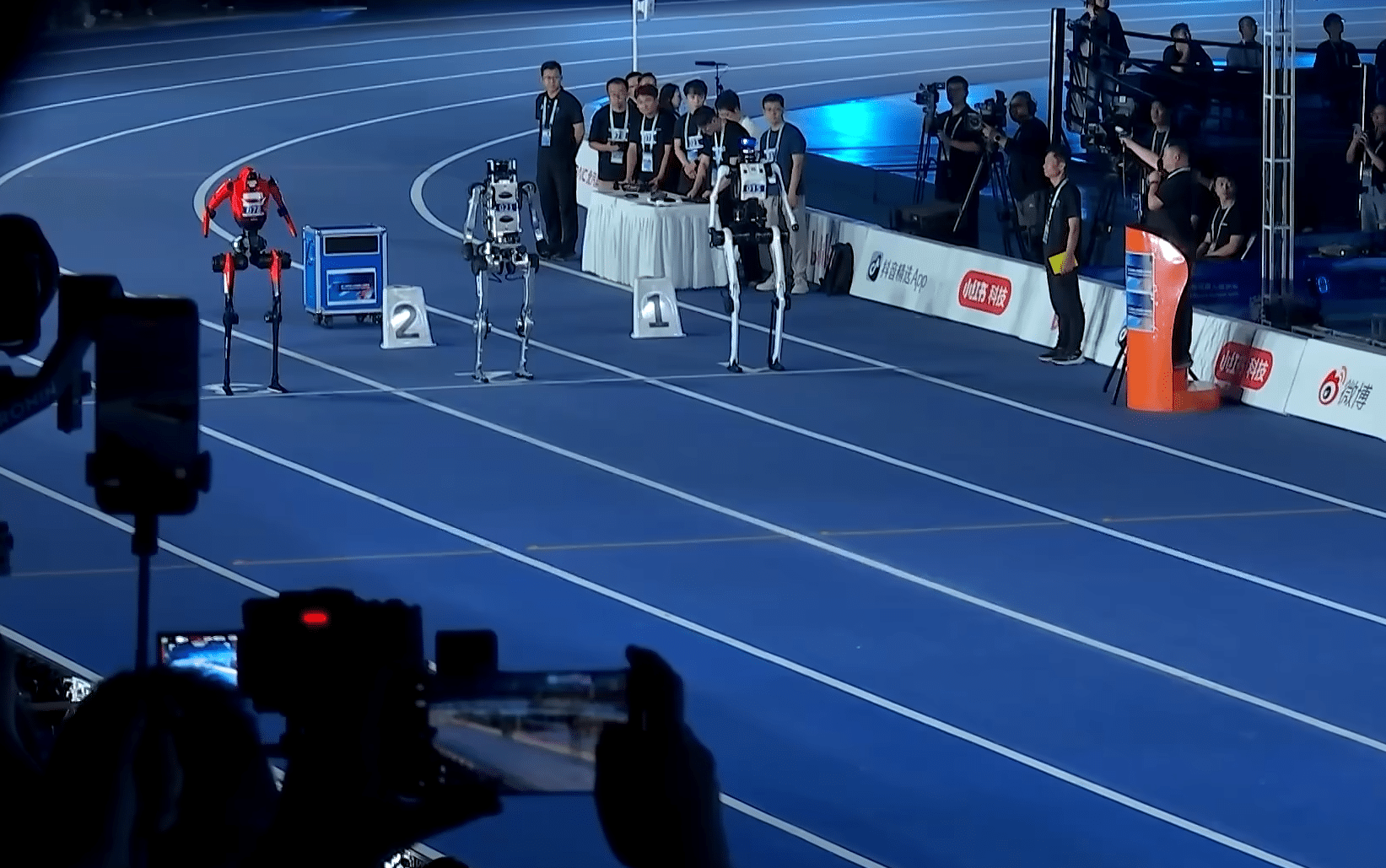
Chinese humanoid robots have beaten the human world records in both the 100-metre and 400-metre sprints at the World Humanoid Robot Games in Beijing, underscoring rapid advances in AI-driven robotics.
The Tien Kung Ultra robot, developed by the Beijing Innovation Center of Humanoid Robotics (also known as Beijing Humanoid Robot Innovation Center), finished the 100-metre preliminary heat on Saturday in 9.32 seconds, which is faster than Usain Bolt’s 9.58-second mark set in Berlin in 2009. After crossing the line, the machine crashed into a deceleration mat and caught fire.
The same model later clocked 38.15 seconds in the 400-metre final on Sunday, beating Wayde van Niekerk’s 43.03-second world record from the 2016 Rio Olympics.
Tiangong Ultra humanoid robot wins the long jump with a 7.97 meter leap at the World Humanoid Robot Games pic.twitter.com/921m3C2ZXz
— ViralRush ⚡ (@ViralRushX) August 24, 2026
More than 2,000 humanoid robots, fielded by 666 teams from 16 countries across six continents, are competing across 51 events during the five-day run at the National Speed Skating Oval—the “Ice Ribbon” venue from the 2022 Beijing Winter Olympics.
Around 90% of the teams are from China, with Brazil, Germany and the United States also represented. The inaugural games last August drew 280 teams; this year’s edition saw a 138% jump in teams and roughly a fourfold increase in robots.
The programme spans 30 competitive events—athletics, gymnastics, football, martial arts, weightlifting and dancesport, and 21 scenario-based contests simulating real-world settings such as factories, hotels, homes, logistics facilities and emergency response.
A humanoid robot developed by China’s Beijing Innovation Center of Humanoid Robotics ran 100 meters in 9.39 seconds, beating the human world record held by Jamaican sprinting great Usain Bolt https://t.co/z0D4H4Vco6 pic.twitter.com/EYuum0iwA8
— Reuters (@Reuters) August 22, 2026
Japan’s GMO Internet Group entered a robot developed by China’s Unitree Robotics. It competed in track and field races, including the 400-metre for small-size robots, but did not win its category. In one preliminary, it finished in over 1 minute 55 seconds, then collapsed and was carried away on a stretcher.
Shota Takizawa, a GMO senior research engineer, told reporters: “We do not aim to develop robots specialised in races, but plans to utilize know-how obtained through the competitions for practical use in the future.”
The games also feature football, boxing, table tennis, weightlifting and tug-of-war, alongside demonstrations of retail, catering and office-service applications. The opening day included an exhibition football match and human-versus-robot demos in tennis and table tennis.
In April, Beijing hosted a half marathon with humanoid robots and amateur runners; the winning robot finished in 50 minutes 26 seconds, breaking the human world record.
KEY MOMENTS FROM CHINA’S 2026 WORLD ROBOTICS CONFERENCE IN BEIJING
Humanoid robots are getting WILD:
💃 Robots even celebrate with victory dances
🦘 TianKung reportedly clears 2.88m in a standing high jump, above the 2.45m human record
⚽️ Robot scores a free kick… then hits… pic.twitter.com/G8x0X7qwex— Tech Ultimatum (@TechieUltimatum) August 23, 2026
The event unfolds amid tightening US restrictions on foreign-made humanoid robots. Last month, the US Federal Communications Commission announced a ban on imports of new foreign-made humanoid robots, citing national security concerns and targeting China. The Pentagon recently added Unitree to its list of companies deemed to have ties with the Chinese military; Beijing has rejected the accusations.
Read more: Chinese Animation Film ‘Niu Lai’ Was So Bad That It Became a Box Office Hit
China accounts for about 82% of global humanoid robot shipments, according to industry reports. While Chinese manufacturers say they have thousands of orders from government and private buyers, some experts note the technology remains largely demonstration-stage and will take time to achieve mass real-world deployment.