Stephen Chow’s latest sports comedy Kung Fu Soccer is drawing heavyweight backlash in South Korea, even as it dominates the Chinese box office.
Hong Kong actor-director Stephen Chow Sing-chi’s film – widely viewed as a gender-swapped spin-off of his 2001 hit Shaolin Soccer – follows an underdog women’s football team that uses martial arts to chase a fictional “Invincible Cup.” The film has already crossed more than 1.2 billion yuan in takings less than two weeks after its July 11 release in China.
Read more: Stephen Chow’s ‘Kung Fu Soccer’ Smashes Box Office Records With Massive $74 Million Opening
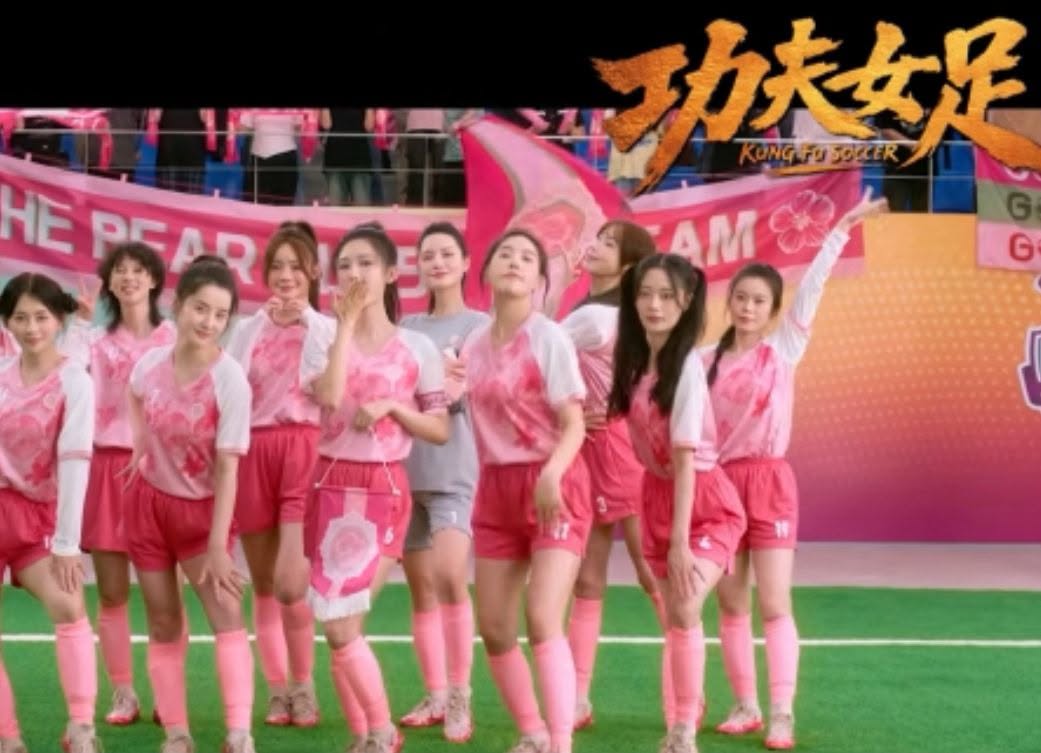
The controversy centres on a fictional Korean side called the Ewha Women’s Football Team, whose name mirrors Seoul’s prestigious Ewha Womans University. In the film, the Ewha players wear pink kits, Korean-style make-up and “circle” contact lenses associated with K-pop idols, and are portrayed as obsessing over their appearance while resorting to fouls, bribery, provocation and seduction to sway referees – even yelling in Korean, “Referee, please help us!”
Critics in South Korea argue the caricature is clearly meant to evoke the national women’s team and long-running accusations that Korean football relies on biased officiating and dirty play.
Seo Kyoung-duk, a professor at Sungshin Women’s University and an outspoken cultural activist, has emerged as one of the film’s loudest critics.
In a Facebook post and local media interviews, Seo said the movie “appears to disparage the Korean women’s football team”, warning that even fictional works can cement harmful stereotypes about Korean sport and society. He also linked Kung Fu Soccer to Fly! Light on the Ice, a short-track film released during the 2022 Beijing Winter Olympics that depicted Korean skaters as “foul kings”, arguing that “continuously insulting the Korean sports community” through such portrayals is “truly wrong”.
Seo has called for “the wrong parts” of Kung Fu Soccer to be corrected before its international rollout in August, saying the production team “should correct the controversial scenes before the film is released overseas next month” and “stop crossing the line with offensive portrayals that harm neighbouring countries”.
His comments have fuelled calls for a boycott on Korean online communities, where some users said: “I used to like Stephen Chow, but I’m so disappointed,” and “This kind of movie should never be released in Korea. I don’t want to watch Chinese movies like this.” Others framed the film as a jab born of insecurity, asking whether Chinese filmmakers really saw their own football as being on the same level as South Korea’s despite Korea’s recent World Cup slump.
Read more: The Hong Kong Cinema Renaissance
Not all Korean viewers are outraged. Some women said the portrayal of appearance-obsessed players “hit close to home”, citing social pressure and “lookism” in South Korea, with one commenter writing: “As a Korean woman, I don’t see the lie …” Another added that the movie “accurately reflects lookism and plastic surgery addiction among Korean women”.
Other Koreans took a more relativist stance, noting that Korean comics and dramas have long depicted Japanese teams as underhanded and ethnic Chinese-Koreans as criminals, and arguing that “a movie is just a movie, not a documentary”.
On Chinese social media, the backlash has sparked its own backlash. Many users accused Seo and Korean critics of being overly sensitive or “glass-hearted”, saying he was taking a broad football satire too personally.
Some comments mocked the Ewha team as having “no real strengths” and relying on opportunism, suggesting the squad was “clearly meant to represent the Korean team”. Others insisted that China “doesn’t need” the Korean market, and pointed out that South Korean media also leans on nationalist tropes and regional rivals.
Chinese media reactions have been mixed as well. Sina News ran a review headlined “Director Stephen Chow delivers a sharp critique of the reality of Korean football”, explicitly linking the Ewha team to real-life accusations about Korean players’ “fouls and biased officiating” dating back to the 2002 World Cup and extending to short-track and speed skating.
At the same time, outlets like Sohu News and The Paper have criticised Kung Fu Soccer’s heavy-handed nationalism and reliance on stereotypes, even as they noted its record-breaking opening day haul and massive production budget partly eaten up by computer graphics.
Audience response in China has also cooled as the initial hype fades. While some viewers describe Kung Fu Soccer as harmless, old-school Stephen Chow slapstick, others say it “wasn’t funny at all”, complaining that it feels “stuck several decades in the past”, with exaggerated Korean characters and visual effects that “look as if they were hastily made with AI”.
Read more: The Quiet Defiance and Lasting Legacy of Chow Yun Fat
On Douban, the film hovers around a mid-tier rating, and jokes about fans defending it – “the entire theatre was laughing”, “these are malicious comments from rival films’ fans” – have become memes in their own right.
Despite the dispute, Kung Fu Soccer’s commercial momentum shows no signs of slowing down. It has already set records for a summer release in China, will soon roll out across Hong Kong, Singapore and other markets, and is being framed domestically as both a nostalgic return to Shaolin Soccer and a patriotic crowd-pleaser.
Whether the filmmakers heed calls to tweak or edit the Ewha team’s depiction for overseas audiences could determine if the film scores an easy win abroad – or commits a costly own goal in the ongoing cultural rivalry between China and South Korea.