Adrian Leung, a.k.a., Drexler, released his new record, Olympia-5 earlier this year. A stunning 16-piece project spanning the time following shortly after Leung’s father relapsed with lymphoma. Being based in Edinburgh while his father was in Australia, Leung began improvising piano pieces to send back home, a different way of saying “I’m thinking about you.”
Many of us might relate to the strange phenomenon of caring for loved ones at a distance, especially in the ESEA community. One track in particular, “Brothers”, offers a glimpse into what Leung imagines his father’s childhood to be like. In Leung’s own words about the track, “My dad was the eldest of 5 boys, and I like to imagine what it was like growing up in Hong Kong in that environment in the 50’s and 60’s. They lived in a two bedroom housing estate, where 3 of the boys slept in a triple bunk bed and the two others in the living room. It must have driven my grandparents mad!”
Perhaps one of the many things that makes this project special is the visual chapter that accompanies the album. Leung enlisted the help of fellow filmmakers, allowing each creative to take a piece from Olympia-5 and make a mini-film for each track. Resonate premieres “Brothers”, directed by Carlos Hernan, a gorgeous film within the confines of a room, where memory, nostalgia, and childhood collide between the expressions of dancers and projections displayed around the set.
Read our conversation below:
Carlos, what was the first image you had when you heard the piece?
Carlos: The music, the title, and its story all emerged at the same time, so my mind was already influenced by that. When I listened to Adrian’s piece “Brothers,” I was immediately transported to his dad’s childhood home with his four younger brothers in Hong Kong. I imagined a small house, with seven people living on top of each other, warm and loving, fun but challenging.
All of those images overlapped with real memories from my own childhood. Back in Spain, when I was 8–11 years old, I lived with my grandma, my aunties, and my mum in a three-bedroom ground-floor flat. It was very small and felt quite cramped. But at the same time, the constant flow of people made the flat lively and fun; there was a lot of love and mutual care there. I resonated with this piece because of my own story, the challenges of not having much money or space, and having to face life together as a family.
What drew you to this project?
Carlos: I felt touched by the project, by this “ritual” music album. I felt that the love he is sending to his dad through music is something to be appreciated and honoured.
I felt a connection with Adrian’s creative process, and I wanted to be part of it. I felt I had something to share.
What was the creative process making this film? How involved was Adrian and how did your original interpretations differ or resonate with the piece?
Carlos: I had a very personal way of interpreting this; however, I also responded directly to the story behind the title. I envisioned a living room with five people in it, set in a distant time, all sharing a small space. They were dancing, exploring the space between them, a space of both closeness and tension.
I shared this idea with Adrian, and he was happy to move forward with it. He connected me with Ling Tse and Pik Kei, both from Hong Kong. I also reached out to Sky Su, who I was already friends with, and he introduced me to Nina Dhillon and Khalid Almaini. I was very grateful that they all shared their talent and time for this.
I met the dancers individually first, and shared the piece and its story with them. They had a one-hour rehearsal to get to know each other and explore the themes I gave them as inspiration. On the second day, we filmed. Adrian was with us; he introduced himself and the project, and reminded us of the meaning behind “Brothers.”
The dance was mainly improvised, with some staged scenes. I responded directly to the dancers’ movements in an unrehearsed way. I filmed with a handheld, moving camera, using manual focus to create a more organic feel.
Adrian, has your own interpretation of the piece changed after seeing and working on the film? Why is it called “Brothers”?
Adrian: I have always been drawn to the fluidity of instrumental music, how it shifts and reshapes itself depending on who is listening, and how time itself can cast new meaning over the same piece. Each composition on the album began as an improvisation, a way of searching for clarity while my father was in hospital, and while I was trying to make sense of the emotional distance between us.
The titles came later, almost like fragments of memory surfacing. “Brothers” is rooted in my dad’s childhood as the eldest of five boys. When I play it now, I find myself imagining his early life in Hong Kong, seven people sharing a one bedroom council flat. It is difficult to picture that kind of closeness, that kind of noise, that constant presence of others. I am sure that shaped him and his side of the family.
Since the album’s release, my dad has passed away, and the piece feels different again. It carries a new weight. When I return to it, there is a quiet shift in meaning, as though the music continues to evolve alongside my own memories of him.
Carlos’ interpretation adds another layer to that evolution. There is something beautifully abstract in the way he has approached it, something that opens the piece up rather than closing it down. Now, when I listen back, I feel a deep sense of gratitude. Not only to Carlos for offering his vision, but to the dancers who gave their time and energy to create something that feels like a living tribute to my dad.
View this post on Instagram
I love the visual of the hands; to me it feels like an extension of the themes of community, care, support. Can you tell me more about the themes running through this film?
Carlos: Hands are sometimes forgotten in film, Bresson filmed hands beautifully.
And I thought of this way of filming hands. It seems that some unspoken glimpses of life can only be felt through the story-telling quality of hands. And this was exactly it, focusing on their hands made me think of mutual care, support, love and union, tension and extension.
This film tries to capture mutuality but also memory, there are very literally moments to do with memory, like the projected images of Eddie on the dancer’s hands. with also less old memories like projected images of Hong Kong.
They hold a shared memory that naturally wants to fade, but together they create a larger flame that extends beyond themselves.
I love the projections in the background too. Can you tell me a little more about these and why you picked this imagery?
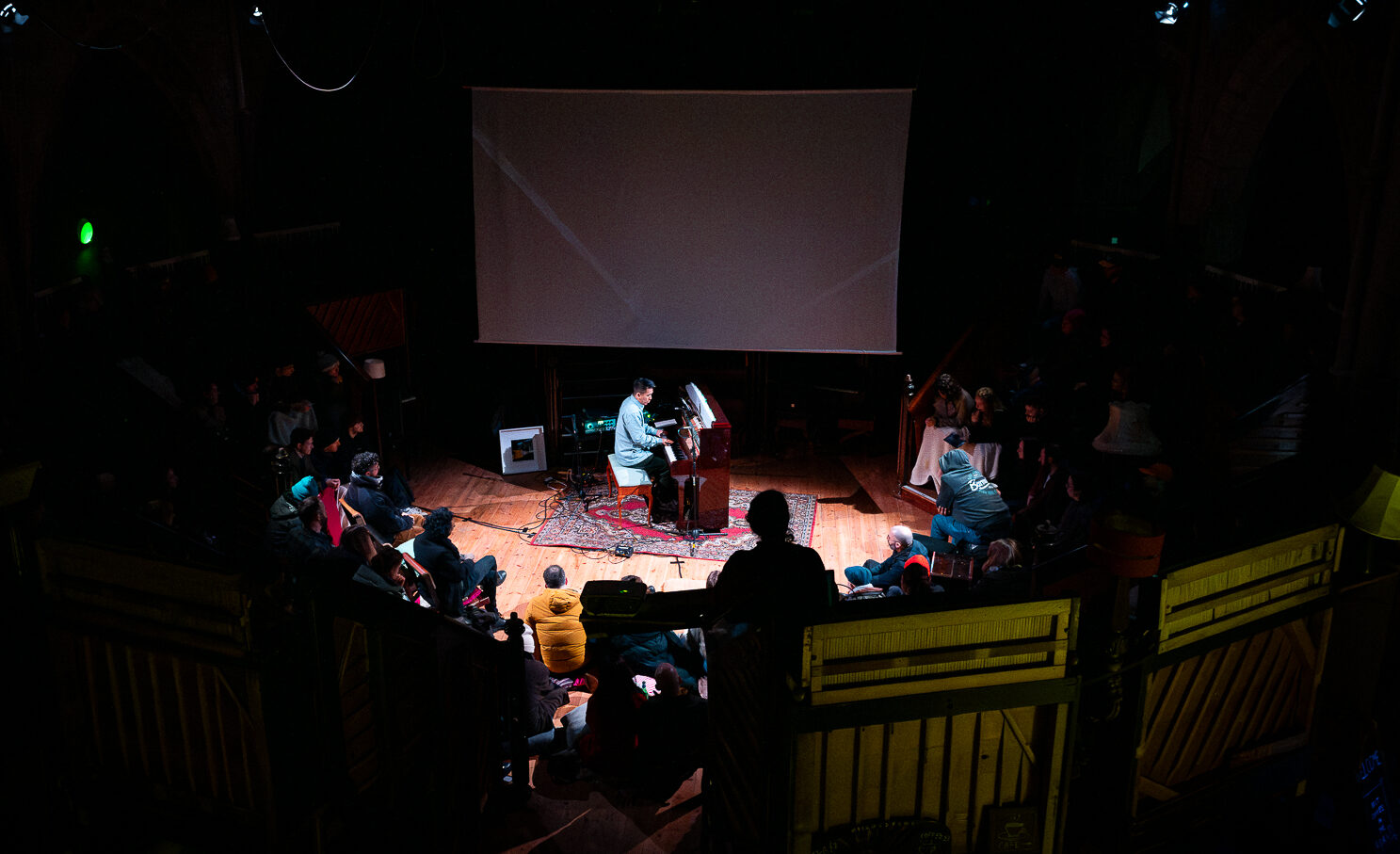
Adrian: It all came together in a strangely serendipitous way. A friend of mine, Isaac, had invited me to play a small living room concert at his home. The space itself felt incredibly warm and intimate, filled with soft light, plants, comfortable couches, and a large wall that could be projected onto.
Just a couple of days later, Carlos’ original location fell through. Isaac’s place immediately came to mind. When we stepped into the space again, it felt obvious that the wall was calling out for imagery, like a canvas for memory.
The projections bring together still images of Hong Kong, taken by my friend Gemma Thorpe, alongside photographs of my dad. It felt important to root the film in Hong Kong, because that is where my father’s story begins. His experience growing up there, and later moving away, has shaped much of who I am.
The images themselves carry a certain texture, slightly grainy, almost dreamlike. That quality felt essential. It allows the film to sit somewhere between memory and imagination, between something that is remembered and something that is being rediscovered. Including photographs of my dad brought a sense of intimacy that grounded the abstraction, giving the film a quiet emotional centre.
What is it about dance as an art form that felt right for a video like this? Were you looking for anything specific when casting the dancers?
Adrian: When Carlos suggested working with dancers, I was immediately drawn to the idea. There is something about dance that feels instinctive and unspoken. The way bodies move in relation to one another can express things that feel just out of reach for language.
For this piece in particular, that felt right. The music itself is quite open, and I liked the idea of allowing the movement to interpret it freely, almost like another form of improvisation. The dancers bring a kind of sensitivity to each other’s presence, a responsiveness that mirrors the themes of connection and care within the piece.
In terms of casting, I love being able to showcase East and Southeast Asian artists. It felt meaningful that the people bringing this story to life shared some connection to those cultural backgrounds. As it happened, Carlos and I already had overlapping circles, so it came together quite naturally that we were able to find a number of ESEA dancers.
Carlos: I wanted to create an organic, slightly abstract scene, an intimate moment that couldn’t be repeated. Dance improvisation has that quality; it allows people to play and explore closeness.
To me, it feels like a stream of consciousness, but with movement instead of words. They were able to do that. They had the talent and the passion to connect with one another and create long, intimate bodily sentences.
The first person who came to mind was Sky. I felt that if he were there, everything else would fall into place. I also wanted to move away from the idea of “five brothers,” so we brought together a diverse group of people in terms of age, gender, and cultural background. I wasn’t looking for a specific look; I was looking for people who could deeply connect with the story behind the piece.
We were lucky that a number of ESEA dancers also wanted to be part of the project. In a way, you could imagine that Eddie is one of them, but at the same time, the lines of protagonism are blurred. It could be any of them. This story has happened before.
Were there visual references or touchstones you both kept returning to by way of films, photographs, paintings?
Carlos: I’m sure I’m subconsciously influenced by all the dance films I’ve watched and by other films and art. But for this piece, I wanted to start with a blank canvas, to let the images emerge slowly. We didn’t know what it would look like until the very moment we were dancing and filming.
To both—how do you feel that the piece is in dialogue with the filmmakers interpretation, and vice versa?
Adrian: From the beginning, I wanted each film connected to the album to stand on its own, not simply as an accompaniment to the music, but as its own creative response. What I find so striking about this film is how closely it resonates with the emotional core of the piece, while still feeling entirely its own.
The presence of five dancers subtly echoes the five brothers, while the visual language of Hong Kong and the inclusion of my dad’s image anchor the work in something deeply personal. It feels less like an illustration of the music and more like a conversation with it, each element reflecting and reshaping the other.
Carlos: I think the moving images guide the music into a new space, a reimagined one that doesn’t literally follow the story of five brothers. In this music video, we feature a mix of people, which universalises the concept of brotherhood and brings it into a space of siblinghood.
At the same time, the images still follow the tenderness and slowness of the music. I don’t see a separation between the music and the images anymore. I feel like I’ve come to listen to this piece in a different way, as it kept evolving throughout the process.
They come together to offer the same reminder: our shared vulnerability helps us come closer to one another.
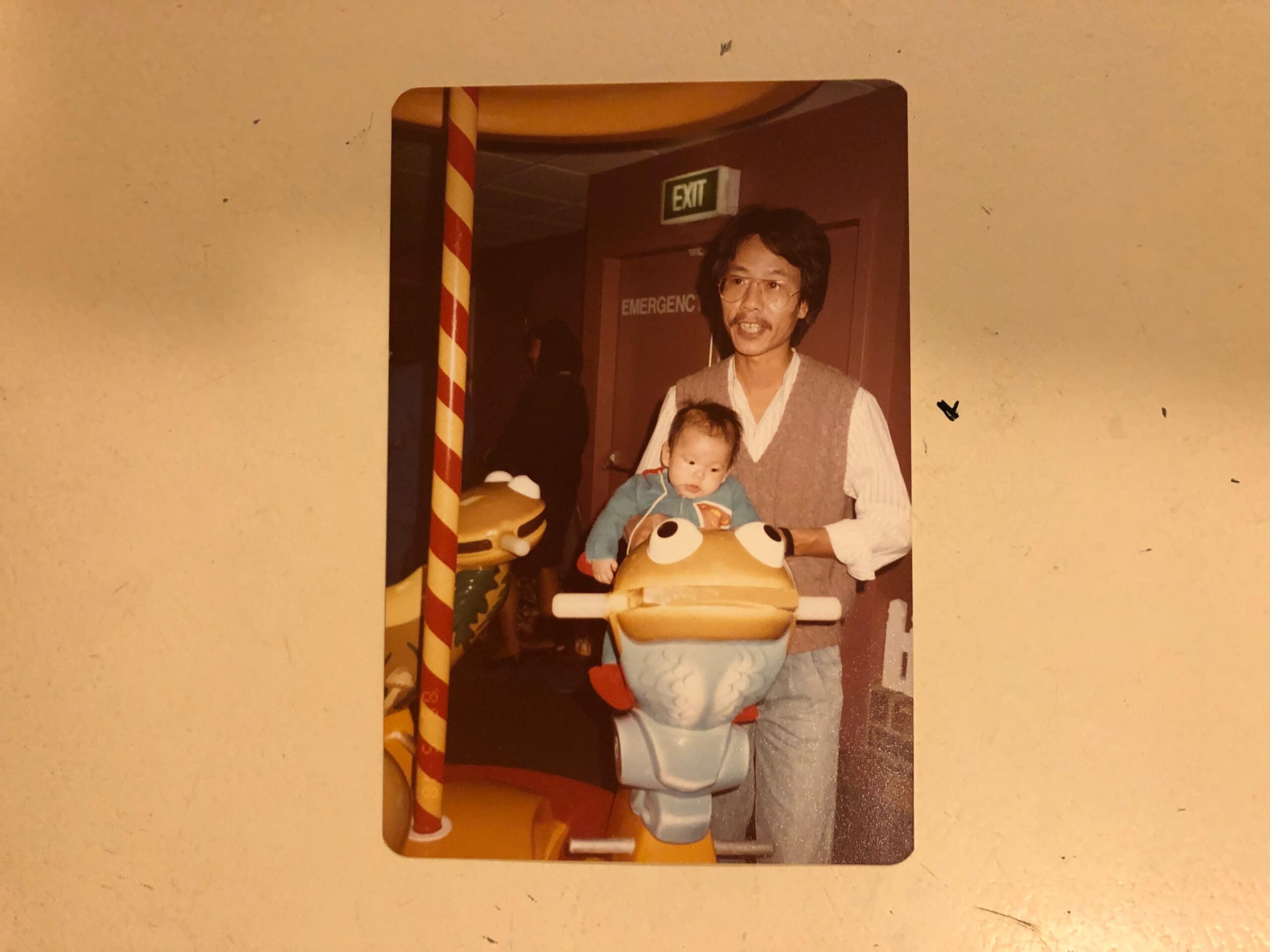
Adrian, there’s something quite tender about imagining a parent’s childhood. What did writing this piece teach you about your relationship with your dad—especially as you are now one yourself!
Adrian: Wow, how long do you have? Haha. Even before becoming a parent myself, I felt that the shortcomings you might perceive in your parents as role models often come from how they themselves were raised.
My dad was not the stereotypical “super dad”. He did not always encourage me, and he didn’t always play or engage in the ways dads are perhaps expected to today. But I’ve never blamed him for that. Part of that is because I am sure he was never shown that type of love or care by his own parents.
This piece makes me imagine how chaotic and difficult life must have been for my dad’s family, and how fortunate I am that my parents made the choices they did to give me a better life.
‘Brotherhood’ also links to a wider significant theme. Care between men, and the ways they do or don’t express it. What’s your relationship like with the concept, especially against the context of ESEA masculinity?
Adrian: A number of people have commented how this album is a gesture of love, or like you said, a way of showing care between my Dad and I. I think I’m quite open emotionally, perhaps that why I’m a musician, and the idea of writing music to create warmth and comfort to his hospital room, and to let him I know I was there for him, just very like the natural thing to do. There wasn’t actually much more I could do at the time, being so far from him in Australia.
Regarding my own relationship with masculinity, it’s not really something I’ve thought too deeply about. I think I was raised to care about others, to be kind and to feel deeply about things. I am lucky that my friends from school, who are still my closest friends, have always been empathetic people. Yes, we talk about sport and have banter, but we also know when to be there for each other, to check in, and to keep the door open for deeper conversations. I think it’s important for men to have those people to go to, whether they’re family, partners, or friends.
So while I think I’m relatively open with my feelings, since my dad passed, I’ve found myself bottling things up at times or deliberately distracting myself to avoid dealing with emotions. I think that is just part of grief. Everyone processes it differently, in their own way and in their own time.
Working with several filmmakers across this album, each one brings their own lens to a different piece. What does it mean to you as an artist to have an album holding so many interpretations simultaneously?
Adrian: Working with different filmmakers across the album has been one of the most meaningful parts of the process. Each person has brought their own perspective, their own sensitivity, and their own way of seeing the music. I didn’t have a budget, so they all very generously gave their time for free. I think that says a lot about them as artists, wanting to create work that resonates with them, as much as it says about the album itself.
Each film feels distinct, almost like its own world, yet they are all connected by shared themes of care, memory, family, and distance. Together, they form a kind of expanded interpretation of the album, one that I couldn’t have created on my own.
The beautiful thing is that I will now have these films to return to for the rest of my life. My dad even joked before he passed away that we wouldn’t need to sort out imagery for the funeral, because we already had all these films.