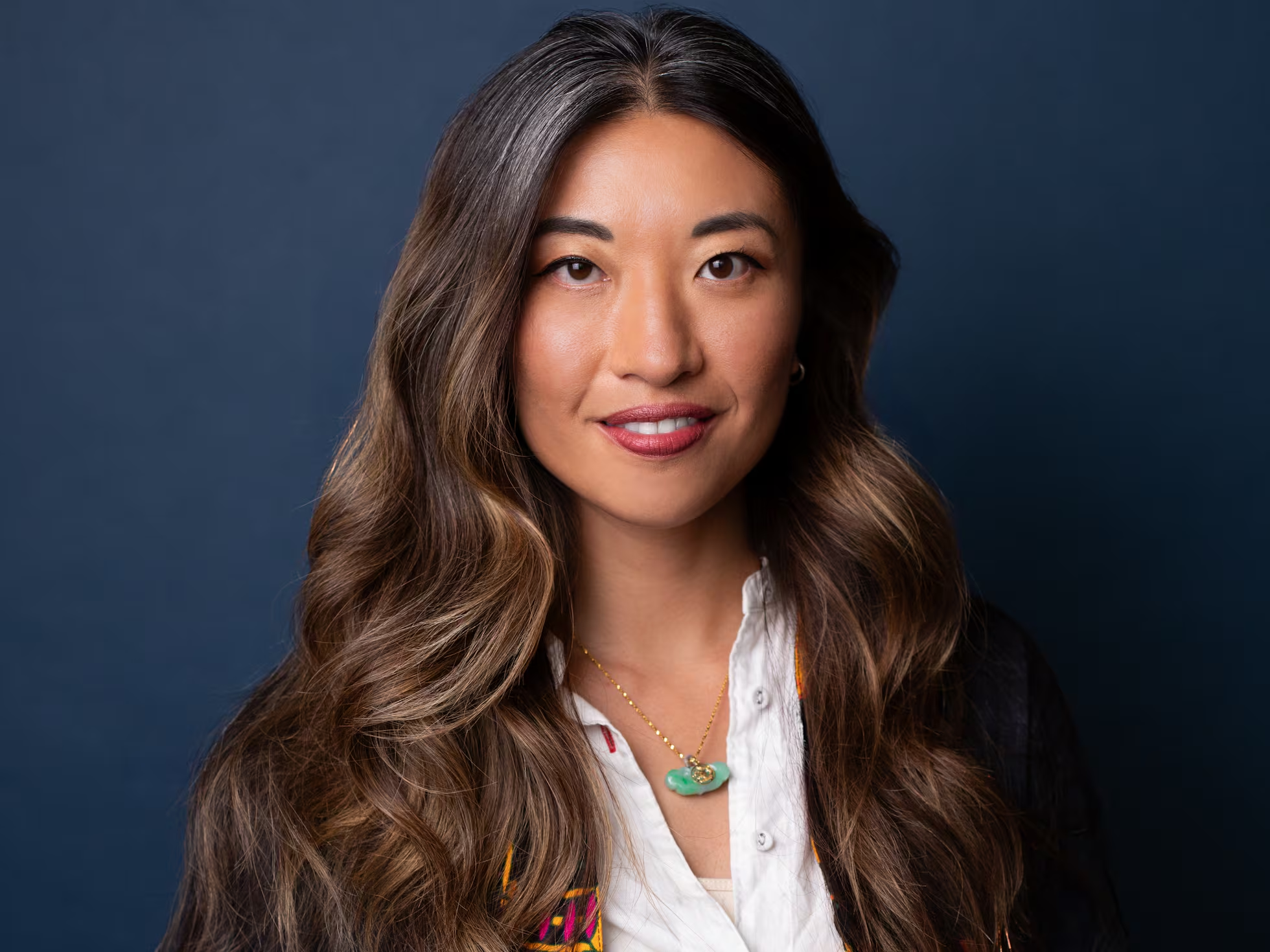
The chief operating officer of Bluesky, Rose Wang, has stated that major social media networks have abandoned their original purpose. Speaking at a fireside chat on Monday afternoon during the SXSW London festival in Shoreditch, Wang argued that the internet has become overly reliant on automated systems.
The panel discussion took place as Bluesky continues to expand rapidly. The decentralized platform has attracted over 44 million users within two years, benefiting from a series of mass digital migrations away from established platforms.
A Mass Exodus of Scientists and Journalists
Wang addressed the audience alongside journalist Amit Katwala, explaining that traditional social networks operate under a broken model controlled by a handful of corporate entities. While she did not name Elon Musk or Mark Zuckerberg directly, she made clear references to the cultural shifts that occurred after Musk acquired X, formerly known as Twitter, in 2022.
The platform’s rapid user growth spiked significantly following the 2024 United States presidential election. Wang noted that while critics frequently dismiss the platform’s user base as a political monoculture, the individuals fleeing established networks are actually seeking reliable data.
“We have to look deep into who these people are,” Wang said. “They are journalists, scientists, and people who want to rely on actual verified information. They fled because none of that was available anymore.”
She argued that when a single billionaire controls an entire network, they can change the rules overnight. This makes the digital environment inhospitable for professional communication.
The Problem With Corporate Scale
According to Wang, the sheer size of platforms like Facebook and X prevents them from adapting to the changing needs of ordinary internet users. She suggested that these firms have shifted their core business models entirely away from hosting social interaction.
“Facebook and Twitter are huge, and they have tons of users, so for them to turn the shift is difficult,” Wang remarked. “Also, they are basically AI companies at this point.”
Read more: ‘Spider-Noir’ Soundtrack Spotlights Li Jun Li With Cover and Original Song
The executive, who manages a lean team of forty staff members, stated that Bluesky wants to return control to individual communities. The network operates on a decentralised protocol, allowing users to build and manage their own feeds rather than relying on a centralised corporate algorithm to dictate what they see.
A Different Approach to Artificial Intelligence
The conversation inevitably turned to the role of generative artificial intelligence in the media landscape. Wang pushed back against the industry trend of using automated tools to manufacture synthetic articles and imagery.
She stated that Bluesky does not find the use of automated software to create content particularly interesting. Instead, the firm views the technology as a tool to level the playing field for independent application developers.
The company recently launched an internal tool called Attie, designed to help users filter, sort, and organize their personal feeds based on specific niche interests. Wang also noted that automated systems remain useful for basic content moderation, comparing corporate platform guidelines to a broken judicial system.
“The way they work is there is one court system on every platform with one set of rules governing an entire world audience, and they have ten thousand clerks who go make those decisions,” Wang said. Bluesky intends to bypass this structure by letting individual user communities determine their own rules for speech and interaction.