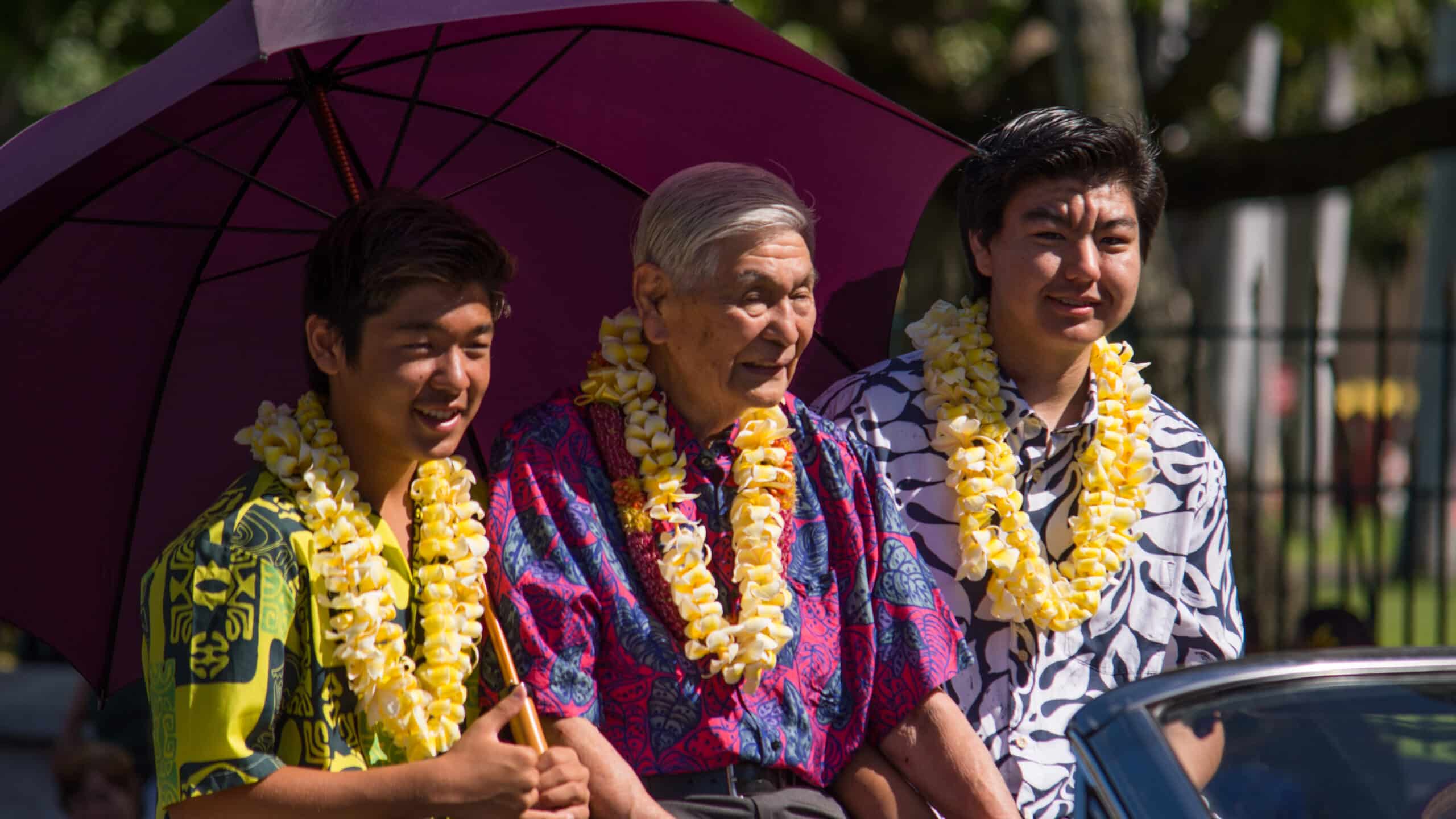
George R. Ariyoshi, the first Asian American governor in US history and a defining figure in Hawaii’s modern political identity, has died at the age of 100.
Ariyoshi passed away peacefully on Sunday night, surrounded by family, according to a statement released Monday by Hawaii Gov. Josh Green.
“Governor Ariyoshi devoted his life to Hawaiʻi with humility, discipline and an unwavering sense of responsibility to the people he served,” Green said. “He led our state during a pivotal moment with quiet strength and integrity, and his legacy as a trailblazer and public servant will endure for generations.”
Ariyoshi’s legacy is often framed in terms of firsts, but his political rise was also deeply tied to Hawaii’s own transformation in the post-statehood years. By the time he stepped into the governor’s office in 1973 — initially as acting governor after John Burns fell ill — the state was already undergoing a shift in who held power, and who it represented.
He would go on to win the role outright in 1974, and again in 1978 and 1982, becoming a steady presence during a period of rapid growth that reshaped Hawaii’s economy and identity.
Read more: Hallmark Slammed Over “Whitewashed” Cast In New ‘Mahjong’ Movie Premiering During AAPI Month
That growth, however, was something Ariyoshi viewed with caution.
“I was convinced that neither our infrastructure nor our environment would support this rate of growth,” he wrote later, reflecting on the tourism boom and rising population during his time in office.
Born in 1926 near Honolulu Harbor, Ariyoshi grew up in Kalihi, a working-class neighbourhood where many immigrant families, including his own, were building new lives. His father, originally a sumo wrestler from Fukuoka, later worked on the docks and ran a dry-cleaning business. His mother had emigrated from Kumamoto.
In his autobiography With Obligation to All, he recalled a childhood shaped less by financial hardship than by a personal struggle with speech.
“The fact that we had no money did not seem to be a barrier, but I had a barrier of a different kind,” he wrote, describing a lisp that made his early ambition of becoming a lawyer feel uncertain.
That ambition held. After serving as an interpreter for the US Army in Japan at the end of World War II, Ariyoshi went on to study in the US, eventually earning a law degree from the University of Michigan in 1952.
His time on the mainland left an impression — not of exclusion, but of contrast.
“On the contrary, I enjoyed the fact that Hawaii had a reputation even then for people of different backgrounds coming together and living harmoniously,” he wrote.
He returned home to practise law, but politics soon followed. Ariyoshi entered public office in 1954, the same year Democrats broke Republican control of Hawaii’s legislature — a turning point that would define the state’s political direction for decades. After serving in both territorial and state legislatures, he set his sights higher.
“The new state of Hawaii had produced United States representatives and senators of Caucasian, Chinese and Japanese ancestry, reflecting our diversity,” he wrote. “But only Caucasians had been governor.”
Read more: American YouTuber Johnny Somali Jailed in Seoul After Kissing ‘Comfort Women’ Statue
His eventual election marked a shift that went beyond Hawaii. It placed an Asian American leader at the helm of a US state for the first time — something that, at the time, was far from inevitable.
There were also quieter moments that captured how far he and his family had come. In 1975, during a trip to Washington, D.C. for the National Governors Conference, Ariyoshi and his wife Jean attended a White House dinner hosted by President Gerald Ford.
As they danced, Jean leaned in and said, “Look at the little girl from Wahiawa dancing at the White House.”
Ariyoshi answered: “And she’s dancing with the kid from Kalihi.”
After more than a decade in office, his influence carried on through the next generation of leadership. John Waiheʻe, who served as his lieutenant governor, would go on — with Ariyoshi’s support — to become the first governor of Native Hawaiian ancestry in 1986.
Ariyoshi is survived by his wife Jean, daughter Lynn, and sons Donn and Ryozo.