After nearly a decade away from the world stage, K-pop legends BIGBANG made their long-awaited comeback at the Coachella Valley Music and Arts Festival on April 12, marking a major milestone in the group’s 20th anniversary year.
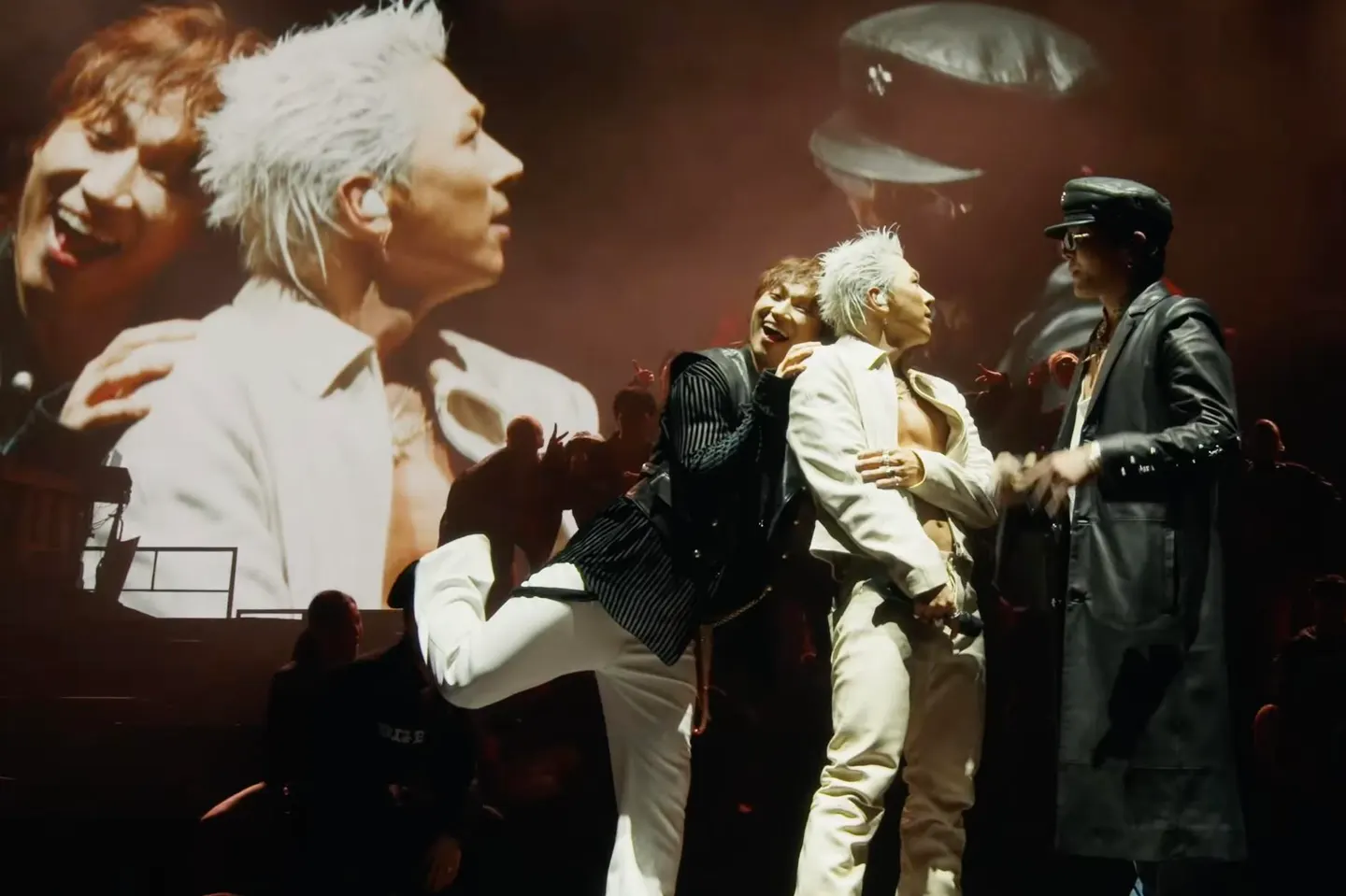
Their hour-long set, staged at Coachella’s Outdoor Theatre, drew an overwhelming crowd as the trio—G-Dragon, Taeyang, and Daesung—performed together for the first time since their Last Dance tour in 2017. Former member T.O.P did not appear but was featured through pre-recorded vocals in the closing song Still Life (2022).
“It took us a long time to get here,” said G-Dragon during the set. “B to the I to the G to the Bang is back.”
Originally scheduled to perform at Coachella 2020 before the pandemic forced its cancellation, BIGBANG’s long-delayed debut at the festival underscored their enduring influence across generations of K-pop listeners. The group’s signature crown-shaped light sticks filled the crowd as fans sang along to hits spanning nearly two decades.
Opening with Bang Bang Bang (2016), Fantastic Baby (2012) and Sober (2015), the trio set an explosive tone before diving into emotional fan favourites like Lies (2008), Haru Haru (2008) and Loser (2015). The performance doubled as both a career retrospective and a sign that BIGBANG are ready for renewed group activity.
Taeyang grounded the moment in experience. “2026 is our 20th year as BIGBANG,” he said. “The years have flown by so fast. We already spent half our lives together and I’m so grateful to share our music and our passion with all of you. This stage tonight—Coachella—means a lot to us.” He also flagged his upcoming solo album and paid tribute to the V.I.Ps, the group’s core fanbase, tying the night to both past and future. “We’ve spent half our lives together and we’re grateful to share our music and passion with all of you.”
Read more: BIGBANG’s G-Dragon Dominates, BLACKPINK’s Jennie Breaks Kpop Records at Melon Music Awards 2025
Daesung projected forward instead of looking back. “This has become an unforgettable memory for me,” he told the crowd. “And we’re gonna make even more unforgettable memories this year so stay with us till the end.”
G-Dragon, ever the showman, first joked, “ok bye bye,” then turned it into a long, emphatic “thank you.” “This year is BIGBANG’s 20th anniversary, it just started,” he said. “We got some biiiiiig things coming soon. So, for now, for just a little bit, stay there, we’ll be there.”
The Coachella show also highlighted each member’s individuality. Taeyang delivered high-octane choreography with Ringa Linga (2013), followed by G-Dragon’s performance of Power (2025) from his recent solo album. Daesung added his own twist with Hando Chogua (2025) and Look At Me, Gwisun (2014), showcasing the group’s stylistic range.
As the set closed with Still Life, G-Dragon looked ahead to what lies beyond. “This is just the beginning of our 20th anniversary. We’ve got big things coming,” he said, hinting at an upcoming world tour alongside Taeyang’s new solo album Quintessence.
View this post on Instagram
BigBang’s Coachella return cannot be fully understood without context. In 2016, Forbes listed the group at number 23 on its list of the world’s highest‑paid musicians, having earned $44 million in a single year—the first Korean act ever on that list, and the third‑highest annual earnings for a boy band at the time, behind only One Direction and Backstreet Boys. That same year, Time magazine’s reader poll ranked BigBang second on its “Most Influential People in the World” list—behind only Bernie Sanders—an almost unthinkable feat for a Korean boy band.
At their peak, BIGBANG weren’t just Korea’s most talked-about boy band—they were global pop powerhouses. In 2016, Forbes ranked them number 23 on its list of the world’s highest-paid musicians, having raked in $44 million in a single year—the first Korean act ever on that list and the third-highest earnings for a boy band at the time, behind only One Direction and Backstreet Boys. That same year, Time magazine’s reader poll placed them second on its “Most Influential People in the World” list—beaten only by Bernie Sanders—a surreal reminder that the group’s reach had stretched far beyond music charts and concert halls.
But the fall came fast. In 2019, member Seungri left the entertainment industry following his involvement in the Burning Sun scandal, closing the chapter on one of the group’s most notorious arcs. His appearance at a Seoul police station that March, answering questions over allegations of supplying prostitution services, became one of the most photographed images of the scandal and of BIGBANG’s decline into public scrutiny.
Read more: BTS Album Arirang Surpasses One Billion Streams on Spotify
By 2022, BIGBANG returned—this time as a quartet—with Still Life, their first release in four years. The ballad debuted at number one on South Korea’s Gaon Digital Chart and crept into the top 10 on the Billboard Global 200, proving the group still had the emotional pull to command mainstream attention.
A year later, T.O.P officially stepped away, leaving BigBang as a trio moving forward. Seungri’s earlier departure and T.O.P’s exit turned the group into a leaner, more resilient version of itself—one with less media noise and more quiet resolve.
For fans and industry watchers alike, BIGBANG’s Coachella return signaled more than nostalgia—it was a definitive reminder that one of K-pop’s most influential acts is ready to reclaim its place on the global stage.
BIGBANG will perform a second and final Coachella set on April 19.