Donald Trump has welcomed Nvidia co-founder Jensen Huang back with an AI-generated assassination-attempt meme, but behind the internet spectacle is a corporate scandal involving alleged affairs, national security concerns and an unusually public apology from one of the world’s most powerful tech executives.
Jensen Huang’s return to Nvidia has been anything but conventional.
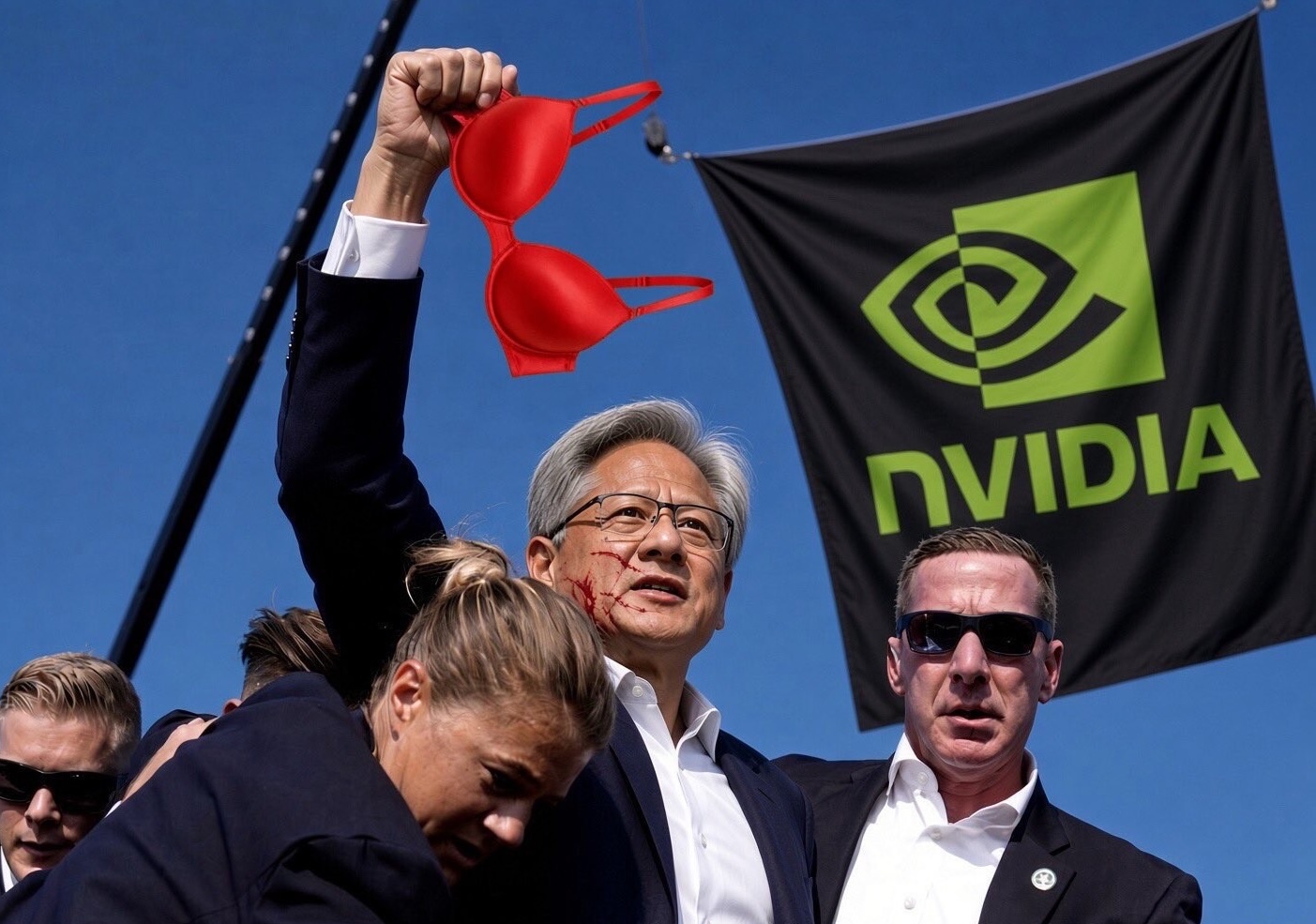
Just days after stepping down as chief executive amid revelations about his personal life, the billionaire founder is back at the helm of the world’s most influential AI chipmaker. And US President Donald Trump has marked the occasion in perhaps the most Trump-like way possible: with a digitally altered image of Huang, covered in fake blood, raising a red bra in the air.
The bizarre image, posted on Trump’s Truth Social account on November 23, recreates the now-iconic photograph of the president raising his fist after surviving an assassination attempt at a campaign rally in Butler, Pennsylvania, in July 2024.
Only this time, Huang takes centre stage.
Instead of an American flag waving in the background, an Nvidia banner flies above him. Secret Service agents surround the tech executive, while a bloodied Huang triumphantly holds a red bra aloft.
The apparent message? Huang has survived his own corporate assassination attempt.
Trump accompanied the image with a congratulatory message celebrating Nvidia’s decision to reinstate its co-founder, calling it an “absolutely GREAT decision”.
Read more: Jensen Huang Lookalike Contests Take Over New York and Vancouver, Backlash Ensues
The president had previously voiced support for Huang’s return, arguing that his leadership was essential to maintaining America’s dominance in artificial intelligence and semiconductor technology.
But the meme’s absurdity belies the extraordinary circumstances surrounding Huang’s departure and comeback.
An 11-day corporate drama
Huang stepped down as CEO following revelations about extramarital relationships, including an alleged affair with a subordinate and another involving Chinese businesswoman Alice Huang, who was suspected by US intelligence of having links to Chinese espionage.
The allegations raised questions extending beyond Huang’s personal life, particularly given Nvidia’s central role in the global AI industry and the national security implications surrounding advanced semiconductor technology.
Nvidia’s board subsequently reviewed the situation before unanimously voting to reinstate Huang on November 23.
In its statement, the company said it had held discussions and meetings with Huang and was satisfied with his candour and ability to lead Nvidia.
The board also acknowledged receiving input from senior US government officials during its deliberations, adding that it was confident Huang’s reinstatement posed no national security risk.
Trump was particularly keen to take credit for the outcome.
Read more: “Whatever… I’m a Piece of Sh*t”: Jensen Huang’s Disgraceful Exit From Nvidia
Speaking to CNBC, the president said he had spoken with the board about Huang’s return, adding: “I spoke to them, let me put it that way.”
He subsequently claimed he had helped convince the directors to bring the executive back.
For Nvidia, the reversal marked the end of an extraordinary 11-day leadership crisis. For Huang, it represented an opportunity to return to the company he co-founded in 1993 and has helped transform into a central force in the artificial intelligence revolution.
Trump weighs in on Chinese spy allegations
Trump has also addressed the allegations surrounding Alice Huang, the Chinese businesswoman reportedly suspected of having connections to Chinese intelligence.
Speaking to CNBC, the president appeared to dismiss the suspicions, while making a pointed observation about the way Chinese women are scrutinised in the United States.
“Every time you have a Chinese woman that’s goodlooking or beautiful, they say she’s a spy,” Trump told CNBC, adding that “with Jensen, I don’t believe that’s true”.
The remarks add another dimension to a controversy that has increasingly blurred the lines between corporate governance, national security and the geopolitical competition between Washington and Beijing.
View this post on Instagram
However, the underlying allegations remain serious. Reports have raised questions about Alice Huang’s alleged connections to Chinese intelligence, although suspicion should not be conflated with proof of espionage.
Nvidia sits at the centre of an increasingly sensitive geopolitical contest over artificial intelligence, with its advanced chips playing a significant role in America’s technological competition with China.
Any questions about the company’s leadership, governance or exposure to foreign intelligence risks therefore carry implications well beyond its corporate headquarters.
This boy needs therapy
However, the celebratory imagery quickly gave way to a more sombre moment.
On November 24, just one day after returning to the CEO position, Huang addressed employees during an all-hands meeting at Nvidia’s headquarters in Santa Clara, California.
The executive apologised for his conduct and acknowledged violating the company’s code of conduct.
Huang reportedly described the gathering as the hardest company meeting he had ever held, telling employees that he had let them down.
He also acknowledged the personal consequences of his actions, including the impact on his wife and children.
Perhaps most unexpectedly, Huang disclosed that he had been undergoing daily therapy to address his behaviour.
The executive reportedly expressed gratitude for being given a second chance to lead the company he co-founded three decades ago.
He also pushed back against suggestions that his reinstatement was the result of being a powerful technology executive who could operate above the rules governing other employees.
Instead, Huang maintained that Nvidia’s board had evaluated the facts and had been assured there was no national security threat.
He also emphasised that the board would hold him accountable going forward.
There is also the question of how much political intervention contributed to Huang’s reinstatement.
While Trump has been unusually vocal about his involvement, Huang reportedly rejected the suggestion that the president had secured his return through political pressure.
Instead, he maintained that Nvidia’s board had independently evaluated the situation and that assurances from the US government regarding national security risks had helped inform its decision.
Read more: “I Was Unfaithful to My Wife”: Jensen Huang Admits Affair as Nvidia Probes Alleged Chinese Spy Plot
Nevertheless, Trump’s intervention has attracted scrutiny from lawmakers in Washington, with concerns about the implications of political involvement in corporate governance and national security decisions.
The company’s sudden reversal also raised questions about the independence of its board and the extent to which external political pressure influenced its decision.
The comeback continues
For now, Huang is back in charge, Trump has his viral meme, and Nvidia has its co-founder once again leading the business.
But the corporate drama is far from inconsequential. Nvidia’s shares rallied on news of Huang’s reinstatement before losing ground in subsequent trading, reflecting the market’s continued sensitivity to developments surrounding the world’s most valuable AI chipmaker.
The episode also raises broader questions about accountability at the highest levels of the technology industry, particularly when the person at the centre of a controversy is also the individual most closely associated with a company’s success.
Huang’s return may have been celebrated with fake blood, a red bra and an Nvidia flag, but rebuilding confidence among employees, investors and the wider technology industry will require considerably more than a viral social media post.
And if his first days back are any indication, the second act of Jensen Huang’s leadership may be considerably more complicated than the first.