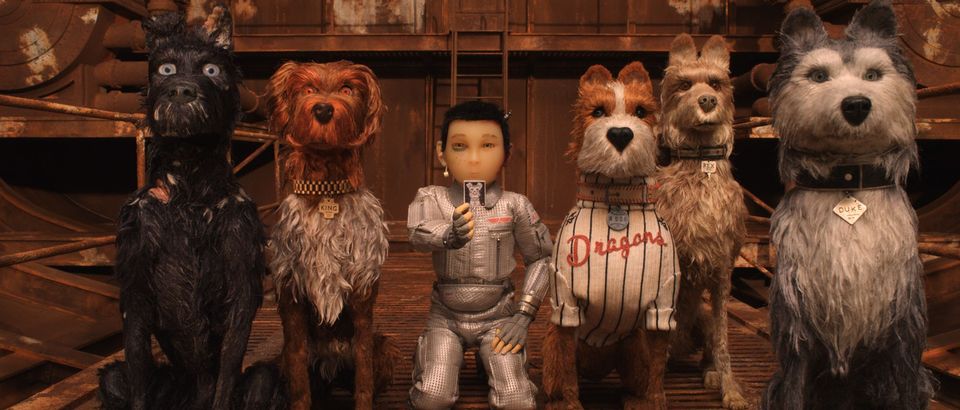
Director Wes Anderson has been criticised for his depiction of Japan in his latest animated film Isle Of Dogs.
Despite overwhelmingly positive reviews, Wes Anderson’s latest film Isle Of Dogs has been called out for cultural appropriation for its depiction of Japan.
IGN awarded Isle Of Dogs 9.5 and the film scored 93% on Rotten Tomatoes. However, Anderson’s futuristic imaging of Japan through the fictionalised city of Megasaki has been deemed by some as cultural appropriation.
The LA Times questions, “does this white American filmmaker’s highly selective, idiosyncratic rendering of an East Asian society constitute a sincere act of homage, or a clueless failure of sensitivity?”
Author of the article Justin Chang particularly takes issue with Anderson’s use of the Japanese language compared to his use of English. According to Chang, the residents of Megasaki City, “speak their native Japanese, a choice that would seem respectful enough except for the conspicuous absence of English subtitles.”
“Much of the Japanese dialogue, especially Atari’s, has been pared down to simple statements that non-speakers can figure out based on context and facial expressions; longer, more complicated exchanges are translated aloud by a handy on-screen English interpreter (Frances McDormand),” Chang explains. “The dogs, for their part, all speak clear American English, which is ridiculous, charming and a little revealing.”
Rose also criticises Greta Gerwig’s American exchange student character who, “turns out to be something of a “white saviour” who mobilises the passive Japanese populace to rebel and put things right.”
Anderson’s overall depiction of Japan was also criticised by The Guardian. “Anderson’s alternative Japan also ticks off a great many tourist cliches,” Rose writes. “There is sushi, sumo wrestlers, cherry blossoms, taiko drummers. When there’s an explosion at one point, it’s a mushroom cloud – a reminder that Japan suffered a nuclear attack, from a film-maker from the country that attacked them? Really?”
Mashable took the film to be offensive to Asian culture. “The problem is that Isle of Dogs falls into a long history of American art othering or dehumanizing Asians, borrowing their “exotic” cultures and settings while disregarding the people who created those cultures and live in those settings,” wrote author Angie Han.
Twitter users seemed to agree with the critics. One user tweeted, “#IsleOfDogs: Thank you @JustinCChang for devoting far more attention than most critics will to many of the willfully tone-deaf ways Wes Anderson appropriates and marginalizes Japanese culture and people in his so-called homage. It is ugly, indeed.”
Another added, “.@JustinCChang putting perfect words to all my issues with #IsleOfDogs.”
“Whenever I see the trailer of #IsleOfDogs, I get really offended by the “mushroom cloud” scene,” tweeted another. “It’s so offensive that I’m feeling like I need to watch it and criticize it. But I really hate that trailer. It’s disturbing and I see no necessity that it has to be “Japan”.”
“the thing about isle of dogs is i think it would probably be perfectly charming and fun movie if not for the fact that japan is used as window dressing to make it more ~quirky~ for some reason????” said another.
Whenever I see the trailer of #IsleOfDogs, I get really offended by the “mushroom cloud” scene. It’s so offensive that I’m feeling like I need to watch it and criticize it. But I really hate that trailer. It’s disturbing and I see no necessity that it has to be “Japan”.
— ういろ (@uirou0907) March 21, 2018
.@JustinCChang putting perfect words to all my issues with #IsleOfDogs. 🙏 https://t.co/h1jJRtWucy
— Linda Ge (@lindazge) March 22, 2018
#IsleOfDogs: Thank you @JustinCChang for devoting far more attention than most critics will to many of the willfully tone-deaf ways Wes Anderson appropriates and marginalizes Japanese culture and people in his so-called homage. It is ugly, indeed. https://t.co/GtbWVg40YF
— jen yamato (@jenyamato) March 22, 2018
the thing about isle of dogs is i think it would probably be perfectly charming and fun movie if not for the fact that japan is used as window dressing to make it more ~quirky~ for some reason????
— Val (@val_kung) March 22, 2018