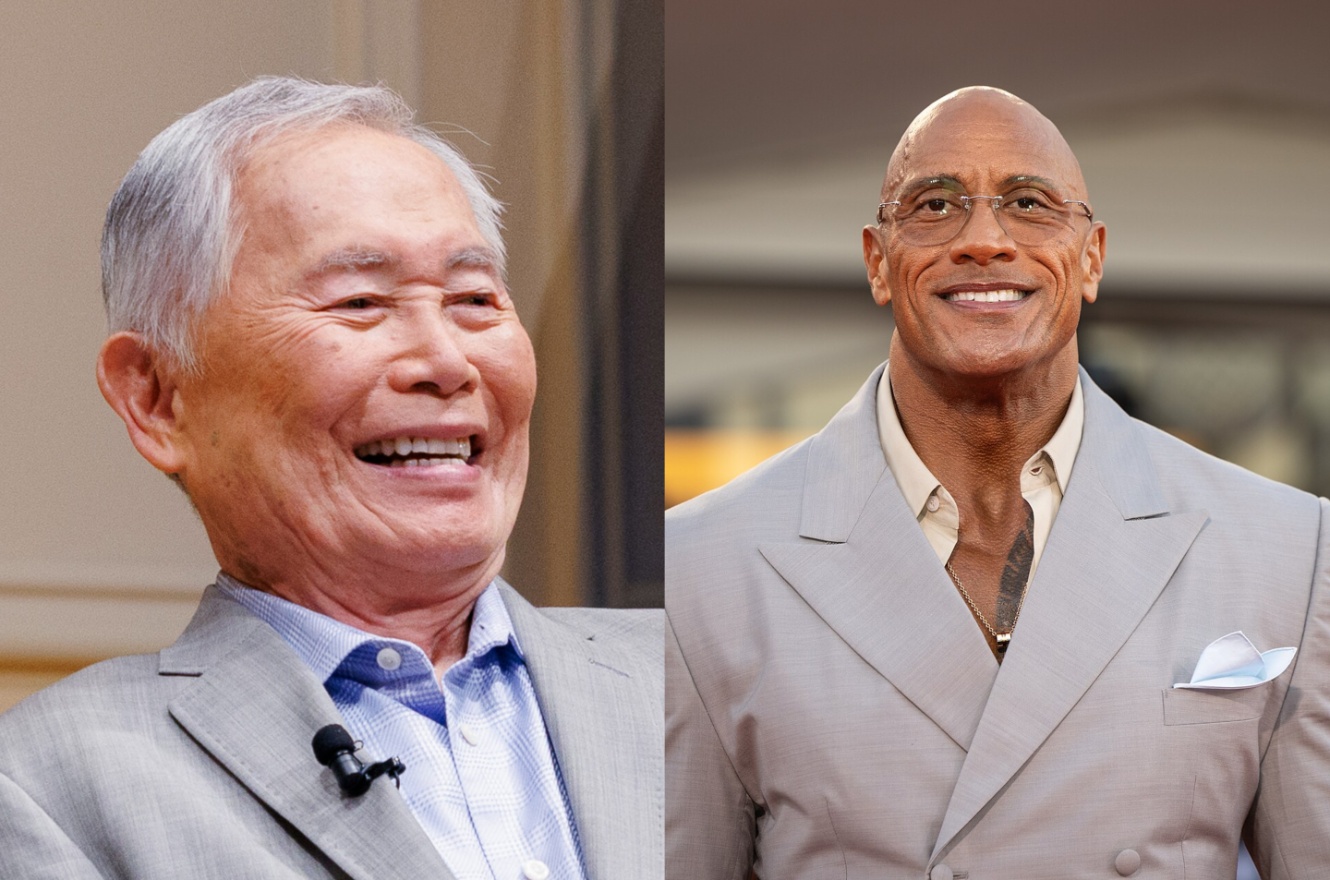
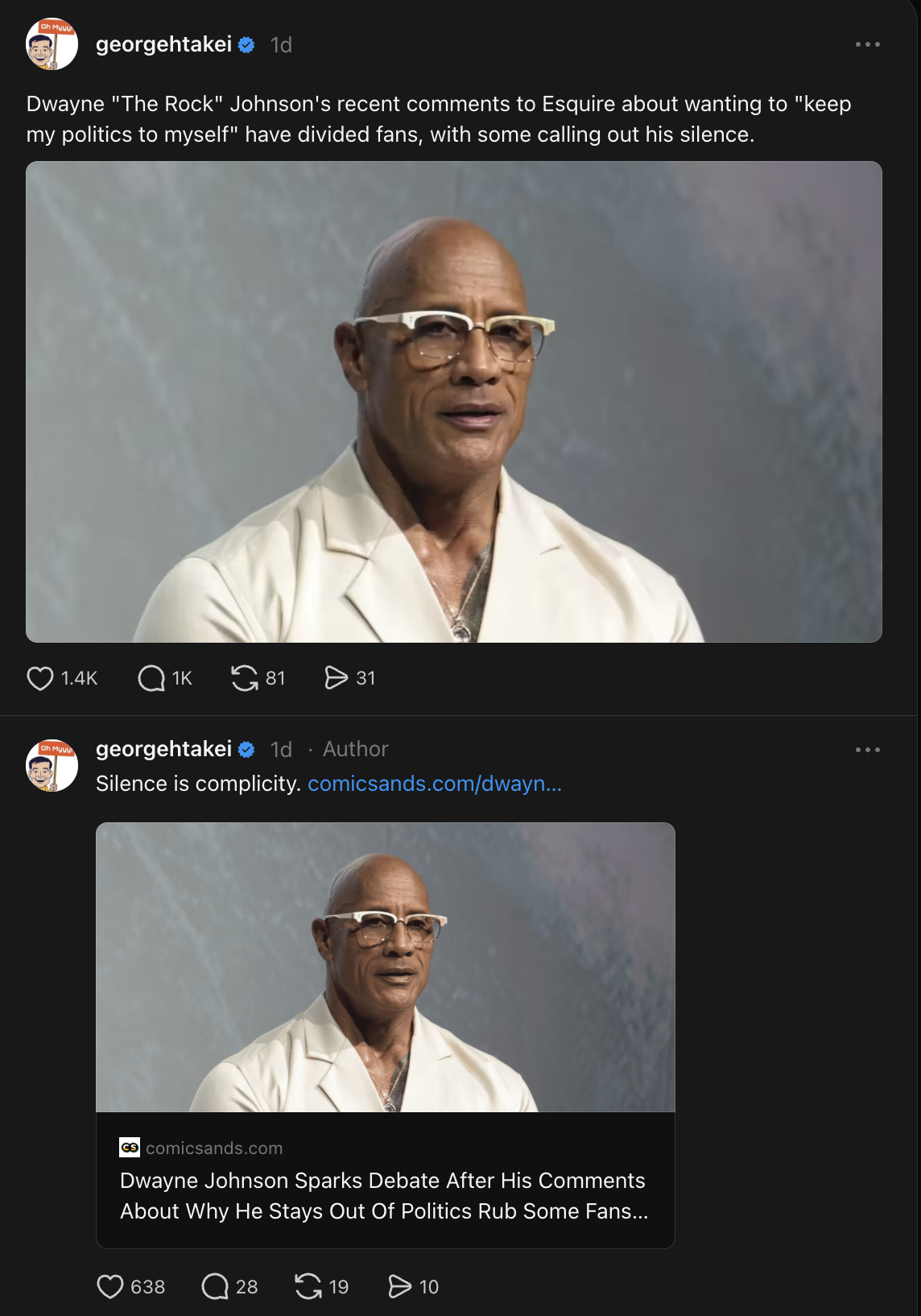
Dwayne Johnson is drawing criticism after saying in a recent Esquire interview that he plans to keep his politics to himself. The reaction has been swift, with George Takei emerging as one of the most pointed voices in the backlash.
Writing on Threads, Takei dismissed Johnson’s silence with a blunt warning: “Silence is complicity.” The comment quickly framed the conversation as less about one celebrity’s media strategy and more about the responsibility that comes with influence.
Wil Wheaton joined in as well, responding to Johnson’s stance with a sharp rebuke of his own. “So disappointing to find out he is such a coward,” Wheaton wrote, echoing the broader frustration that has followed Johnson’s remarks.
Johnson, who is currently on a global press tour for Disney’s live-action Moana, had already signaled this shift in 2024 when he told Fox News he regretted endorsing Joe Biden in 2020. He said that endorsement had created division among fans and made clear where he now stands: “My goal is to bring this country together. I believe in that. There will be no endorsement. At this level of influence, I will keep my politics to myself. It is between me and the ballot box.”
That position was reinforced in his new Esquire interview, where Johnson explained that his focus has moved squarely toward his craft. “What I have learned through experience is that I need to keep — need, not want — the main thing,” he said, adding that the thing he runs toward each morning is “creating,” because “It’s art. It’s storytelling.”
He then expanded on why he wants to avoid political debate altogether, saying, “I’ve learned I’m going to keep my politics to myself.” Johnson added that politics is “omnipresent and it’s forever,” and made clear that what he dislikes most is “the slinging” and “all the bullshit that comes with it.”
The comments land in a climate where celebrities are increasingly being challenged over whether silence is neutrality or avoidance. Johnson’s critics clearly see it as the latter, while Johnson appears to view retreat from politics as a way to protect both his work and his audience.