
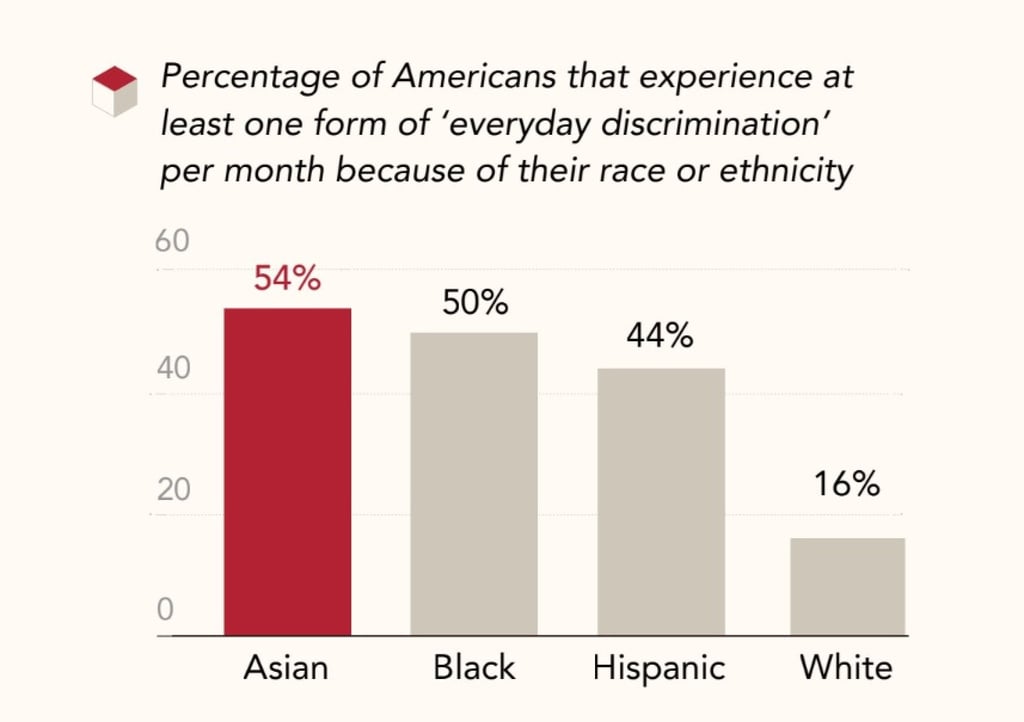
More than half of Asian-Americans living in the United States experience a form of bias that casts them as outsiders—no matter where they were born, how long their families have lived there, or how fluently they speak English.
Described as “assumed foreignness” or the “perpetual foreigner” stereotype, the phenomenon shows up in everyday interactions: being asked “how did you learn to speak English so well?” or “where are you really from?”—questions that subtly reinforce the idea that Asian-Americans don’t quite belong.
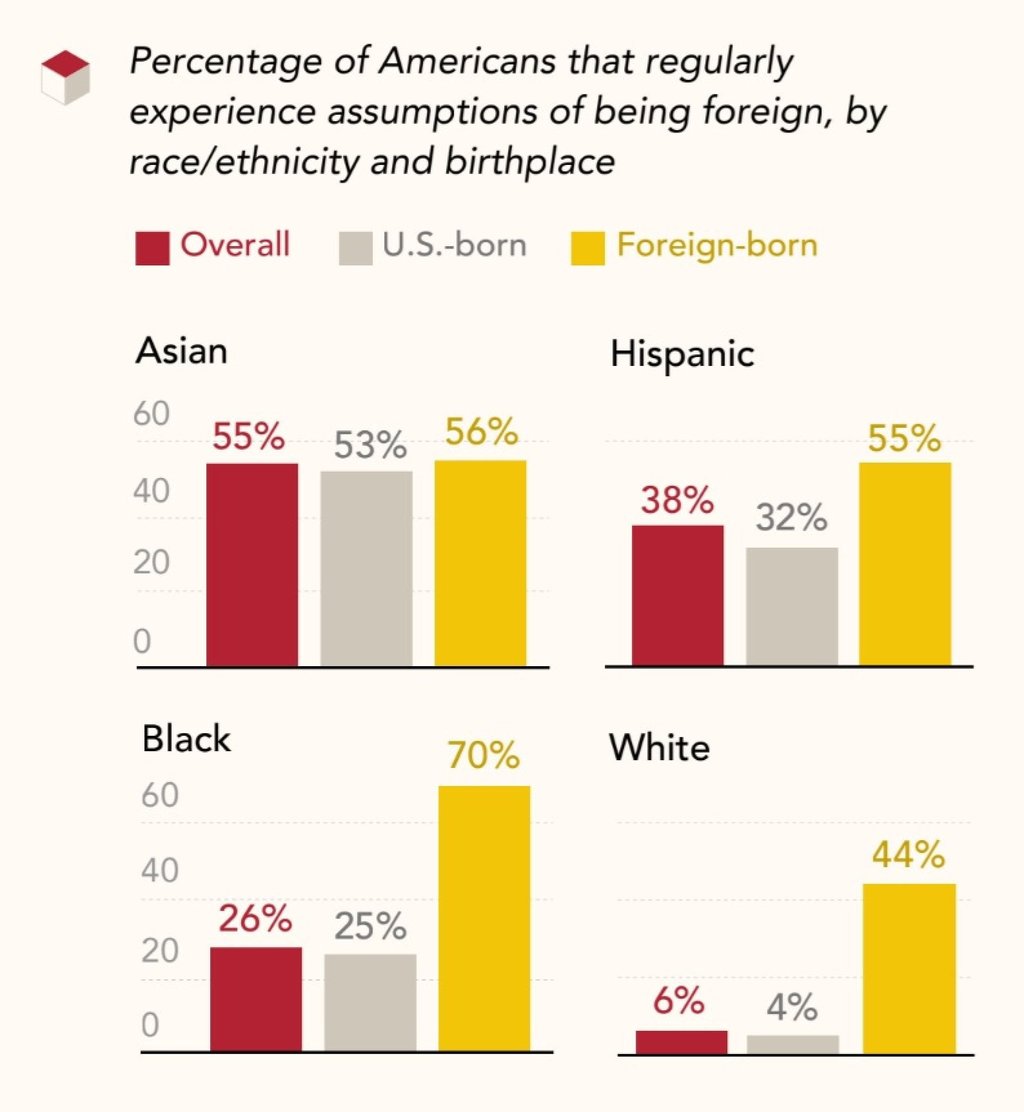
According to a study by the Committee of 100 and NORC at the University of Chicago, these experiences aren’t occasional—they’re routine. For many, they happen monthly. And crucially, they affect Asian-Americans almost equally whether they are immigrants or US-born, suggesting the bias is driven less by background and more by race and appearance.
“Asian-Americans are assumed to be foreign regardless of birthplace,” said Sam Collitt, a C100 social scientist and co-author of the study. “which is not as much the case with other groups,”
This kind of bias often flies under the radar. It’s subtle, sometimes even framed as curiosity. But its impact is cumulative.
Asian-Americans who reported being treated like foreigners experienced nearly twice the level of psychological stress compared to those who did not. Among US-born respondents who frequently face these assumptions, 29 per cent say they feel like they belong “a little” or “not at all”.
“Those who regularly encounter assumptions of being foreign-born or unable to speak English feel societally excluded at significantly higher rates,” the report said.
It’s not just about individual moments—it’s about what those moments reinforce: that no matter how fluent, how local, or how integrated you are, you’re still seen as coming from somewhere else.
The study also compared Asian-Americans with other racial groups, including Hispanic and Black communities. While discrimination was reported across the board, the type of bias differed.
Black Americans, for instance, often face more severe and systemic racism—but are less likely to be perceived as foreigners, even when they are recent immigrants. Hispanic and Asian communities reported similar levels of “foreignness” bias.
White Americans, meanwhile—even those who have just arrived in the US and do not speak English—rarely encounter the same assumptions.
The contrast is telling: for Asian-Americans, foreignness is not a status. It’s an identity imposed from the outside.
Read more: California Restaurant Forced to Remove “Stinky Tofu” After Neighbor Complaints
Like many Asian-Americans, US-born Tiffany Chin has faced her share of slights, including being treated as “other” or “foreign” and judged at times by her race rather than her accomplishments. Growing up outside Chicago, she recalls that in primary school her musical talents were attributed to her “Chinese genes”, and she was told, “you’re probably so good at maths because you’re Asian”.
And as an adult on a family trip to Florida, people gave her nasty looks when she went jogging, wondering what she was doing there, while non-Asians during the pandemic would cover their mouths or walk away when they saw her.
“I hadn’t even visited China in over a year,” said Chin, a 30-something Los Angeles-based manager in the recording industry. “But I was still treated as if I had personally been the one to bring Covid to the States.”
For others, the bias surfaces in more intimate spaces—like dating.
Matt King, a 34-year-old graphic designer in Brooklyn, said some of the times he would run into this most obviously was dating.
“I stopped using online dating apps, it was terrible, people just trolling,” said King, whose father is white and his mother’s side is from Hong Kong. “But people would say “I don’t date Asians” or “I don’t usually date Bruce Lee types but I could do it with you.’”
For many, the tension goes beyond how others see them—it shapes how they see themselves.
Despite growing up in an American suburb, Chin describes feeling caught between worlds. Her childhood was structured around both assimilation and expectation: piano and tennis lessons, weekly Chinese classes, and the pressure to excel academically. At the same time, she gravitated toward interests that didn’t neatly fit stereotypes.
“I was an Asian-looking face speaking accent-free English,” she said. “I still felt out of place in any group I was plopped in.”
“People would look at me as if I was a freak, and generally avoided wanting to play with me on the yard/playground.”
At 10, her family moved to Beijing, where the sense of dislocation followed her. There, she was technically a foreigner in international schools—despite looking and sounding like those around her. “I again felt out of place,” she said.
Even today, the assumptions haven’t disappeared—they’ve just evolved. Chin recalls meeting a relative of her husband’s, who is not Asian, and being told that her English is “very good”.
Read more: San Francisco Dedicates Street to Tien Fuh Wu, the Human Trafficking Survivor Who Saved Thousands
For many Asian-Americans, that moment is instantly recognisable.
Because the issue isn’t just the question itself—it’s what it implies. That no matter how long you’ve been there, how deeply rooted your life is, or how clearly you belong, there’s always a lingering doubt from others.
A quiet but persistent suggestion that you’re still, somehow, from somewhere else.