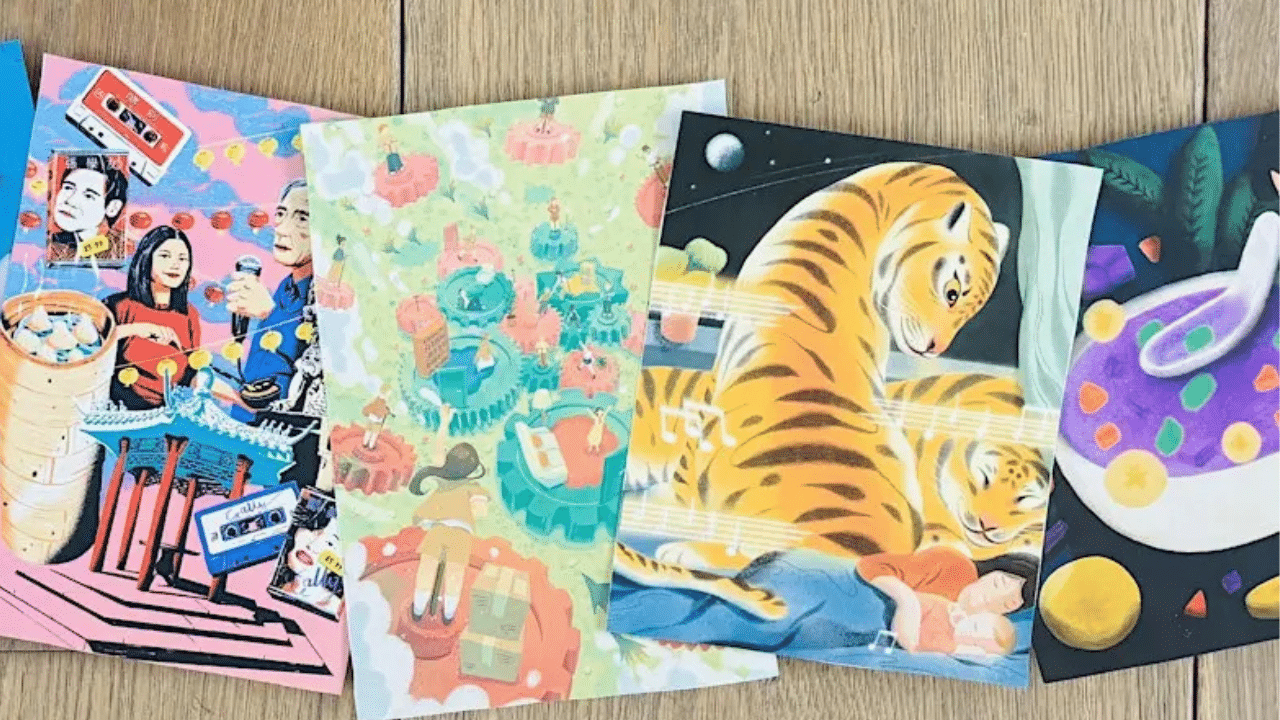
The Attic Bar at Picturehouse Hackney will play host to an event that felt less like a standard gallery opening and more like a quiet act of historical reclamation. The occasion was the launch of “Illustrating Golden,” an exhibition showcasing the visual contributions to Golden, a new limited-edition hardback annual dedicated to the British East and Southeast Asian (ESEA) experience. In a cultural landscape where ESEA voices have often been treated as a silent, uniform block, this collection of work functions as a deliberate, colourful disruption.
The exhibition, which moved from the printed page to the walls of Picturehouse Hackney on 21 March, features fifteen artists whose styles range from the strictly architectural to the wildly surreal. These are not just “illustrations” in the decorative sense; they are visual arguments for the complexity of a community that is often oversimplified. To walk through the show is to encounter a series of windows into different ways of seeing the world, mediated through the specificities of heritage, geography, and personal memory.
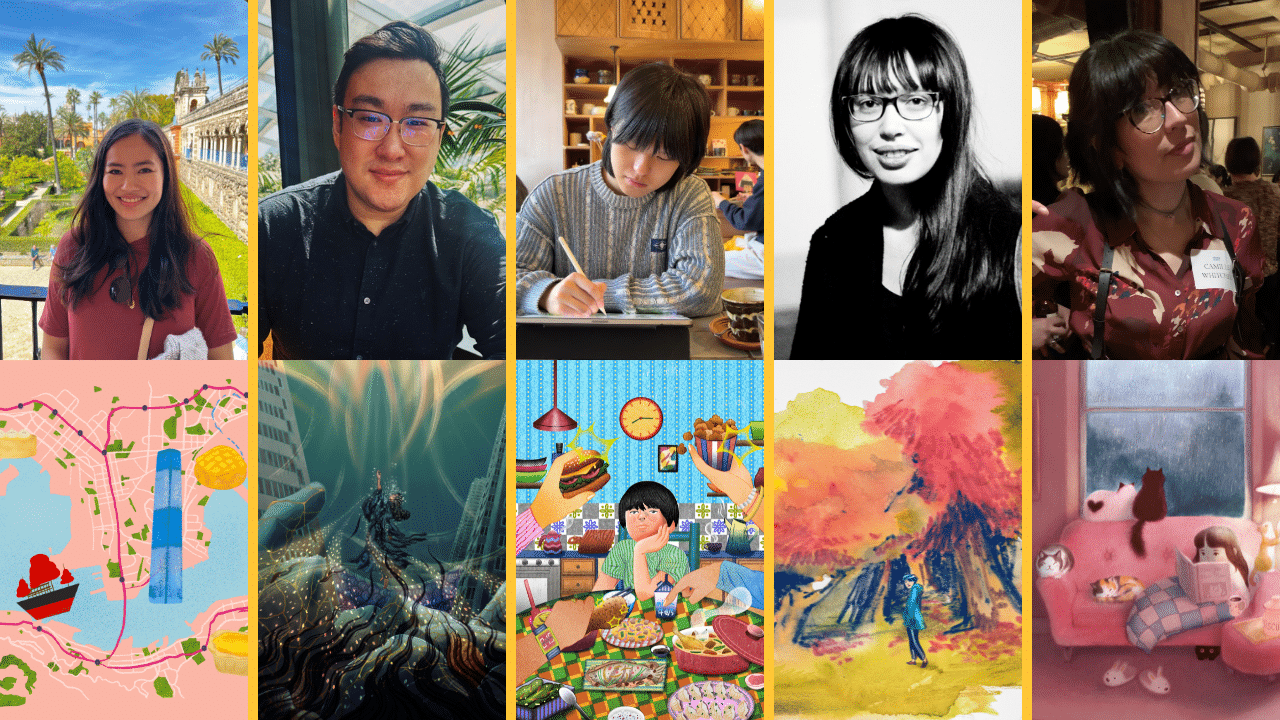
While the exhibition at Picturehouse Hackney celebrates the launch of Golden, it is worth noting that the specific works featured in the profiles below are drawn from the artists’ broader portfolios—offering a unique look at their personal styles that will remain unseen at the physical exhibition
This first part of our look at the exhibition profiles five of these artists: Lisa Ha, Jason Lyon, Oliver Li, Laura N-Tamara, and Camille Whitcher.
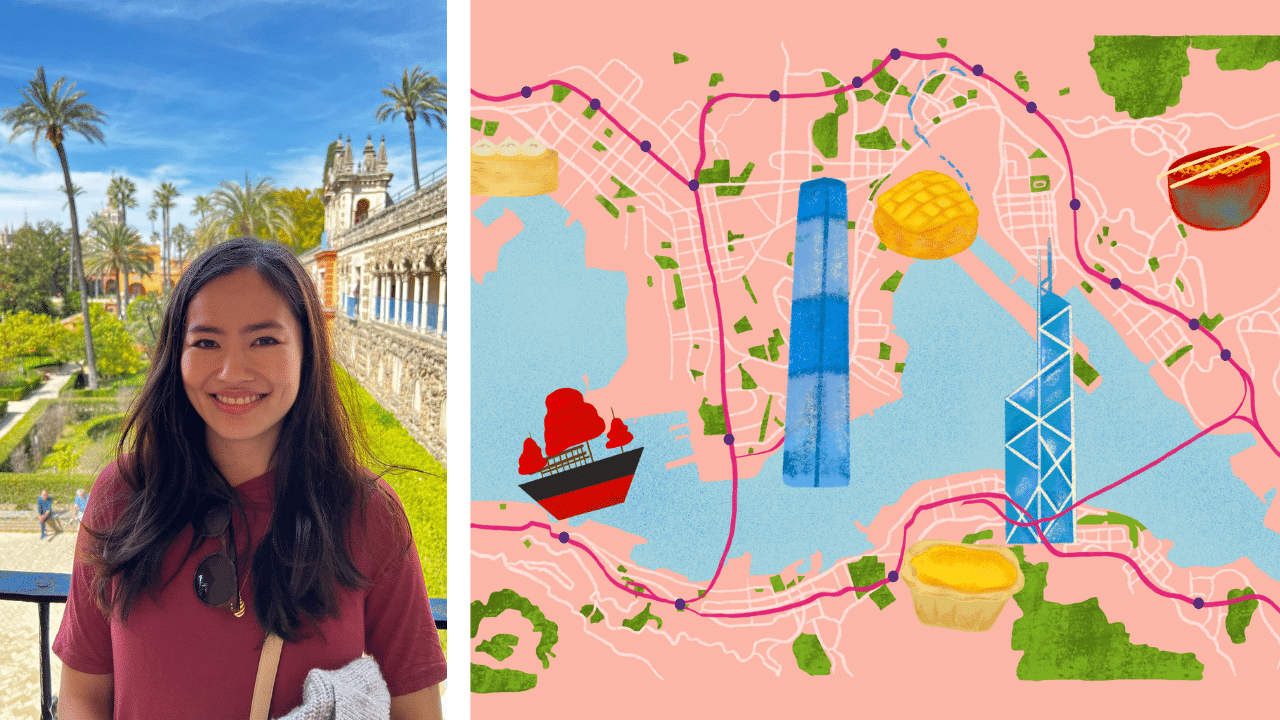
Lisa Ha: The Architecture of Whimsy
Lisa Ha’s work is defined by a sense of structured playfulness. With a background in urban design and architecture, she brings a disciplined eye for composition to subjects that are often surreal or dreamlike. Her contribution to Golden focuses on food, but not merely as sustenance. For Ha, food is a repository of history and a core element of human existence.
“I’ve always been a big dreamer, and for me, drawing and illustration became a primary form of expression,” Ha says. “I just loved the storytelling aspect of art—being able to communicate through colour, shape, light, and texture. Now, it has become a way for me to express complex thoughts or feelings through just a pen and a piece of paper.”
Read more: New Exhibition Features British ESEA Illustrators From Golden Magazine
Her style is a vibrant mix of the bold and the ironic. While her images are bright, they often contain a darker, parallel reality. “Reality can be quite bleak these days, so I like to submerge myself in a different reality—a parallel universe that might be better than our own. It’s a necessary break from the everyday.”
In her piece for the annual, Ha sought to elevate dishes that are sometimes marginalised in the Western culinary imagination. “I wanted the food to be the centerpiece, feeding into the historic and background elements that are pinnacle to these dishes. I wanted to acknowledge the history of these foods—some of which aren’t as common in the Western world—and celebrate them in a new light.”
For Ha, the work is always about three central pillars: people, places, and food. “Places provide context, and people provide connection—I’m fascinated by human behaviour. And food is life; it represents a certain ‘hunger’ or passion for existence. Without those three things, there isn’t much of a story to tell.”
You can view more of Lisa’s work on her Instagram at @LisaHa.draws
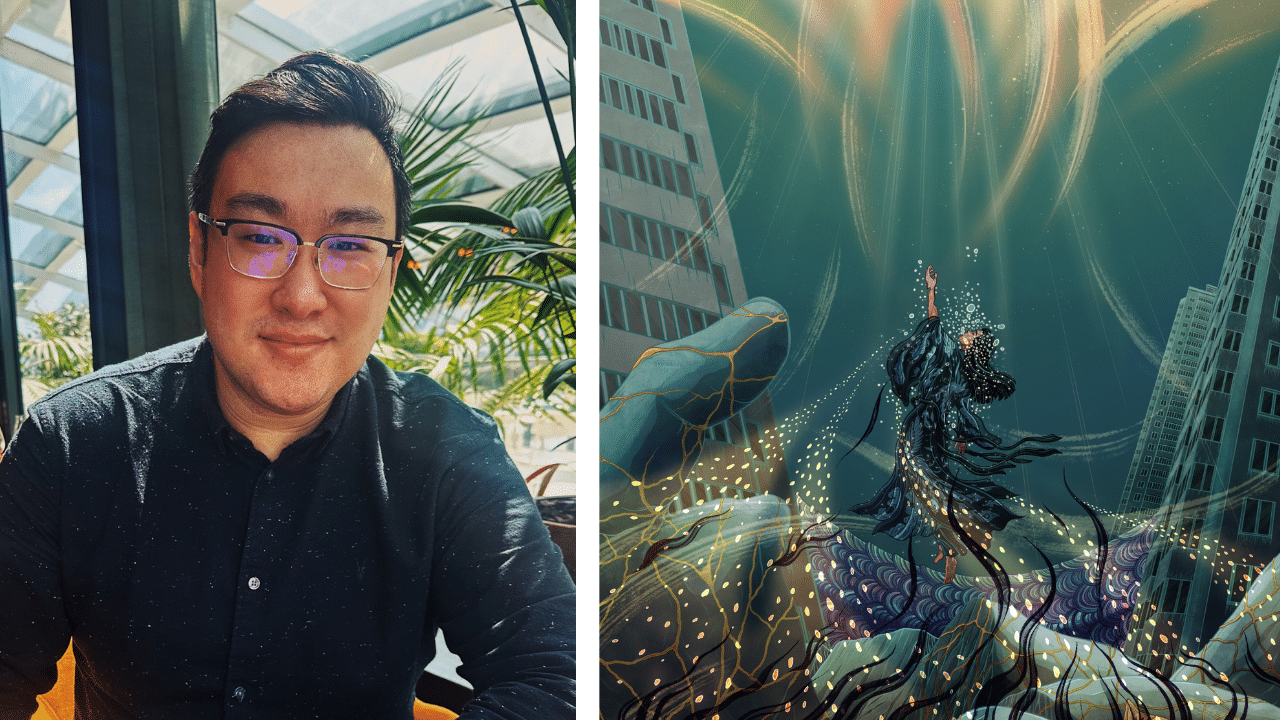
Jason Lyon: Banishers of Bad Vibes
Jason Lyon, a London-based illustrator born in China, creates work that feels like a high-velocity bridge between Eastern and Western visual traditions. His art is a riot of fluidity and line work, heavily influenced by traditional Chinese ink paintings and Japanese woodblock prints, yet filtered through the neon intensity of modern anime and manga.
Lyon’s piece for the exhibition is an interpretation of three major East Asian animation films: Ne Zha 2, Demon Slayer: Infinity Castle, and K-Pop Demon Hunter. “My piece is an interpretation of these three awesome characters banishing demons and ‘bad vibes’ from the world to create something new and beautiful,” Lyon explains. “I choose to illustrate things more vibrantly than they might be in real life just to heighten the beauty and ‘niceness’ of everything.”
Moving to the UK at age eleven, Lyon found art to be a “safe haven” from the rigours of more academic subjects. While his teenage years were marked by darker, more “doom and gloom” imagery, his adult work is intentionally hopeful. “I think I just have a different, happier outlook on life now,” he says. “Back then, art was basically just a way of venting.”
His process is one of digital obsession. Working on an iPad, he often redraws a single line five times until it feels right. This attention to detail is matched by a deep commitment to the ESEA creative community. “Since moving to London, I’ve felt a growing sense of community. Knowing there are more of us—not just creatives, but people in film, writers, and reviewers—makes a big city feel very warm. Knowing this exists makes me feel seen.”
Follow Jason’s latest projects and book covers on Instagram at @jasonlyon_.
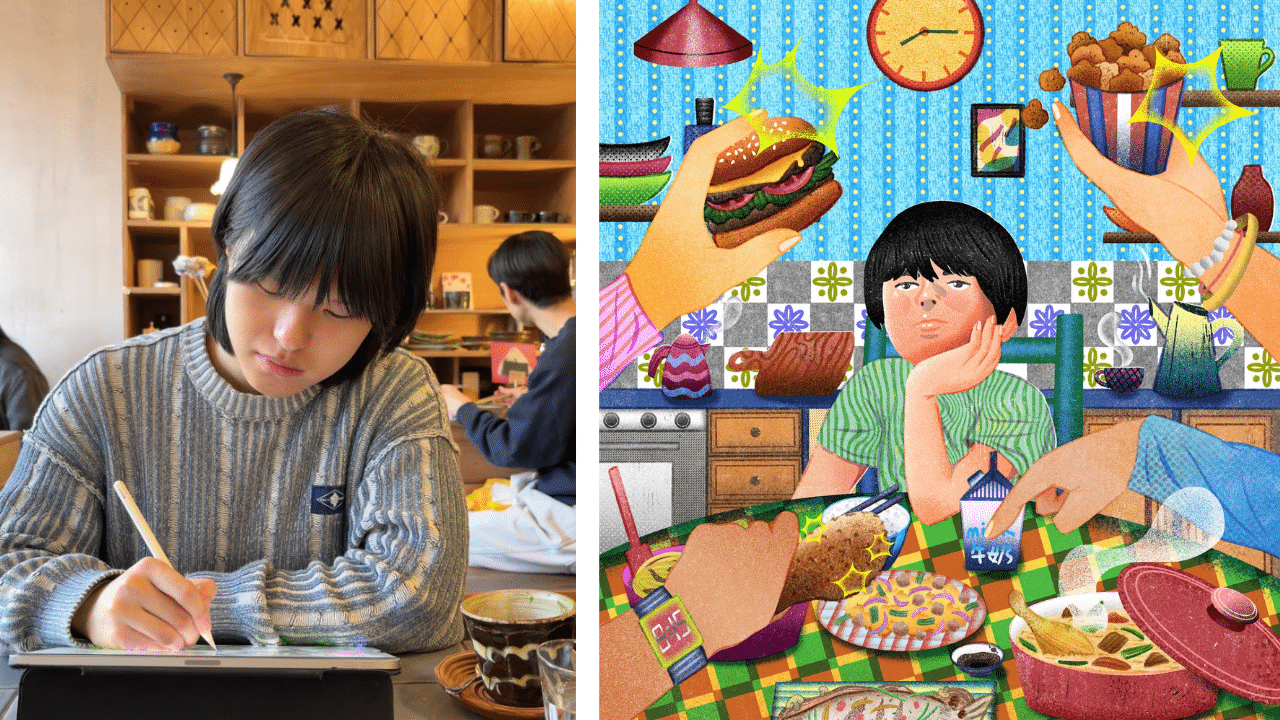
Oliver Li: The Joy of the Group
Originally from Shanghai and now based in Plymouth, Oliver Li describes his career as a “slow burn.” His work is distinctive for its heavy textures and flat, vibrant style. Unlike many artists who focus on the solitary figure, Li is drawn to groups: festivals, communities, and people doing things together.
“I just love creating things,” Li says. “I always liked bright colours and nice artwork. It feels so different when I’m actually doing it. It’s like something else—I feel a genuine need to create. It makes me really happy; it brings me joy.”
Li’s contribution to Golden was an illustration for an article about morkovcha, or “The Salad of Displacement.” It was a challenging brief—transforming a carrot salad into a visual metaphor for the immigrant experience. “The salad represents the author’s identity,” Li explains. “It represents the effort of moving everywhere over the years but never quite finding a place to call home. I felt the salad was a ‘safe space’ for her to go back to and rewind her experiences. That’s why I included a tiny character of the author carrying a suitcase, moving toward the salad.”
Living in a coastal city like Plymouth provides Li with a constant source of inspiration through nature, but his heart remains with the human connection. “I’ve never seen a project like this before,” he says of Golden. “I think it’s a very good thing to have right now, especially in a world that can feel quite anti-immigration. This project needed to be done.”
Check out Oliver’s unique textures and community-focused art on Instagram at @oliversonline667
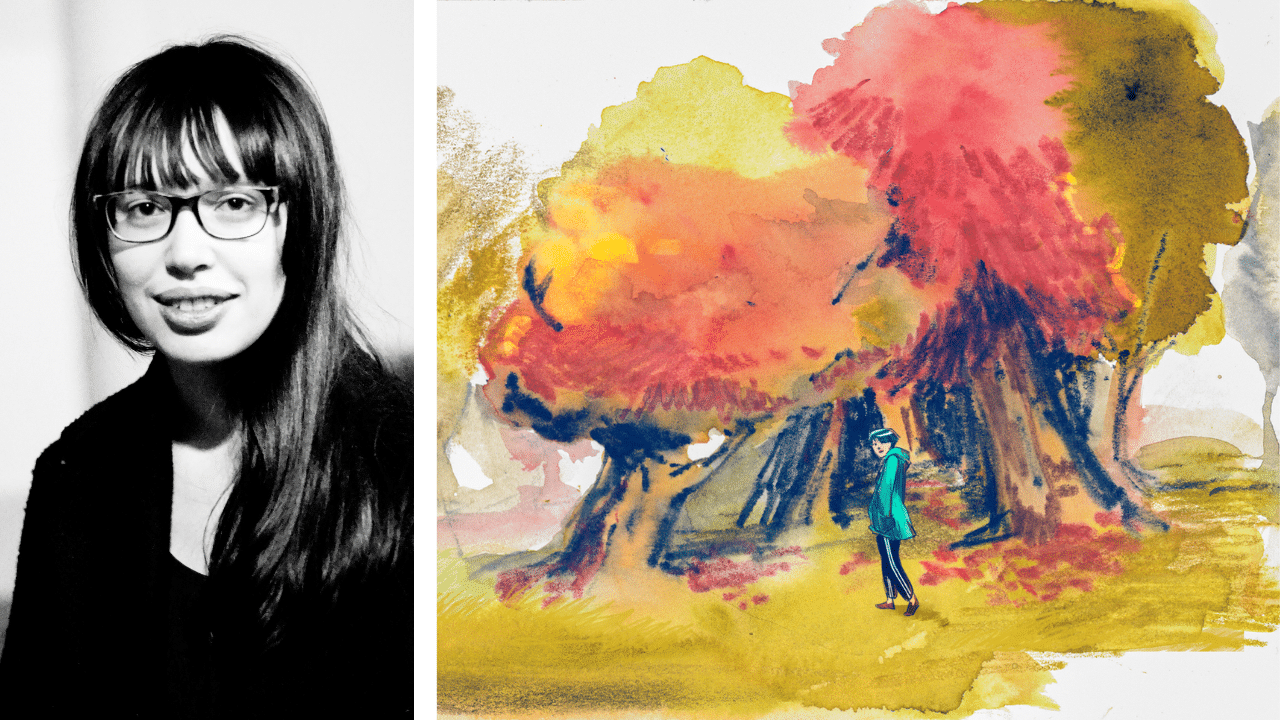
Laura N-Tamara: Reconciliation in the Frame
Laura N-Tamara is an award-winning animator whose work is an exercise in what she calls “reconciliation.” As a French-Indonesian artist, she uses her work to make different worlds coexist within a single frame—a visual encapsulation of the mixed-race experience.
“Filmmaking threw me into the deep end, but it made me realise how I can visually make very different things coexist within a single frame,” she says. “I think that encapsulates the mixed-race experience—even if I don’t talk about it directly—where you are reconciling two completely different worlds that are both part of your identity.”
N-Tamara’s technique is “Tradigital”—a blend of traditional hand-painted textures, primarily watercolours, with digital refinement. The process of watercolour, she explains, is one of managed chaos. “You’re managing how fast the water dries and wondering if the next colour you add will ruin the piece or make it incredible. There is a bit of preparation, followed by a moment of pure fear and joy when you’re actually painting.”
Her pieces for the exhibition illustrate themes of nature and activism. Ginkgo Biloba depicts an ancient, flourishing tree, while Koi shows a fish leaping into a wind farm, capturing the tension between awe and extraction. For N-Tamara, the physical act of making art is a necessary counter to the rise of AI. “Animation is a time-consuming, repetitive process. I think there is something beautiful about having a craft that you dedicate your time to. I think of the hand as a ‘second brain.’ When you are physically engaged in the process, it unlocks new ways of thinking.”
Explore Laura’s animations and watercolour work at laura-ntamara.com.
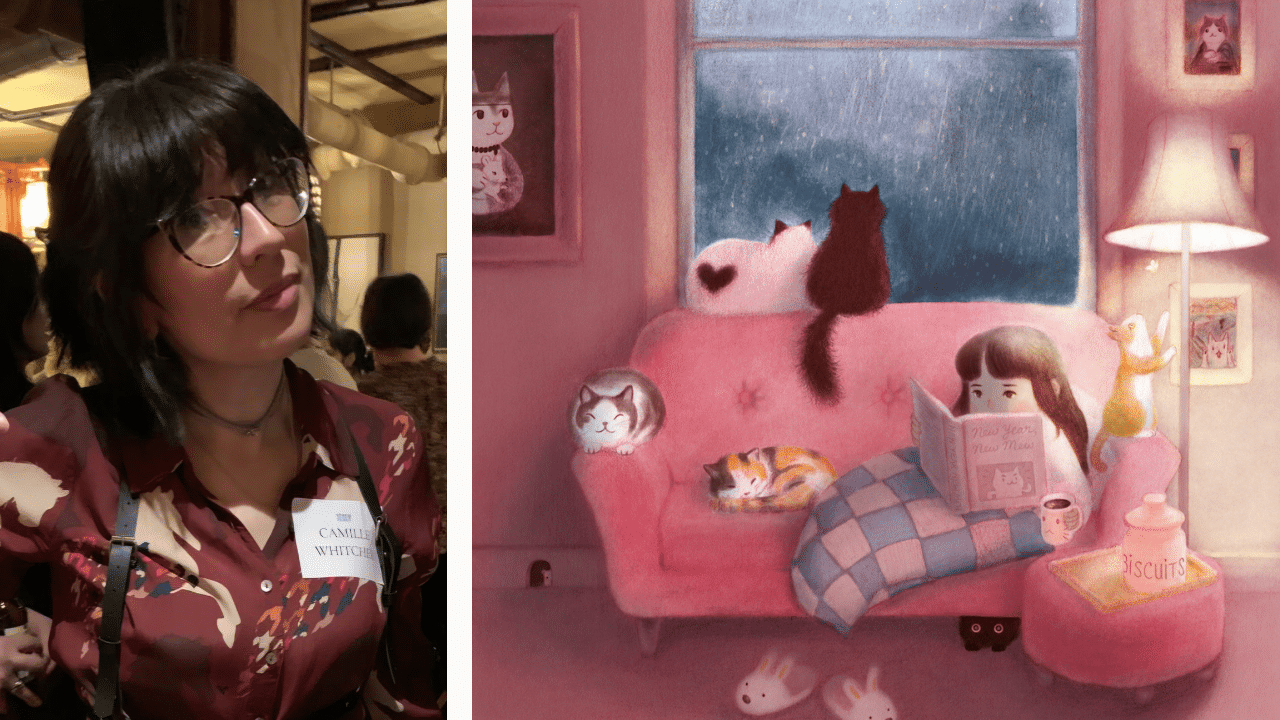
Camille Whitcher: The Daydreamer’s Wildlife
Camille Whitcher’s path to illustration was “twisty-turny.” After a period of disillusionment with art school, she moved to Japan for five years. It was the visual richness of Japanese packaging and children’s books that reignited her desire to draw.
“In Japan, I noticed that so much general stuff gets illustrated,” Whitcher recalls. “Everything is very design-led, illustration-led, or art-led. I went to an exhibition of children’s book illustrations out there and thought, ‘Oh, that looks really cool.'”
Her style is dreamlike and wildlife-focused, characterized by a love of pinks, aquamarines, and soft, warm palettes. Her piece for the annual, featuring a nightjar and magnolias, was created under a tight deadline, which she believes helped the final result. “I didn’t have to think. I just went with it. I was a lot freer. I love drawing birds and wildlife. The colours are chosen because they make me feel nice.”
Whitcher is a self-described daydreamer who prefers the quiet of her own head to drawing from life in public. Her work is a testament to the power of perseverance over raw talent. “I feel AI negates the hard work creators put in. Some people say, ‘I don’t have your talent,’ but it isn’t just talent. It’s perseverance. It’s hours and hours of hard work. I’ve improved because I worked at it for 20 years. AI is just lazy. It’s theft.”
You can see Camille’s dreamlike illustrations and portfolio at camillewhitcher.co.uk
“Illustrating Golden” runs until 26 April at Picturehouse Hackney. It is a rare opportunity to see the visual language of the British ESEA community celebrated with the permanence and weight it deserves. These five artists, through their various “twisty-turny” paths, have contributed to a record that is not just a reflection of where the community has been, but a vibrant indicator of where it is going.
Grab your free ticket now to join us at the Attic Bar this Saturday, March 21, for a celebratory drink and an exclusive look at the ESEA talent featured in Golden.