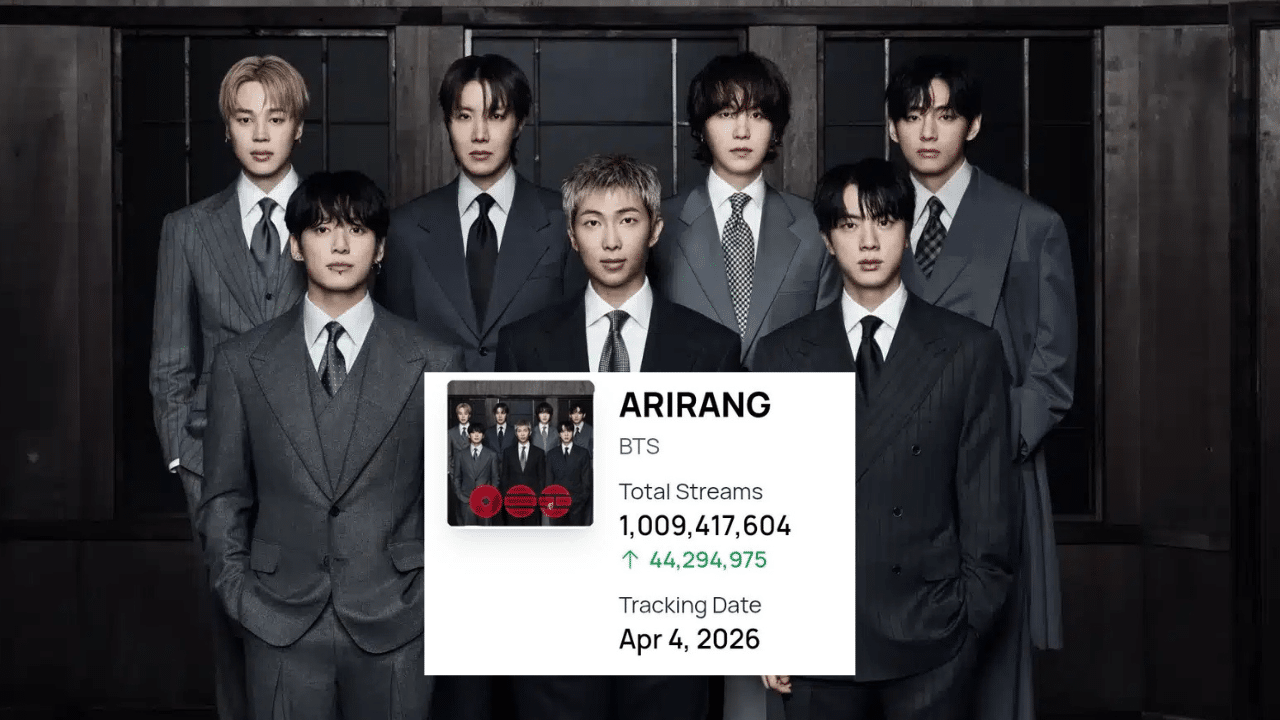
The commercial return of BTS has moved from a successful debut to a sustained cultural event. This week, the group’s fifth full-length album, Arirang, officially surpassed one billion streams on Spotify, achieving the feat with remarkable speed. The milestone arrives as the album enjoys its second week at No. 1 on the Billboard 200, making it the longest-running chart-leader of the group’s career.
While the album’s opening week was defined by massive physical sales and “Army” fervor, its second-week performance—earning 187,000 equivalent album units—suggests a reach that extends far beyond a dedicated core. Spotify data indicates that on the day of the album’s release, new listeners discovering the band surged by nearly seven hundred percent.
Read more: BTS Returns To No. 1 On The Billboard 200 With Record Sales For Arirang
The scale of Arirang was established long before it reached the public. The group utilized large-scale songwriting camps in the United States, a traditional Western pop production model that has become increasingly rare due to high costs. These sessions brought together heavyweights like Ryan Tedder and Diplo, resulting in hundreds of demo tracks that were eventually distilled into the final fourteen-song tracklist.
This collaborative intensity was captured in the Netflix documentary BTS: The Return. Industry analysts suggest that this “revival” of the songwriting camp format underscores K-pop’s current position as a central, stabilizing force in the global music market.
Exporting Everyday Culture
The album is notable not just for its production value, but for its specific focus on Korean identity. Tracks such as “Body to Body” and “No. 29” incorporate the melodies of traditional folk music and the resonant tones of the Sacred Bell of King Seongdeok.
This cultural exchange has spilled over into the group’s public appearances. During a recent visit to The Tonight Show Starring Jimmy Fallon, the members shared the Korean custom of indoor slippers with the host. At a performance at the Guggenheim Museum, the audience was seated on traditional floor cushions. By focusing on these modern, everyday aspects of Korean life, the group has moved away from merely adapting to Western standards, choosing instead to export a specific cultural identity.
Read more: ‘Tonight Show’ Warm-Up Act Apologizes To BTS For North Korea Joke
For years, BTS has been the primary case study for the “fandom economy,” where high engagement from a specific group drives commercial success. However, Big Hit Music chairman Bang Si-hyuk has signaled a shift in strategy. He described this new era as one where the group becomes a “globally popular destination” that people want to experience regardless of their level of prior devotion.
The numbers for the lead single, “Swim,” support this “destination” theory. The track recorded 14.6 million streams on its first day, significantly outperforming the group’s previous English-language hits like “Butter” and “Dynamite.” By combining high-level global collaboration with unyielding cultural specificity, Arirang appears to be a new blueprint for how international artists can dominate the mainstream.