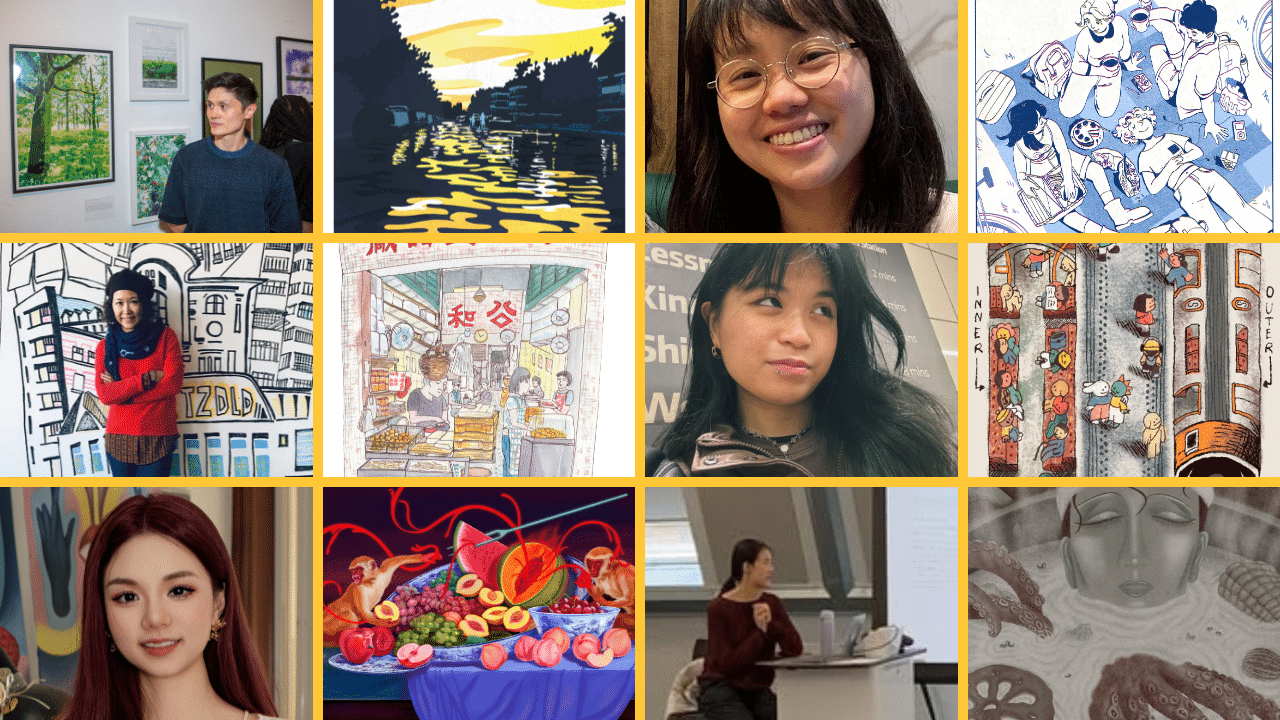
In the first part of this feature, we explored how a group of illustrators used the launch of Golden magazine to challenge the idea of the East and Southeast Asian (ESEA) community as a silent monolith. That conversation continues at Picturehouse Hackney, where the exhibition “Illustrating Golden” brings the visual contributions of the inaugural annual to a wider public. If the first volume of the magazine was a cultural time capsule, this exhibition is the unpacking of that capsule, revealing the specific, often divergent ways ESEA creatives are documenting their lives in Britain.
The artists in this second selection move between the deeply personal and the overtly political. They use everything from soup recipes to Palestinian flora to explore what it means to belong to a diaspora that is constantly in flux. By taking these images off the page and onto the gallery wall, the exhibition asks the viewer to slow down and look at the intricate details of ESEA identity that are often lost in digital feeds.
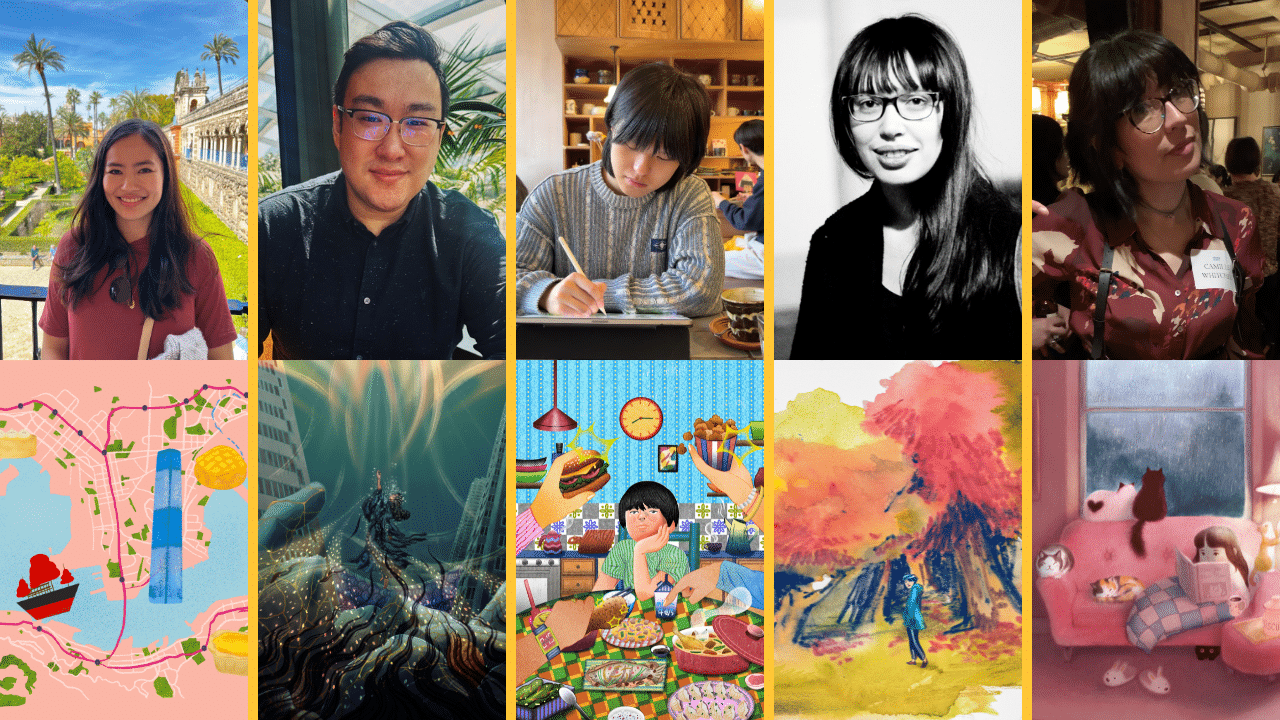
To provide a deeper look at their creative journeys, we have profiled six additional artists below. Please note that the works featured in this article are highlights from the artists’ personal portfolios; these specific pieces are “unseen” at the Hackney exhibition, which features their exclusive contributions to the Golden annual.
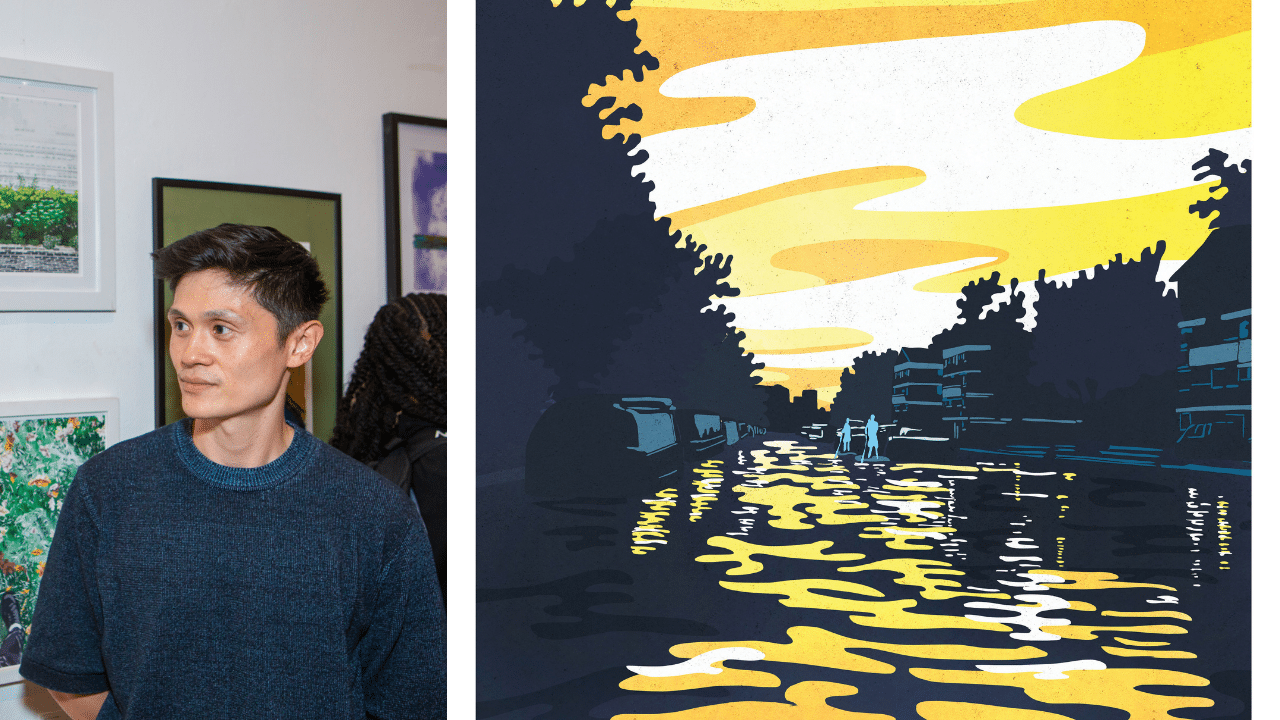
Ken On Martin Lee: Symbolism as a Calling Card
Ken On Martin Lee is a landscape architect by profession, a background that informs his meticulous approach to space and form. Based in South London, his work shifted during the lockdown as he began “beautifying” local green spaces through digital illustration. More recently, however, his art has taken a turn toward the linguistic and the political.
“I speak Cantonese at home, but I can’t read or write it,” Lee explains. “That realisation started a journey of producing art as a way to link back to my heritage.” This personal quest for literacy has merged with a growing political awareness. His piece for Golden is a departure from his usual landscapes, focusing instead on themes of global solidarity.
“I wanted to create something that related to my identity and spoke to others with a similar background,” Lee says. “There is an intersection between that identity and current global events—whether it’s the rise of Reform in the UK or the situations in Gaza, Lebanon, and Iran. It all converged into a feeling that I needed to express something about it.”
His illustration uses flora native to Palestine, incorporating patterns found in the keffiyeh. It is a quiet but firm statement of resistance. “When I’ve attended rallies in central London, I’ve noticed a lack of East Asian supporters in the crowd. That sense of apathy drove me to produce this. This is my ‘calling card’ to say that there are people standing with these causes.”
You can find Martin’s work on Instagram at @penonlee.
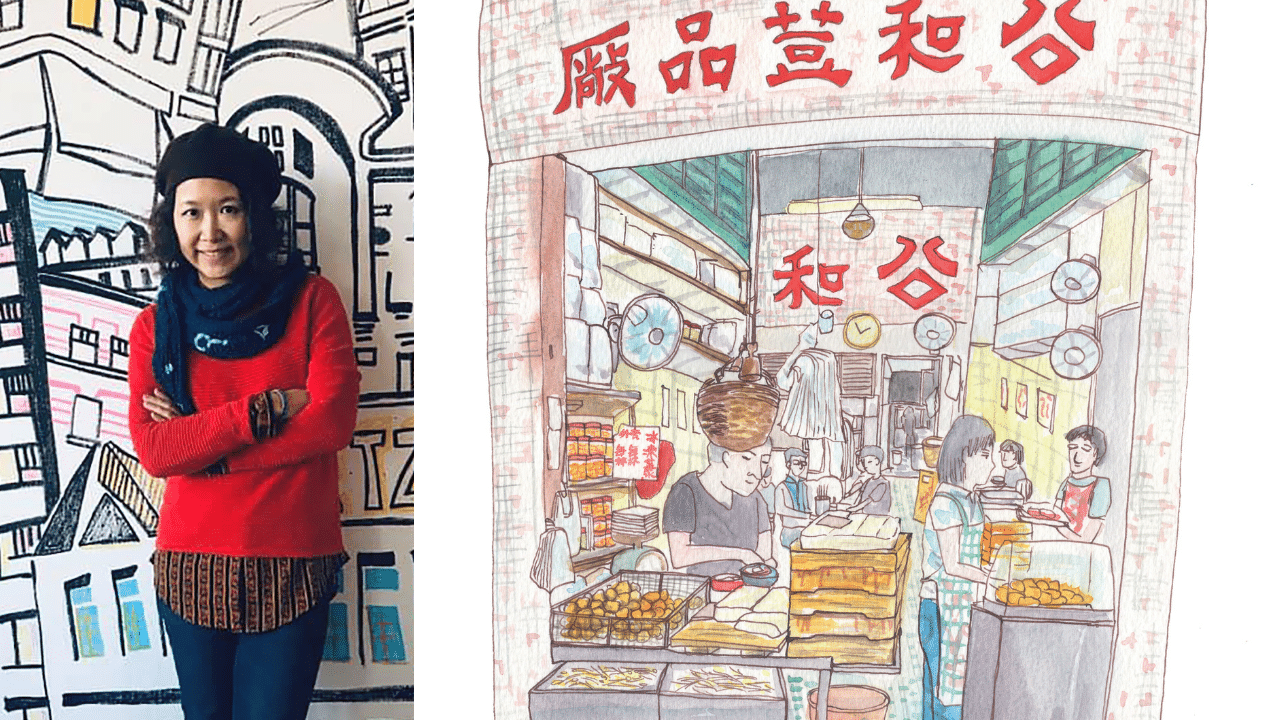
Alison Hui: The Human Touch of the Cityscape
Alison Hui is relatively new to the UK, having spent most of her life in Hong Kong. For her, contributing to Golden was a way to anchor herself in a new creative community. “I am still relatively new to the UK, so I am trying to build my connections with the group,” she says. “I think this is a good way for me to achieve those two key points: contributing to the group and building my own connections.”
Hui’s work blends research, writing, and illustration. She has a particular interest in “boring” history, which she makes accessible through fountain pen outlines and watercolours. “I love the ‘human touch’ of it—the way the water runs through the paper and the colours mix to create surprises. I want to keep those ‘imperfect’ effects.”
Her contribution to the magazine focuses on the cultural history of milk tea, a beverage she sees as a universal connector. “Since arriving here, I’ve realised that milk tea is a common ground that connects many different groups,” she explains. “It isn’t just for ESEA groups; it connects basically everybody. Whenever I meet people here, regardless of their background, if we talk about milk tea culture, they find it relevant and we can talk for hours.”
For Hui, being part of the exhibition is a validation of her self-taught path. “I don’t have any institutional training; I just kept drawing what I liked. So, being included in the exhibition means a lot. It makes me feel like I am truly part of the creative world here.”
Browse Alison’s visual diaries and work at alisonhui.com and her instagram page a.h.inkpen
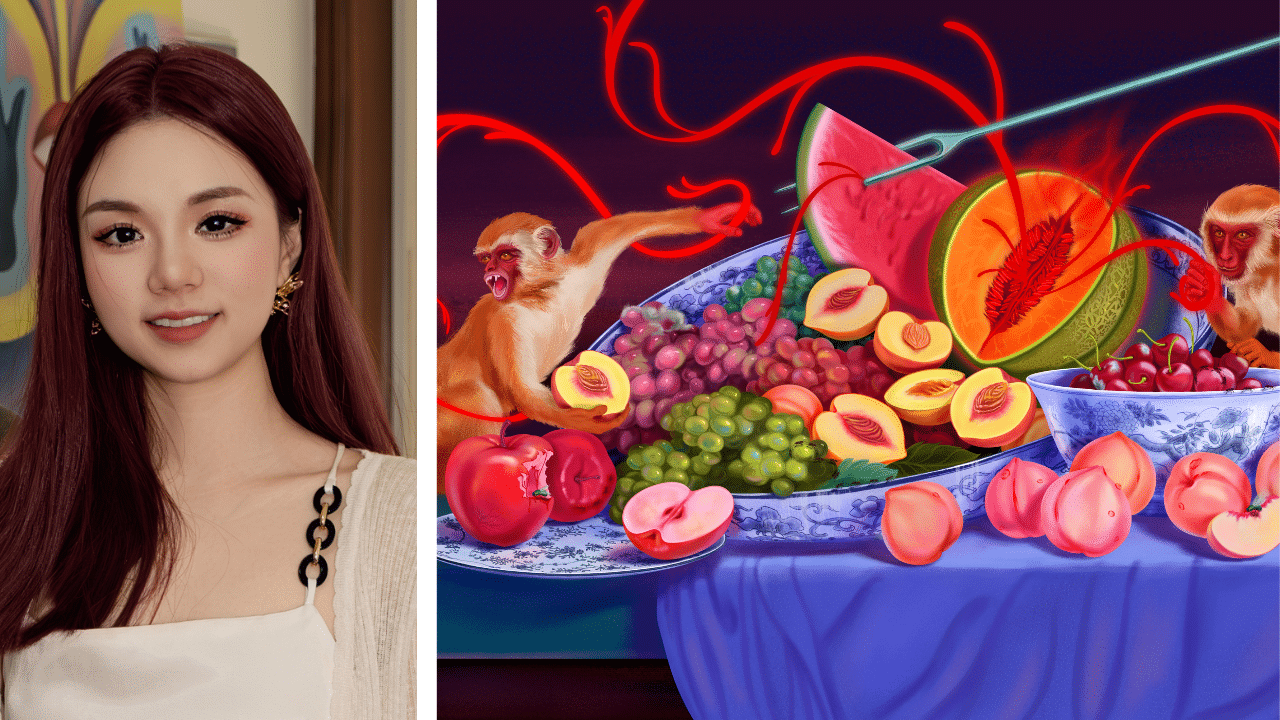
Scarlett Yang: The Power of Obscurity
Scarlett Yang is a book cover designer and illustrator whose work is defined by duality. She explores the space between beauty and ugliness, light and darkness. Her style is surreal and metaphorical, often requiring the viewer to look beyond the surface to find a deeper social reflection.
“As a Chinese woman, you face many standards and pressures in traditional Chinese society,” Yang says. “I want to create female figures that feel beautiful but have something powerful behind the image. It isn’t meant to be ‘scary’ for the sake of it, but rather to convey strength.”
Her illustration for Golden, titled Golden Era: Rising Hospitality, features a golden vinyl record growing into a Bodhi tree inside a sealed fish tank. It is a commentary on the fragility of cultural visibility. “For me, this symbolises cultural success and visibility, but also a sense of containment,” she explains. “Outside the glass, I introduced flames and distant, ominous shadows to suggest a hostile environment where celebration and vulnerability exist at the same time.”
Yang finds inspiration in movies and literature, preferring “things that aren’t too straightforward.” Her work is a reminder that ESEA identity is not a simple narrative but a layered experience of struggle and resilience. “I prefer to leave space for the audience to enter the narrative from their own perspective.”
See Scarlett’s surreal book covers and editorial illustrations on Instagram at scarlettyang.ig
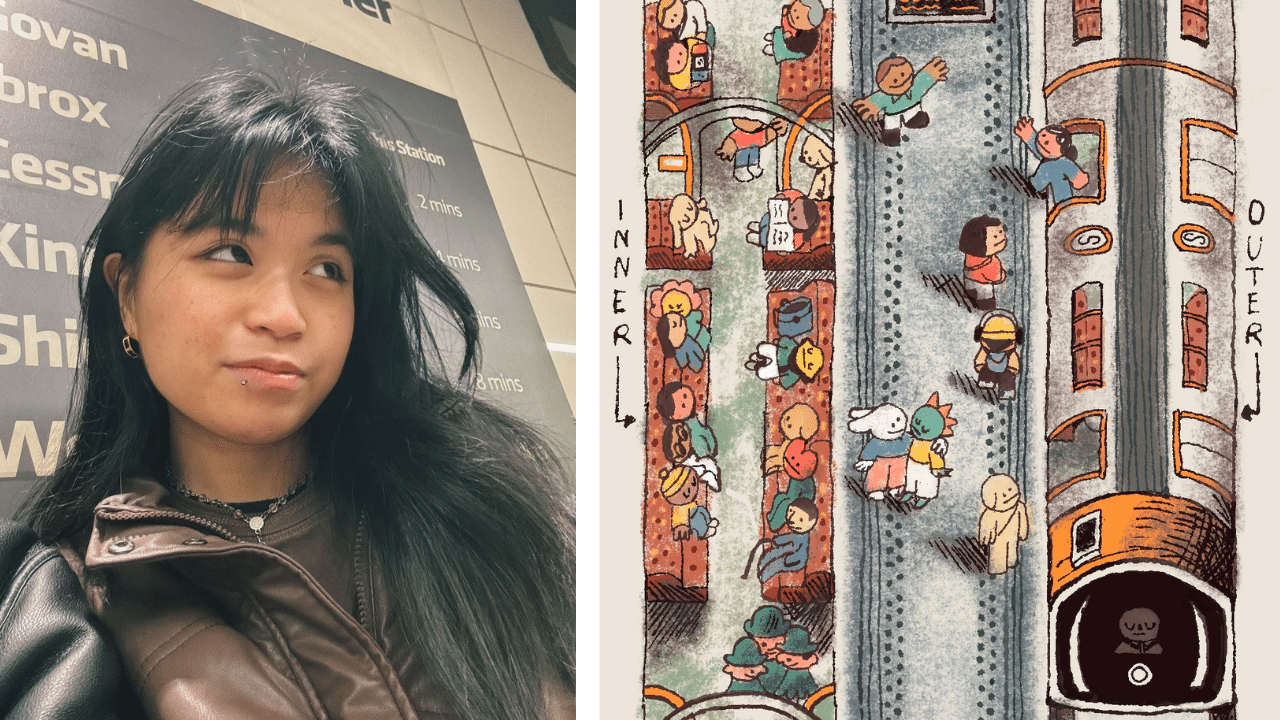
Jillian Mendoza: Capturing the Energy of Celebration
Based in Glasgow, Jillian Mendoza brings a playful, “cartoon-head” energy to the exhibition. Her work is heavily influenced by video game art and classic American comic strips like Calvin and Hobbes. “Other people often say my work is innocent and joyful,” she says. “It takes a lot of influence from video game art and cartoons; it’s just something very playful, innocent, and cute.”
Mendoza was born in the Philippines and moved to Scotland as a child. Her piece for Golden was a collaboration with ESEA Creatives, a network supporting artists in Scotland. She was tasked with capturing the essence of their Liquid Identities Festival. “Since I wasn’t at the festival in person, I had to use my imagination to capture the likeness of the people and the essence of what ESEA represents,” she notes. “My job as an illustrator was to capture the energy of that celebration.”
Her process is low-key and tactile, starting with “scribbles” in a sketchbook before moving to digital finalisation. For Mendoza, the exhibition is about finding a sense of belonging. “It’s about being part of a group of people who likely have similar lived experiences—being a Southeast Asian creative living in the UK. It feels nice to be part of a community where I feel seen and where we can relate to each other.”
View Jillian’s playful and energetic illustrations on Instagram at ohmendonka
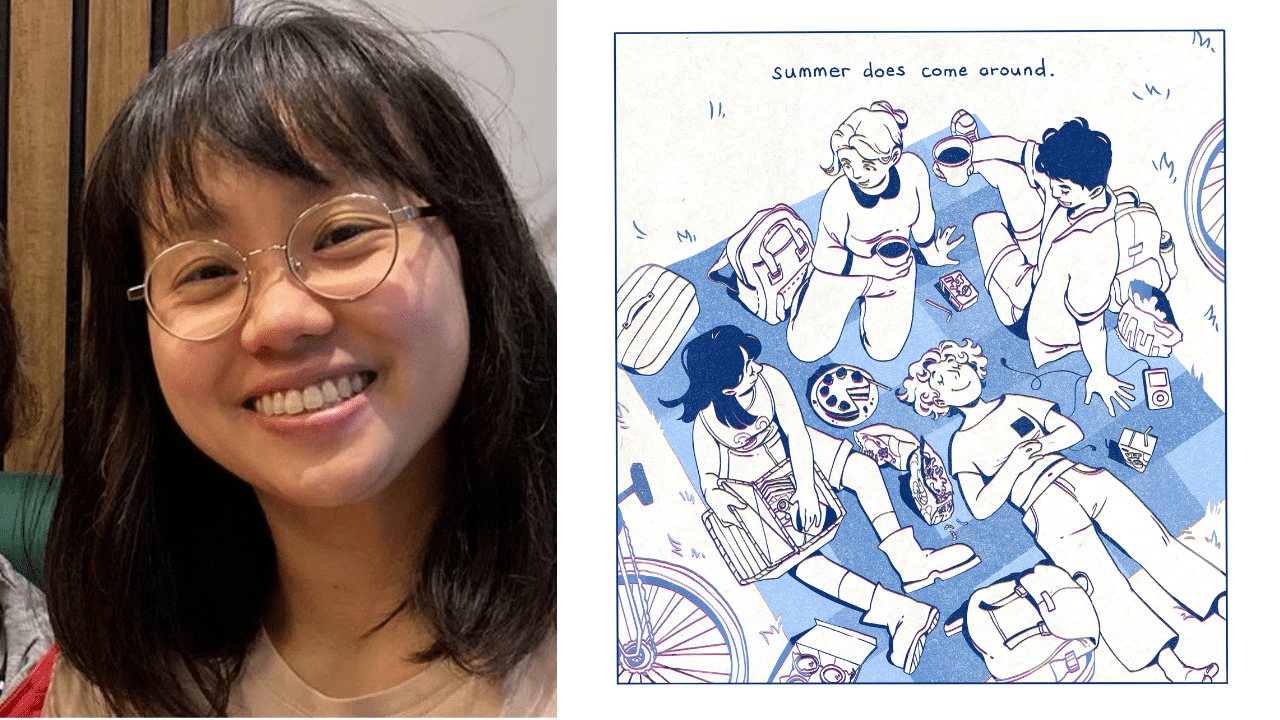
Vicky Lee: The Weight of Memory
Vicky Lee is an animator living in Essex whose work examines the intersections of personal and collective memory. Like many ESEA artists, she had to pursue her passion outside the “traditional” academic paths encouraged by her parents. “I had to put my dreams on hold until I could be independent enough to pursue them without needing my parents’ help,” she says.
Her illustration for Golden accompanies a short story titled A Glass of Memories, which explores the trauma of the Hong Kong diaspora. “Many of us in the Hong Kong diaspora are physically elsewhere, but we are still stuck in memory or trauma. It defines the rest of our lives,” Lee explains.
The piece is set in a Bing Sutt, a traditional Hong Kong café, and uses specific colours and textures to evoke nostalgia. “I really wanted to get the tiling in because it’s so iconic. Even without reading the text, the tiling makes you think, ‘That’s Hong Kong.'” She painted the protagonist in desaturated colours to show a loss of vitality, a man literally stuck in the past.
“I liked that art was mine,” she says of her journey. “It allows you to get out of your own head, be observant, and slow down. You realise you’re living in a world where everyone else is also living in their own little ‘worlds.'”
Check out Vicky’s observations on time and memory on Instagram at svickerdoodles
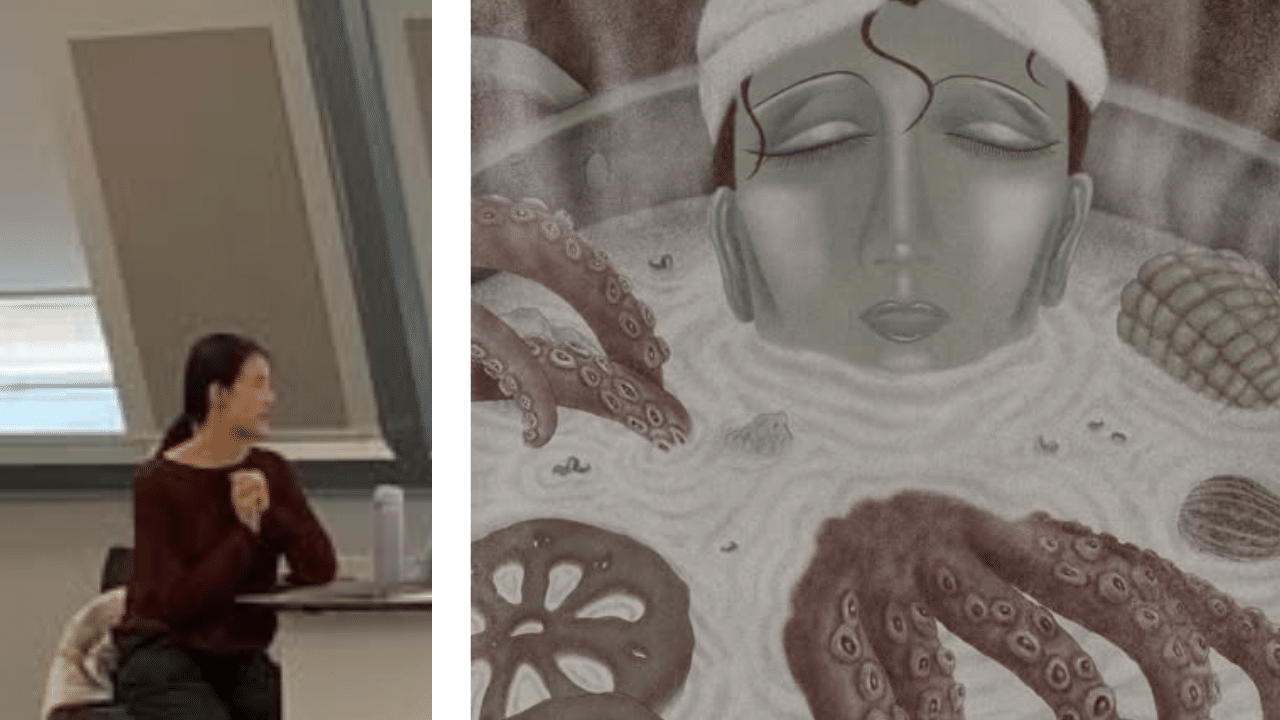
Ann Man Hei Wong: The Visual Storyteller
Ann Man Hei Wong describes herself as a visual storyteller. Her work moves between illustration, animation, and puppet-making, exploring themes of migration and urban life. Having moved to London from Hong Kong three years ago, she used her contribution to Golden to process the disorientation of her new environment.
Her personal essay and accompanying illustrations focus on an obsession with home-cooked soup. “I wanted something to connect my past, present, and future,” Wong says. “I want to hold on to my cultural heritage and my family life in Hong Kong, but I also need something to help me adapt to the cold weather here, the loneliness, and the disorientation.”
Wong’s style in this piece is a departure from her puppet-making, using digital tools to imitate the tactile feeling of pencils and crayons. “I used darker colours to convey a contemplative mood. I also tried to convey a sense of ‘muddiness’—that feeling of being stuck or being unclear about things.”
For Wong, the exhibition is an answer to the isolation of the creative process. “Being part of Golden makes it clear that there are people interested in what our community writes and draws. It also means being connected to a community of like-minded people who look similar, speak in a similar way, and are willing to commit to such a big project.”
You can find more of Ann’s visual storytelling and upcoming graphic novel work on Instagram at annwong.art
“Illustrating Golden” is more than a display of technical skill; it is a collective act of documentation. As these artists map their heritage and resistance onto the walls of Picturehouse Hackney, they offer a vision of British life that is as complex as it is vibrant.
Experience the full “Illustrating Golden” collection in person at Picturehouse Hackney until April 26.
To celebrate the ESEA talent from our community, join us for a drinks reception at the Attic Bar on Saturday, March 21—tickets are free and include a complimentary drink! Click here for tickets