The Olympics are often framed as a rare pause from the world’s conflicts — a place where competition replaces politics, and national rivalries are distilled into sport. But at this year’s Winter Games, that separation feels increasingly fragile.
What began as a question posed to freestyle skier Hunter Hess about representing the United States has escalated into a broader conversation about identity, dissent, and what athletes owe the flag they compete under.
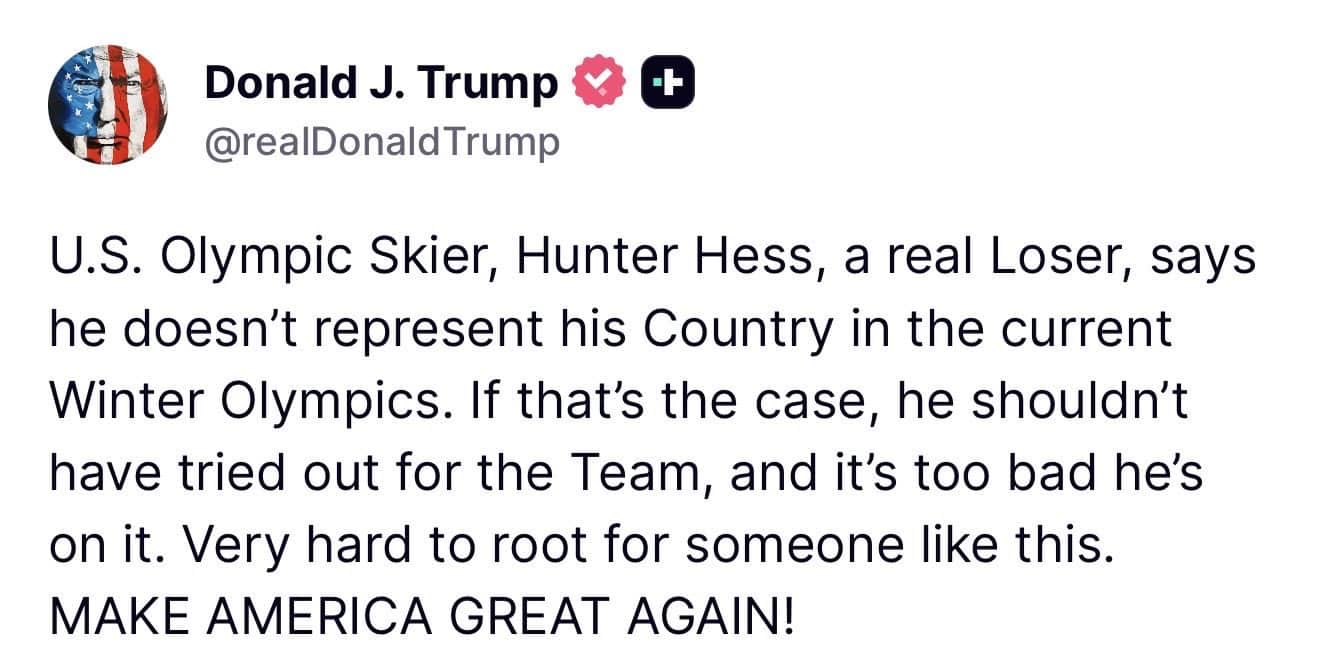
After President Donald Trump publicly criticised Hess on social media, calling him “a real loser,” the political undertones of the Games came sharply into focus.
“U.S. Olympic Skier, Hunter Hess, a real Loser, says he doesn’t represent his Country in the current Winter Olympics. If that’s the case, he shouldn’t have tried out for the Team, and it’s too bad he’s on it. Very hard to root for someone like this. MAKE AMERICA GREAT AGAIN!” Trump posted on Truth Social on Sunday.
Now, some of the most recognisable faces of this Winter Olympics are responding — not with slogans or counterattacks, but with calls for empathy, unity, and perspective.
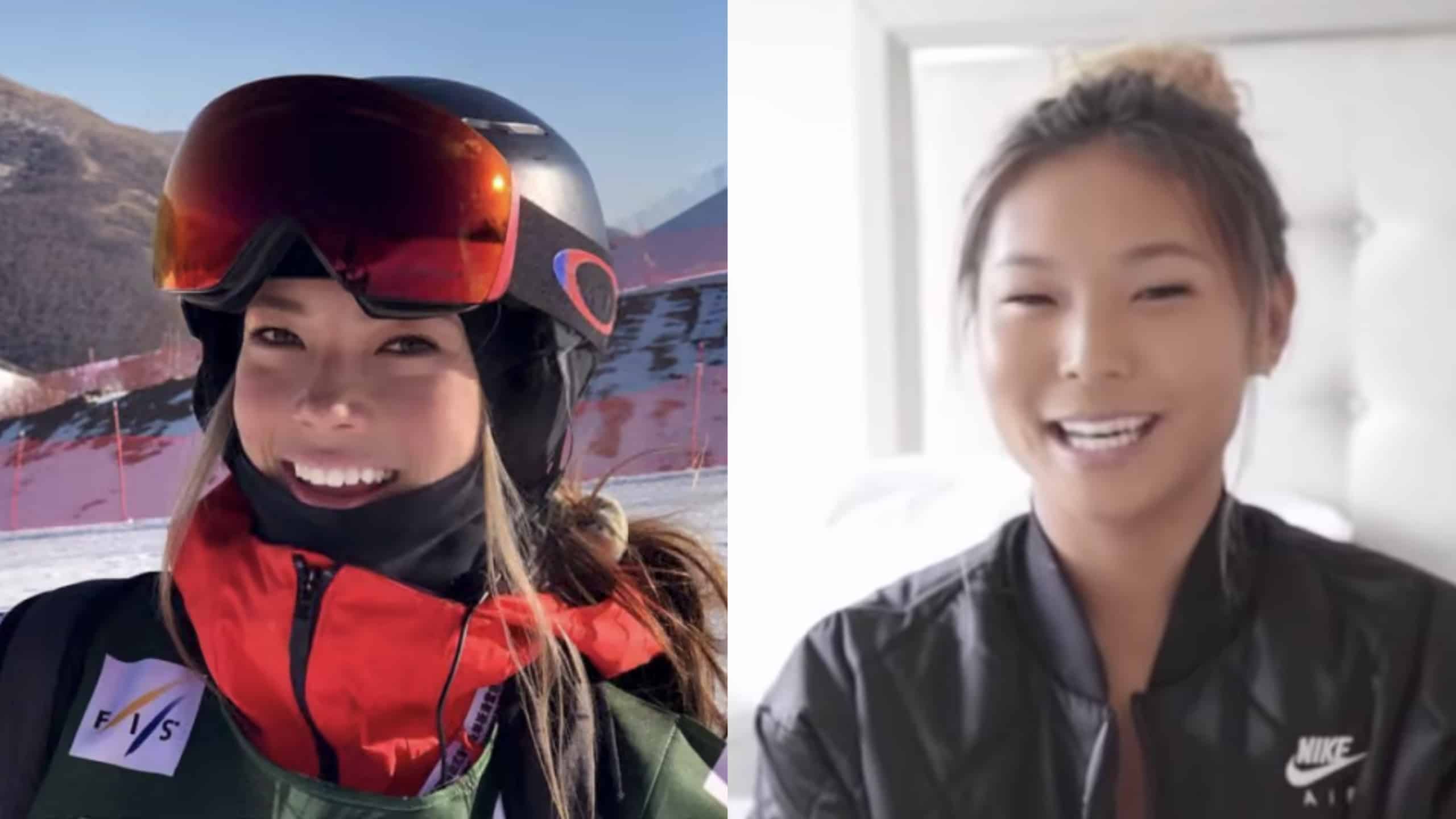
Speaking after securing silver in the women’s freeski slopestyle, Eileen Gu reflected on how the controversy has overshadowed the very essence of the event.
“I’m sorry that the headline that is eclipsing the Olympics has to be something so …” said the 22-year-old, pausing before adding, “unrelated to the spirit of the Games. It really runs contrary to everything the Olympics should be.”
For Gu, the issue goes beyond any single athlete or political figure. Sport, she said, is meant to transcend the divisions that dominate everyday life.
“The whole point of sport is to bring people together,” she said. “One of the very few common languages, that of the human body, that of the human spirit, the competitive spirit, the capacity to break not only records, but especially in our sport, literally the human limit. How wonderful is that?”
Gu knows firsthand what it means to be caught between nations and narratives. Born and raised in San Francisco, she trained with U.S. Ski & Snowboard before making the highly scrutinised decision to represent China in 2019. Her choice placed her at the centre of geopolitical debate long before she arrived at these Games.
“As someone who has got caught in the crossfire before, I feel sorry for the athletes,” she said. “I hope that they can ski to their very best.”
While Gu was measured in her response, snowboarder Chloe Kim addressed the issue more directly, emphasising that pride and critique are not mutually exclusive.
“We need to lead with love and compassion, and I’d love to see more of that,” said Kim, who is chasing a historic third consecutive halfpipe gold.
Kim, whose parents emigrated from South Korea in 1982, acknowledged how personal the conversation feels.
“Obviously, my parents being immigrants, this one hits pretty close to home.”
For Kim, representing the United States remains an honour — but not one that requires silence.
“It’s important in moments like these for us to unite and kind of stand up for one another with what’s going on,” she said.
“I’m really proud to represent the United States. The U.S. has given my family so much opportunity, but I also think we are allowed to voice our opinions on what’s going on.”
That sentiment echoed through the Team USA snowboarding contingent. Maddie Mastro spoke of holding pride and disappointment at the same time.
“I’m proud to represent Team USA and my country,” she said. “I’m also saddened about what’s happening at home. It’s really tough, and I feel like we can’t turn a blind eye to that.”
Bea Kim, making her Olympic debut at just 17, framed the moment as evidence of both division and possibility.
“I think there are a lot of different opinions in the U.S. now. Obviously, we’re very divided,” she said. “I personally am very proud to represent the United States… I think diversity is what makes us a very strong country and what makes us so special.”
At the centre of the controversy remains Hunter Hess himself. Asked earlier what it meant to represent the U.S. amid domestic and international tensions, the freeski halfpipe specialist described “mixed emotions.”
“There’s obviously a lot going on that I’m not the biggest fan of and think a lot of people aren’t,” he said. “If it aligns with my moral values, I feel like I’m representing it. But just because I’m wearing the flag doesn’t mean that I represent everything that’s going on in the U.S.”
Read more: Why Eileen Gu Is Skiing for China Again at the 2026 Winter Olympics
Hess also stressed that he competes for the people closest to him — “friends and family back home, and all the things I believe are good about the United States.”
Despite Trump’s response, Hess never claimed he wasn’t representing his country.
Away from the political noise, Gu’s silver medal carried its own quiet weight. Returning to the same slopestyle podium she stood on in Beijing 2022, she did so after years marked by injury and recovery.
“I really did overcome so much to get here,” Gu said. “The last four years have been challenging, to say the least. I’ve dealt with a number of injuries. A year ago, I had the worst concussion I’ve ever experienced. I had seizures afterwards. There were people concerned [whether] I’m going to wake up.”
Her final run, despite an early stumble, was enough to secure silver — a result she accepted with perspective rather than disappointment.
View this post on Instagram
“So being able to compete and really showcase my best skiing… to participate in pushing the sport at the level that it’s at, is the highest honour for me.”
As Gu accepted her medal from HRH Princess Anne, smiling and embracing fellow competitors, the moment felt like a reminder of what the Olympics aspire to be — not an escape from reality, but a space where difference, dissent, and determination can coexist.
In a Games increasingly shaped by the world beyond the slopes, athletes are making one thing clear: representation is complex, identity is personal, and unity — like sport itself — requires effort.