In a genre where “historical accuracy” has long been used to justify the absence of Asian and Black bodies on screen, Train Dreams quietly insists on their presence. With four Oscar nominations, including Best Picture and Best Adapted Screenplay, the film is being celebrated for its historical authenticity. What strikes me most, however, is not only what it preserves but what it refuses to erase.
This is a personal reflection on Train Dreams, adapted from Denis Johnson’s novella by Clint Bentley and Greg Kwedar, with Bentley also directing. Rather than a review, it explores something I have not yet seen meaningfully addressed: how this film quietly and deliberately refuses the idea that “historically accurate” must mean invisible.
Train Dreams begins in 1917 in the Inland Pacific Northwest and ends sometime in the 1960s, in the same region. One could accurately say that during this time period in American history, particularly in the Inland Pacific Northwest, there was little ethnic diversity in the population.
Census statistics from the era indicate that the United States was predominantly white, with only about 10-11% of the population classified as non-white. In the Pacific Northwest, that percentage was even smaller, ranging from 1-4%, a statistic that held true well into the 1950s and 1960s.
Given this, it would be easy, accurate even, for a filmmaker setting a story in this time and place to argue that there was no need to cast any Black or Brown actors and to feel justified in doing so.
I have heard this argument many times.
Oh, did I mention? I am an Asian American actor. And I’m in Train Dreams.
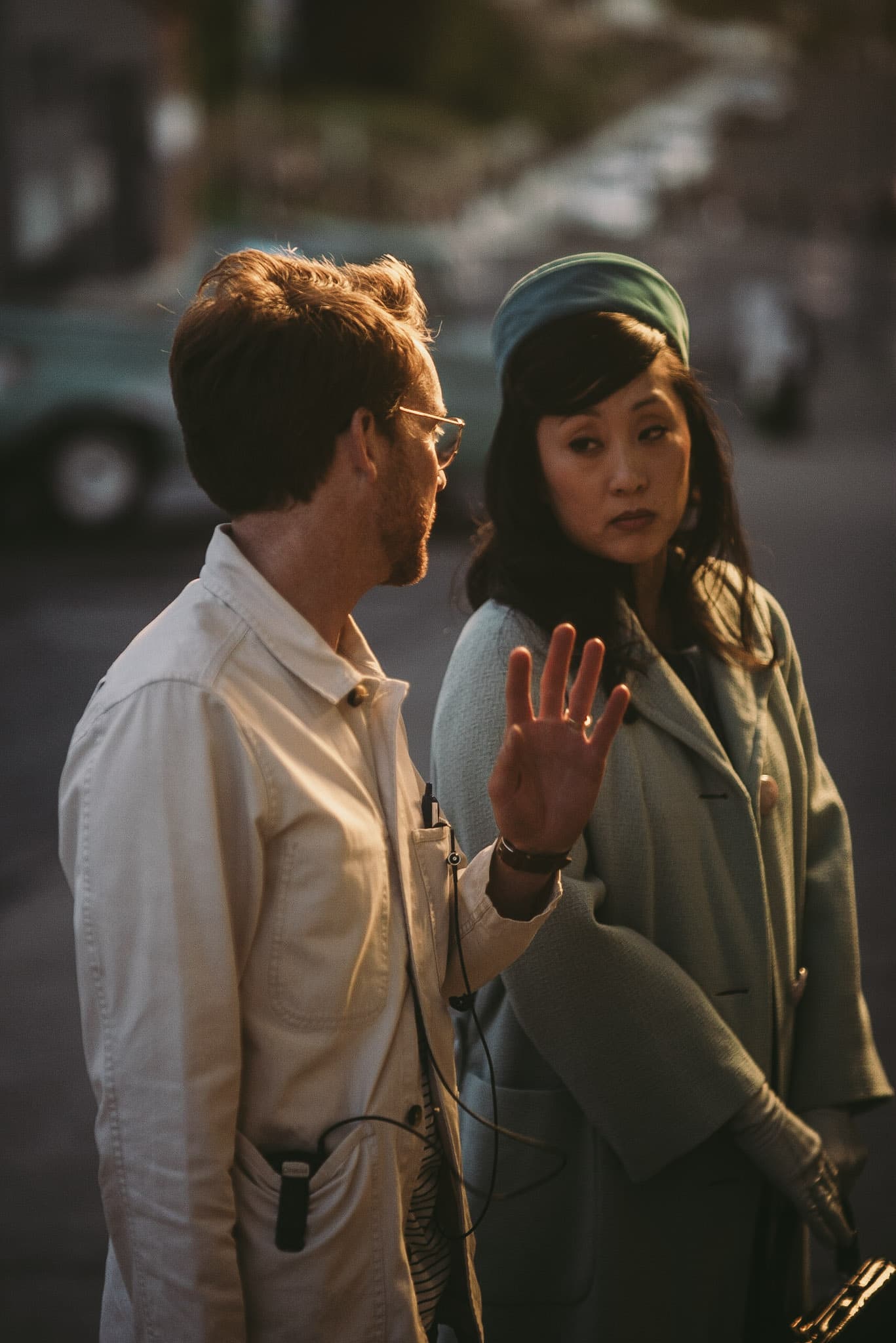
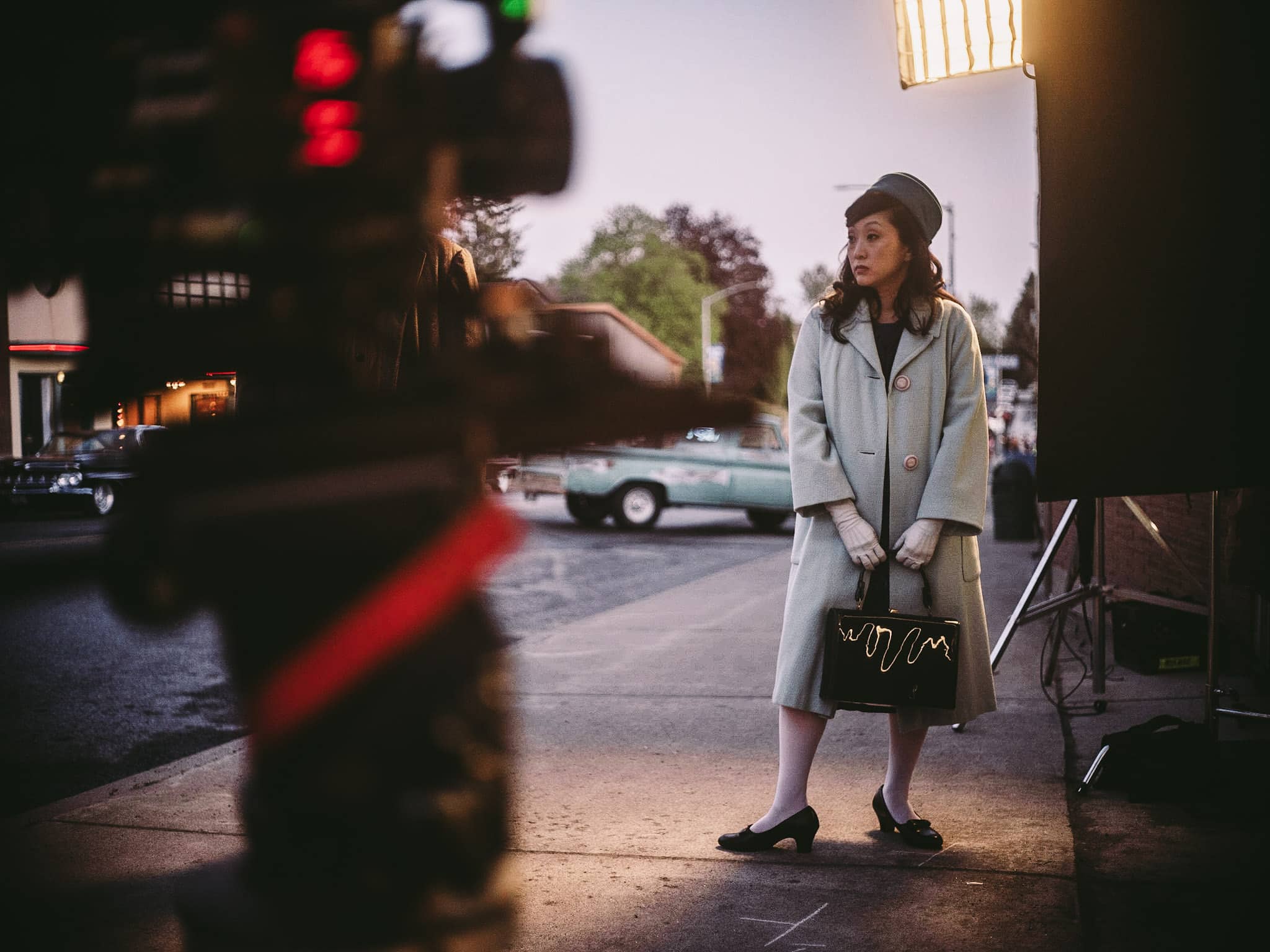
the set of Train Dreams.
Photo by Daniel Schaefer
Living in the Inland Pacific Northwest, I was told as recently as a few years ago by my agent (paraphrasing): “I’m so sorry, I can’t submit you for this {modern-day Christmas Rom-Com} because the writers and directors just don’t see someone who looks like you as the lead or supporting lead in this world. You get it, right? It’s supposed to be set here in the Pacific Northwest, so it just doesn’t make sense.” And then she asked if I would like to be on the extras list.
Instead of anger, something inside of me quietly broke. The explanation reinforced a deep-seated insecurity – that my face would never be what people wanted to see on their screens.
Read more: ‘Bridgerton’ Season 4 Review: Yerin Ha and Katie Leung Sparkle in a New Era of Regency Romance
As an adopted Korean growing up in the ‘80s and ‘90s in the Inland Pacific Northwest, I was surrounded almost exclusively by white faces – at home, at school, in my community, and in the media. There was no K-Pop Demon Hunters. The only Asians I saw on television were Connie Chung, Kristi Yamaguchi, a few kung-fu caricatures, or, more often, prostitutes fetishized by men.
So, a younger version of me would have fully accepted the idea that an actor of Asian descent had no business appearing in a film set in 1917 in the Pacific Northwest. It would have felt reasonable, reinforced by society. When I first received my audition and read the description of Train Dreams, I had little hope that I would be involved, simply knowing the world in which it was set.
And yet the creators of Train Dreams did not populate the film solely with white actors.
Given the source material, the time-period, and setting, it makes sense that the leads are white. Still, the director deliberately places several actors of color in significant, meaningful roles.
There is a scene where a Black character, Elijah Brown – played with gravity and steadiness by Branden Lindsay – appears in search of a “Sam Loving”, who goes by the name Apostle Frank among the loggers and speaks endlessly about religion. Elijah shoots him, killing him, and explains: “That man shot my brother, Martin Brown, in cold blood… He killed him only because of the color of his skin.”
Watching this moment, I was struck by how deftly the writers crafted a scene addressing the brutality of racism, rampant and blatant at the time, into a film that did not strictly require it. It gives the lead character, Robert Granier (played brilliantly by Joel Edgerton), something to carry and reckon with, while granting a Black character (and actor) meaningful presence in what could otherwise have been, even defensibly, a purely white world.
The film also includes strong Indigenous representation and the presence of Hispanic actors in featured supporting roles. But I want to focus specifically on the director’s use of Asian actors.
Early in the film, Robert Granier witnesses a brutally racist act: a Chinese railroad worker named Fu Sheng is thrown from a bridge to his death for no apparent reason. Fu Sheng represents one of many Chinese laborers who made up a small percentage of the population but a significant portion of the workforce that built the railroad.
Read more: Park Chan-wook’s ‘No Other Choice’ Review: A Bloody Satire for the AI Age
Played with lingering resonance by Alfred Hsing, Fu Sheng is marked as a clear “them”, an other, murdered by white loggers in an act of casual brutality. Throughout the remainder of the film, his face and death linger unresolved, appearing several times and haunting Granier’s interior life.
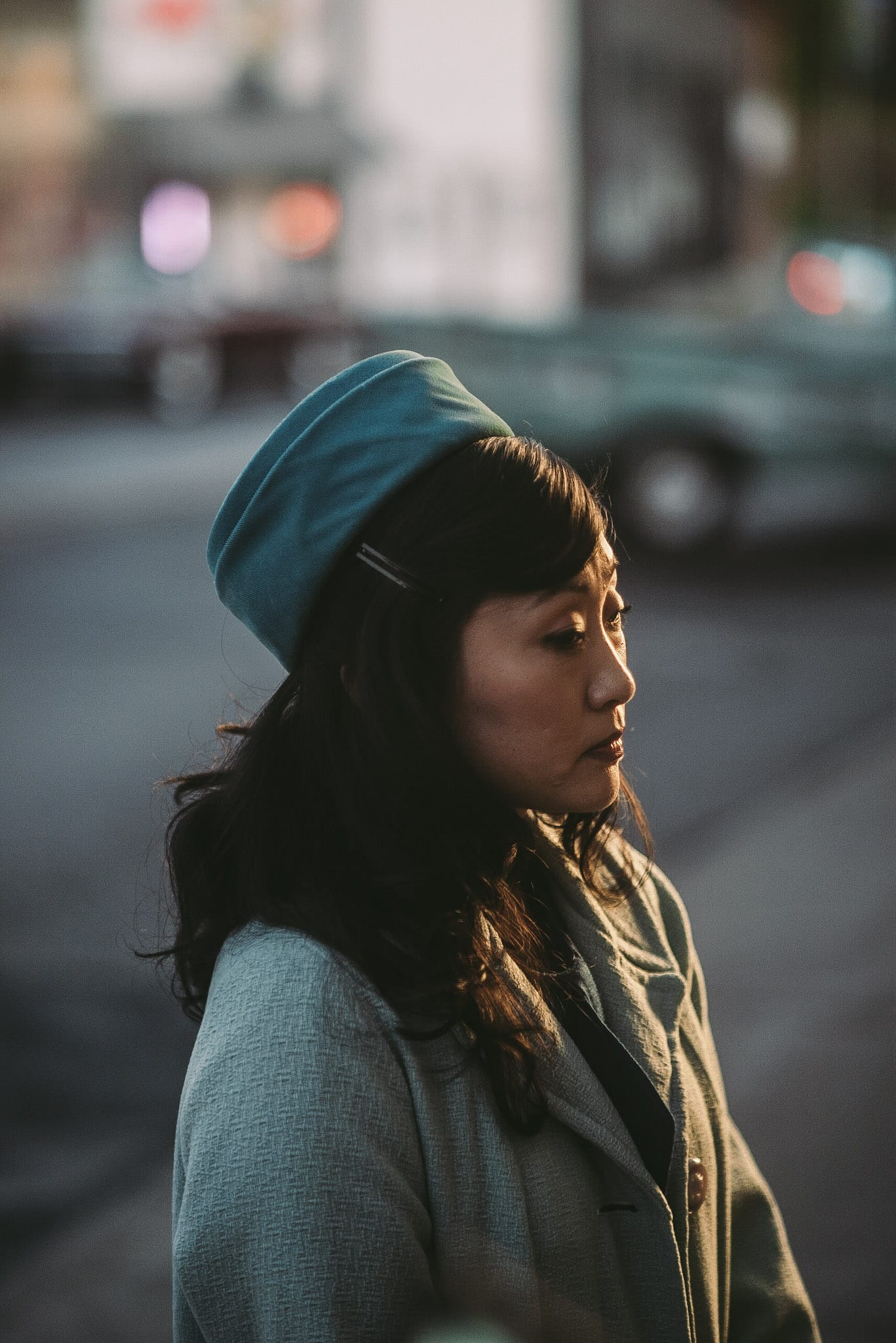
Photo by Daniel Schaefer
Once again, the filmmakers make a deliberate choice to place an Asian actor not just in the story, but at its emotional core. Fu Sheng becomes a catalyst for Granier’s inner life, his searching, his yearning.
Near the very end of the film, now in the 1960s, another Asian actor appears… it’s me.
My character is listed simply in the credits as “Woman at TV”. My face is not seen directly but reflected in the picture window of a storefront selling televisions. On one of them, we see astronaut John Glenn in space. Granier approaches and watches alongside me. At the end of our brief interaction, an image of the Earth appears and Granier asks “Is that…?” I reply, “That’s us.”
Senior Writer, Krittika Mukherjee, wrote in Fandomwire:
In that small exchange, something shifts inside Robert. For a man who spent his life feeling lost, this moment quietly connects his tiny world to the vast, spinning planet seen from space.
Ponder this moment with me.
At the end of his long odyssey, Granier stands before a storefront window and looks into what is, quite literally, a new world. This is a man who has spent his life seeking meaning, trying to make sense of profound loss. In this moment, like many Americans witnessing it for the first time, he sees Earth from space: vast, strange, beautiful. And in that same glass, a Korean woman stands beside him. She is fashionably dressed, wearing a Jackie Onassis-style pillbox hat, a subtle visual bridge between East and West, past and present, old world and emerging one. It is a quiet nod to the passage of time and to what has evolved.
Perhaps he realizes that he is just a tiny fleck in an enormous universe.
My character’s simple line, “That’s us.” reframes everything. It places his suffering, his life, and his search for meaning into a broader perspective. After a journey marked by grief, violence, and isolation, this becomes a full-circle moment, an elegy of hope. Not erasure, but expansion. Not division, but belonging.
The scene lasts perhaps thirty seconds, yet it helps complete the arc of the film’s central character. In this moment, the director chooses to place an Asian woman beside him. The effect is powerful and undeniable: diversity is subtly and exquisitely woven into the final moments of Granier’s odyssey.
Was it deliberate, a conscious closing of a circle that began with Fu Sheng’s death? I do not believe it was accidental, either in casting or editing. A director of Clint Bentley’s caliber – one whose films have garnered numerous nominations – does not make accidental choices.
He did not need to keep this moment. Having read the original script alongside what ultimately appeared on screen, I know how much was cut. What remains is there because it was chosen.
Read more: Toshiko Akiyoshi: A Japanese Pianist Who Changed Jazz Forever
Bentley’s casting of Asian, Black, and other underrepresented actors reads as deeply intentional. These are intelligent creative choices, played lightly and delicately, subtle yet profoundly moving. They are not statements, but truths allowed to exist.
Looking at his other work, like Sing, Sing and Jockey, it becomes clear that this intentionality is not incidental. Bentley consistently tells stories shaped by varied human experiences and makes space for people from underrepresented communities within them.
After years of seeing roles whitewashed and Asian American actors overlooked, I give Clint Bentley not merely credit, but gratitude. There is a particular kind of meaningful recognition in being cast in roles that choose me, a Korean American actor, when the easier, more expected choice would have been a white actor.
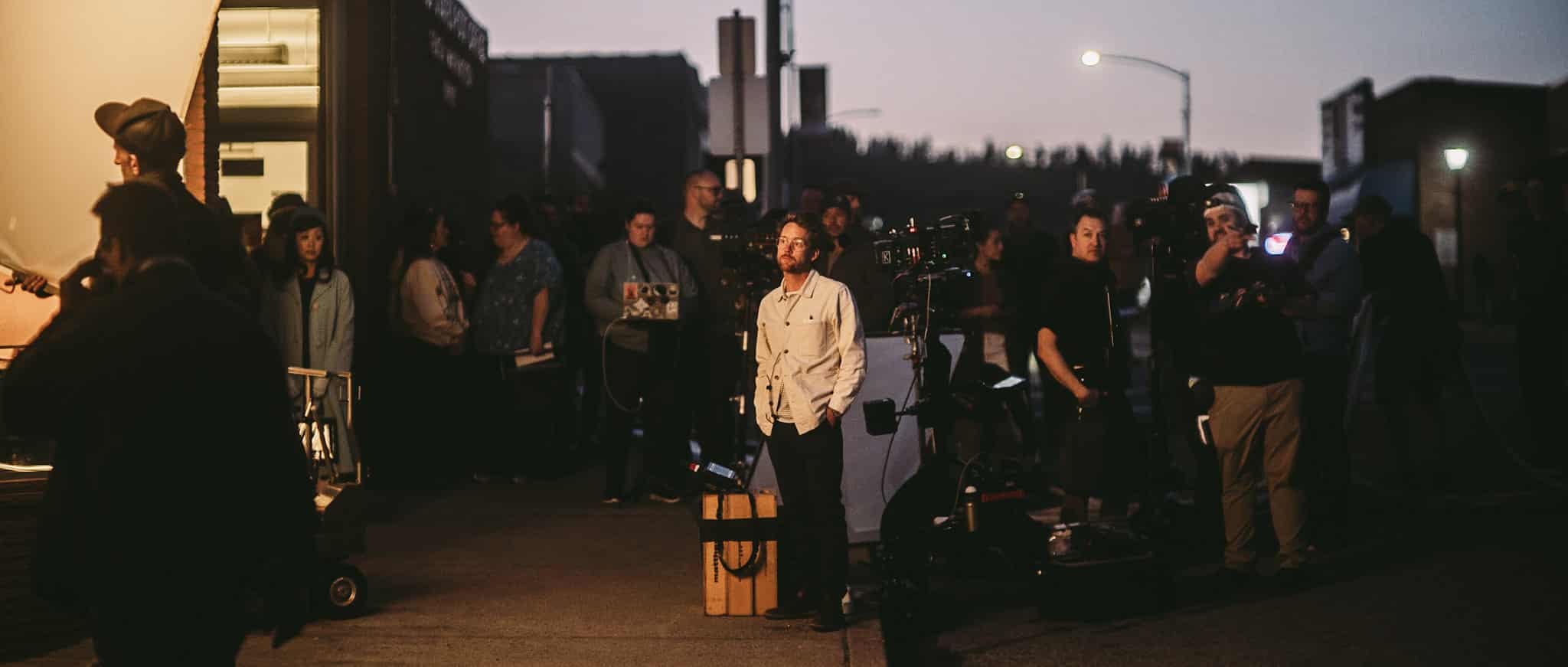
Photo by Daniel Schaefe
It is also important to note the work of local casting director Dr. Nike Imoru, CSA, an Artios Award nominee for Train Dreams. Known for championing excellent actors from BIPOC communities, she ensured that actors of color were presented wherever possible, even in roles where diversity might not have been obvious. Together, these choices form the quiet architecture of the film’s inclusiveness.
Train Dreams demonstrates that it is possible to include diversity even within so-called “historically accurate” narratives and that accuracy does not require erasure.
If it can be done in a film about logging in 1917 in the Inland Pacific Northwest, it can surely be done elsewhere, under far less restrictive circumstances. History was never as homogeneous as we often pretend, and our storytelling need not be either.
In these strange and dangerous times, let us continue moving forward in our artistic storytelling rather than retreating. May Black and Brown children (and adults) see their faces reflected back at them in the stories they watch, as mine was reflected back at me in this film.
Train Dreams is now streaming on Netflix.