For the first time in 14 years, South Korea’s film industry ended a year without a single 10-million-viewer movie. No breakout juggernaut. No cultural monolith. No familiar victory lap.
In 2025, Korean theaters welcomed just over 104 million viewers—down from last year, but enough to keep the industry afloat in a post-pandemic era where 200 million admissions now feel like folklore. South Korean films recorded their lowest audience (43,195,725) and market share (41.4%) in 20 years since 2005, excluding the COVID-affected years of 2021–2022. No Korean film crossed the 10 million milestone, and only one domestic release, Zombie Daughter, surpassed five million viewers.
By traditional standards, 2025 should read as a disappointment. Korean films posted their lowest audience numbers and market share in two decades, excluding COVID-affected years. No domestic release crossed the 10 million mark, and only one—Zombie Daughter—cleared five million admissions.
Even prestige couldn’t bend the curve. New films by Bong Joon-ho and Park Chan-wook arrived in the same year for the first time since 2003, an alignment that once would have guaranteed box office gravity. Instead, Mickey 17 and No Other Choice landed in the three-million range—respectable, but far from defining.

High budgets proved no safer. Omniscient Reader’s Viewpoint, a summer tentpole built on IP, star power, and a 31.2 billion won production cost, stalled at just over one million viewers. The old equation—more money, more certainty—finally collapsed.
If Korean cinema struggled to command attention, Japanese animation had no such problem.
What emerged instead of the blockbuster wasn’t a void, but a reordering: Japanese animation took center stage, low-budget films punched far above their weight, and the industry began—quietly, reluctantly—to let go of its obsession with scale. Once an arena ruled by Marvel’s “reliable blockbusters,” multiplexes were overtaken by what industry observers dubbed the “era of demon-slaying, sorcery, and chainsaw men.”
Demon Slayer: Kimetsu no Yaiba – The Movie: Infinity Castle released in August, ranked second overall with 5,690,000 viewers, while Chainsaw Man – The Movie: Reze Arc followed in sixth place with 3,430,000. Jujutsu Kaisen also performed strongly through re-edited TV animation releases, including Jujutsu Kaisen 0 and Jujutsu Kaisen 0 vs. Sukuna.
The latter, released earlier this month, climbed back into the year’s top 10 during the year-end surge after initially falling to 12th. Even compilation releases proved viable: Theater Edition: Attack on Titan – The Final Attack, released in March, drew nearly 1,000,000 viewers. The dominance of Japanese animation extended into the re-release market.
Read more: ‘Demon Slayer Infinity Castle’ Arc Review: Is the Record-Breaking Anime Film Worth the Hype?
This wasn’t just fandom—it was generational convergence. Viewers in their 40s and 50s, raised on manga, sat alongside teens who discovered anime through Netflix. OTT platforms, long framed as cinema’s existential threat, quietly became its feeder system. Streaming trained the audience; theaters delivered the event.
Japanese animation’s appeal also reflected something deeper: a genre no longer bound to simplistic heroism, but comfortable with moral ambiguity, psychological complexity, and cinematic spectacle. In a year short on Korean myths, anime offered worlds audiences still wanted to inhabit.
The top re-release was Princess Mononoke (199,200 viewers), screened in 4K and IMAX, followed by Nausicaä of the Valley of the Wind (62,000) and Your Name. (37,000). This marked a clear shift from last year’s romance-driven re-releases, which included 10 Years, Begin Again, Better Days, and The Notebook.
Re-releases, once a stopgap, now function as cultural programming—proof that audiences will show up when the theatrical experience feels intentional rather than obligatory.
While big films struggled to justify their budgets, small ones rewrote the rules. The year’s most surprising success stories came from the opposite end of the budget spectrum.
Yeon Sang-ho’s Face, produced for just 200 million won under profit-sharing terms, surpassed one million viewers—an outcome that would have seemed absurd a few years ago. Yoon Ga-eun’s Masters of the World also sailed past its break-even point, confirming that audience trust could still be earned without spectacle.
These weren’t anomalies; they were signals. In a contracting market, sustainability mattered more than scale. The industry noticed. Public funding bodies responded by doubling support for mid-budget productions next year, acknowledging that cultural impact no longer correlates neatly with size.
There is optimism ahead—measured, cautious, but real. Around 35 Korean films with budgets exceeding 3 billion won are expected in 2026, including long-awaited projects from Na Hong-jin and Ryu Seung-wan. Global franchises will return. The calendar will fill again.
But 2025 may be remembered less for what it lacked than for what it revealed.
The absence of a 10-million film didn’t kill the market. It exposed how much creative oxygen had been consumed by chasing one. In its place, audiences gravitated toward animation, intimacy, risk, and memory—toward films that felt chosen, not engineered.
Despite a difficult year, optimism is building for 2026. The number of mid- to large-budget Korean films with production costs exceeding 3 billion won is expected to rise by five or six, bringing the total to around 35.
The most anticipated release is Hope, directed by Na Hong-jin and scheduled for July. His first film in a decade since The Wailing, the science fiction blockbuster stars Hwang Jung-min and Jo In-sung and is set in the isolated village of Hopohang near the demilitarized zone during the 1970s and 1980s.
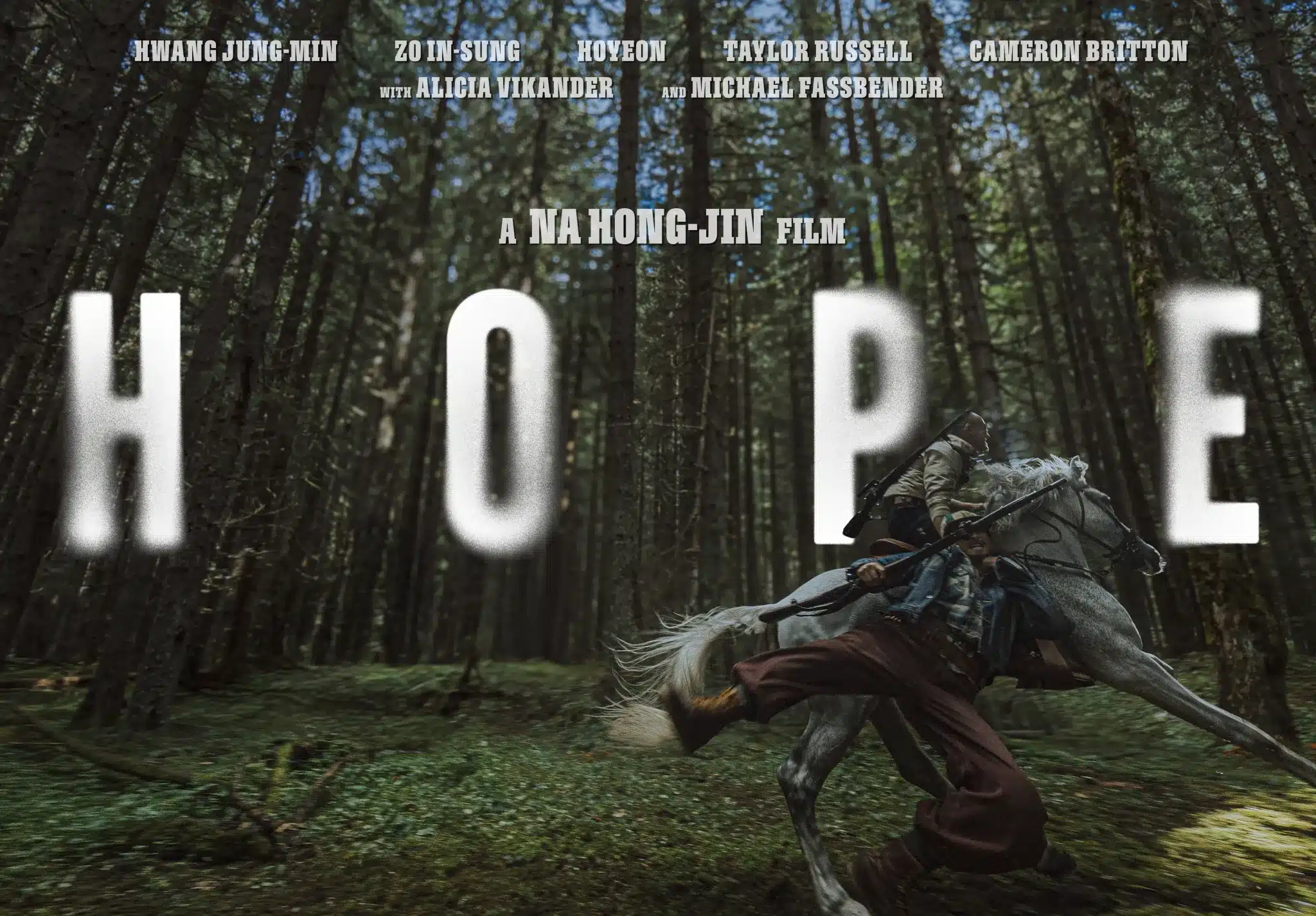
The story follows residents confronting an unidentified alien life form. With a reported budget of 100 billion won, the film also features Hollywood actors Taylor Russell and Cameron Britton.
Another major release is Humint, an espionage action film from Ryu Seung-wan, slated for February. Set near Vladivostok, the film follows North and South Korean agents operating along the Russian border. To the Land of Happiness, starring Choi Min-sik and Park Hae-il, is also scheduled for release after years of pandemic-related delays.
Originally invited to the 2020 Cannes Film Festival and selected as the opening film for the 2021 Busan International Film Festival, it will finally reach audiences in 2026. Other anticipated titles include Tazza 4 and International Market 2, though release dates remain unconfirmed.
Read more: K-Pop is Driving South Korea’s Record-Breaking Tourism Surge
Internationally, several high-profile films are expected to bolster next year’s box office, including Marvel’s Avengers: Doomsday, Spider-Man: Brand New Day, Disney-Pixar’s Toy Story 5, The Devil Wears Prada 2, Christopher Nolan’s Odyssey, and Dune Part 3 starring Timothée Chalamet.
After a year defined by absence—of blockbusters, of certainty, of old formulas—Korean cinema enters 2026 cautiously rebalanced. The question is no longer whether the industry can produce another 10-million hit, but whether it can sustain a more diverse, resilient ecosystem without one.